Ever wondered if cats could be a status symbol? Believe it or not, the world of feline companionship extends far beyond your average tabby. Some domestic cats command prices that rival luxury cars, and it’s a fascinating blend of history, genetics, and sheer desirability that drives these costs. From royal lineages to wildcat ancestry, certain breeds have become incredibly sought-after, and we’re diving deep into the world of the most expensive domestic cats.
The appreciation of specific cat breeds isn’t a modern phenomenon. Throughout history, certain felines have been prized for their beauty, rarity, or even their perceived ability to bring good luck. Think of the ancient Egyptians’ reverence for cats, or the elaborate breeding programs of European nobility. Today, that tradition continues, albeit with a more scientific and commercial edge, resulting in some truly extraordinary – and expensive – companions.
This article will explore the breeds topping the charts in terms of price, examining the factors that contribute to their value. We’ll cover everything from the fluffy Persians to the exotic Savannahs, detailing their unique characteristics, breeding histories, and the price tags that come with owning one of these high-end felines.
The World of High-End Felines
It’s a surprising reality: some domestic cats command prices that rival luxury cars. Beyond the cuddles and purrs, a complex world of genetics, breeding, rarity, and pedigree exists, driving up the cost of these feline companions. We’re not talking about your average shelter kitty here; we’re delving into the realm of exceptional breeds, meticulously cultivated for their unique appearances and temperaments.
The desire for a truly exceptional pet has fueled a market where a single cat can cost tens of thousands of dollars.
The appreciation for specific cat breeds isn’t a modern phenomenon. Throughout history, certain felines have been prized for their beauty and companionship. Ancient Egypt revered cats as sacred animals, and royalty throughout Europe kept prized felines as symbols of status. Early examples include the Turkish Angora, favored by European nobility in the 16th century, and the Persian, which began to gain popularity in the 19th century through selective breeding programs aimed at enhancing its luxurious coat and distinctive features.
These early efforts laid the groundwork for the sophisticated breeding practices we see today.
This article will explore some of the most expensive domestic cat breeds in the world, focusing on the Persian, Bengal, Savannah, British Shorthair, Russian Blue, Maine Coon, and Sphynx. We’ll examine the historical context of each breed, the specific characteristics that contribute to their high price, and the factors that influence their overall value. Prepare to be amazed by the world of high-end felines!
Persian Cats: A Legacy of Luxury
The Persian cat, with its flowing coat and sweet expression, is arguably the most iconic example of a luxury feline. Its history is deeply intertwined with selective breeding, transforming a relatively common long-haired cat into the show-quality breed we know today. Early Persians, imported to Europe from Persia (modern-day Iran) in the 17th century, were quite different from the modern breed, possessing a less extreme appearance.
Over centuries, breeders meticulously selected for specific traits, resulting in the dramatic features that define the modern Persian.
Several physical characteristics contribute significantly to a Persian’s high price. The most obvious is the incredibly long, dense coat, which requires daily grooming to prevent mats and tangles. The flattened face, or “peke-face,” is another defining feature, though it’s also associated with certain health concerns. Eye color is also a factor, with copper, blue, and green eyes being particularly prized.
The overall impression should be one of luxuriousness and refinement.
Within the Persian breed, several variations exist, each with its own price range. Chinchilla Persians have a silvery-white coat with black tipping, while Himalayan Persians combine the Persian’s long coat with the blue eyes and color points of the Siamese. Traditional Persians, sometimes referred to as Old-Fashioned Persians, have a slightly less extreme face shape and a more moderate coat length.
These variations impact both appearance and price.
| Persian Variation | Distinguishing Features | Typical Price Range |
|---|---|---|
| Chinchilla Persian | Silvery-white coat with black tipping, copper or blue eyes. | $2,000 – $5,000+ |
| Himalayan Persian | Long coat, blue eyes, color points (darker markings on face, ears, paws, and tail). | $1,500 – $4,000+ |
| Traditional Persian | Slightly less extreme face shape, moderate coat length, variety of colors. | $1,000 – $3,000+ |
Bengal Cats: The Wild Look, Domestic Price
The Bengal cat’s striking appearance, reminiscent of a miniature leopard, is a direct result of its unique heritage. The breed’s origins trace back to the 1960s when Jean Mill, a geneticist, began crossing Asian Leopard Cats (ALCs) with domestic cats. The goal was to create a domestic cat with the wild appearance of an ALC but the temperament of a house cat.
This process was challenging and took several generations to achieve.
The Bengal’s distinctive spotted or marbled coat patterns are governed by complex genetic factors. The Agouti gene is responsible for the banding of color on individual hairs, creating the spotted or marbled effect. The intensity of the markings and the contrast between the background color and the spots or marbling also influence the cat’s appearance and value. Genetics play a crucial role in determining the quality and desirability of a Bengal’s coat.
Bengal cats are classified by filial generations, denoted as F1, F2, F3, and so on. The “F” number indicates how many generations removed the cat is from its Asian Leopard Cat ancestor. F1 Bengals (first generation) are the offspring of an ALC and a domestic cat and are typically the most expensive and have the most wild-like characteristics. Temperament can also vary significantly between generations, with earlier generations often being more energetic and less predictable.
Later generations (F4 and beyond) are generally considered more domesticated.
Certain color variations within the Bengal breed are particularly rare and highly sought after. Snow Bengals, with their silver or charcoal-colored markings on a lighter background, are prized for their unique appearance. Charcoal Bengals, with their dark, bold markings, are also considered rare and valuable. The rarity of these color variations significantly impacts their price, often pushing them into the higher end of the Bengal price spectrum.
Savannah Cats: The Exotic Hybrid
The Savannah cat is a relatively new breed, created through crosses between a Serval (an African wild cat) and a domestic cat. Jean Mill, the same breeder who pioneered the Bengal breed, is also credited with developing the Savannah. The initial crosses were extremely challenging, and it took several attempts to produce viable offspring. The resulting cats possess a unique combination of wild and domestic traits.
Savannah cat ownership is subject to legal considerations and restrictions, which vary significantly depending on the region. Many jurisdictions have laws regulating or outright prohibiting the ownership of hybrid cats with wild ancestors. These laws are often based on concerns about public safety and the potential for these cats to escape and establish feral populations. Potential owners must thoroughly research and comply with all applicable laws before acquiring a Savannah cat.
Like Bengals, Savannah cats are classified by filial generations (F1, F2, F3, etc.). The F number indicates the percentage of Serval ancestry in the cat. F1 Savannahs, with 75-85% Serval DNA, are the most expensive and resemble Servals most closely, exhibiting tall, slender bodies, long legs, and large ears. Later generations (F4 and beyond) have a lower percentage of Serval DNA and are generally smaller and more domesticated.
The physical characteristics of a Savannah cat are heavily influenced by its Serval ancestry, resulting in a striking and exotic appearance.
| Savannah Generation | Serval Percentage | Typical Size | Price Range |
|---|---|---|---|
| F1 | 75-85% | 14-20 lbs | $10,000 – $20,000+ |
| F2 | 50-75% | 10-18 lbs | $5,000 – $12,000+ |
| F3 | 25-50% | 8-15 lbs | $2,000 – $6,000+ |
| F4 | 12.5-25% | 6-12 lbs | $1,000 – $3,000+ |
British Shorthair: Classic Charm, Premium Cost
The British Shorthair boasts a rich history as a working cat, originating in the domestic cats of Britain. These cats were valued for their ability to control rodent populations on farms and ships. Over time, breeders began to selectively breed these cats for their appearance and temperament, transforming them into the popular show breed we know today. The breed’s sturdy build and calm demeanor made it a favorite among cat fanciers.
The British Shorthair is instantly recognizable by its distinctive physical traits. Its round face, dense, plush coat, and copper-colored eyes contribute to its charming appearance. The breed’s muscular build and short legs add to its overall impression of strength and stability. The coat is typically short and dense, requiring minimal grooming.
Certain color variations of the British Shorthair are particularly popular and command higher prices. Blue British Shorthairs, with their distinctive grey-blue coat, are arguably the most well-known and sought-after color. Other popular colors include cream, lilac, and chocolate. The rarity and desirability of these color variations significantly impact their price.
There are numerous anecdotes about famous British Shorthairs and their owners. One notable example is Hamilton the Hipster, a British Shorthair with a perpetually grumpy expression who gained international fame on social media. His popularity highlights the breed’s appeal and the growing interest in unique feline personalities.
Russian Blue: Elegance and Rarity
The Russian Blue’s origins are shrouded in some mystery, with legends suggesting it originated in the Archangel Isles of Russia. Historically, these cats were associated with Russian royalty, often serving as cherished companions in imperial households. The breed’s elegant appearance and quiet demeanor made it a favorite among the aristocracy.
The Russian Blue is characterized by its unique physical characteristics. Its plush, silver-blue coat is incredibly dense and soft to the touch. The breed’s emerald-green eyes are striking and contribute to its overall elegance. The coat’s shimmering quality is a result of silver tipping on each hair.
Compared to other popular breeds, the Russian Blue is relatively rare. This rarity contributes to its higher price, as fewer breeders specialize in the breed. The breed’s distinctive appearance and quiet temperament also contribute to its desirability, further driving up demand.
Imagine a Russian Blue cat: its coat is a cascade of shimmering silver-blue, catching the light with every movement. The fur is incredibly dense and soft, almost velvety to the touch. Its body is lithe and graceful, moving with a quiet elegance. The emerald-green eyes are large and expressive, radiating intelligence and serenity. The overall impression is one of understated beauty and refined grace.
Maine Coon: Gentle Giants and High Costs
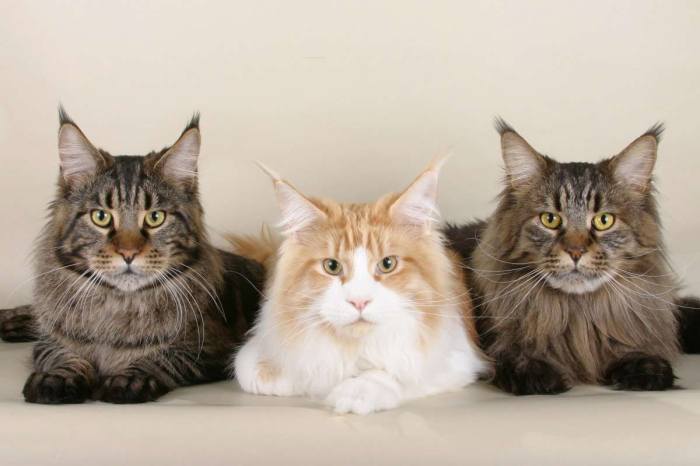
Source: catbounty.com
The Maine Coon’s history is rooted in the harsh winters of Maine, where they served as working cats, controlling rodent populations and assisting with various farm tasks. Legend has it that they are a cross between domestic cats and raccoons, though this is likely a myth. Regardless of their exact origins, Maine Coons developed a thick, water-resistant coat to withstand the cold climate.
Maine Coons are known for their impressive size and distinctive physical features. They are one of the largest domestic cat breeds, often weighing between 13 and 25 pounds. Their long, flowing coat is a defining characteristic, as are their tufted ears and a bushy tail. The breed’s large paws provide excellent traction on snow and ice.
Like many purebred cats, Maine Coons are predisposed to certain health considerations, most notably hypertrophic cardiomyopathy (HCM), a heart condition. Responsible breeders screen their cats for HCM and other genetic health problems, which contributes to the higher price of Maine Coons. The cost reflects the breeder’s commitment to producing healthy and well-socialized kittens.
Maine Coons are renowned for their gentle, playful, and intelligent personalities. They are often described as “gentle giants,” affectionate and devoted companions who thrive on human interaction. Their playful nature and intelligence make them engaging and entertaining pets.
Sphynx Cats: The Hairless Wonder
The Sphynx cat’s unique hairlessness is the result of a spontaneous genetic mutation. The first known Sphynx cats appeared in Canada in the 1960s, and breeders subsequently crossed them with other breeds to establish the modern Sphynx breed. The breed’s distinctive appearance quickly captivated cat fanciers.
Sphynx cats require specific care due to their lack of fur. Their skin is prone to dryness and requires regular bathing and moisturizing. They are also sensitive to temperature extremes and need to be protected from both heat and cold. Their ears require frequent cleaning to prevent wax buildup.
Within the Sphynx breed, several variations exist, each with subtle differences in appearance and price. Mink Sphynx cats have a soft, velvety feel to their skin, while Velvet Sphynx cats have a slightly more textured skin. These variations impact the cat’s overall appearance and can influence their price.
Imagine running your hand over a Sphynx cat’s skin: it’s surprisingly warm and soft, like suede or peach fuzz. The skin is slightly wrinkled, particularly around the shoulders and hips. The texture is unlike anything you’d experience with a furred cat, offering a unique tactile sensation. The skin feels delicate and requires gentle handling.
Factors Influencing Price: Beyond Breed
While breed is a significant factor in determining a cat’s price, several other elements contribute to its overall value. These factors extend beyond the breed standard and reflect the breeder’s investment and expertise. Understanding these factors can help potential buyers make informed decisions.
- Pedigree: A cat with a well-documented pedigree, tracing its lineage back to champion bloodlines, will typically command a higher price.
- Breeder Reputation: Established breeders with a history of producing healthy, well-socialized kittens often charge more for their cats.
- Health Testing: Responsible breeders conduct genetic health testing on their breeding cats to minimize the risk of inherited diseases. This testing adds to the cost but ensures healthier kittens.
- Show Potential: Cats with exceptional conformation and the potential to win awards at cat shows are often priced higher.
Ethical breeding practices are paramount in the world of high-end cats. Responsible breeders prioritize the health and well-being of their cats over profit, investing in quality care and genetic testing. This commitment to ethical breeding is reflected in the price of their kittens.
Raising and caring for high-end cats involves significant costs. Specialized diets, regular grooming, and routine veterinary care all contribute to the ongoing expenses of ownership. For example, a Persian cat’s luxurious coat requires frequent brushing and professional grooming, while a Savannah cat may require a larger enclosure and specialized enrichment activities.
Location and demand also influence prices. Certain breeds may be more popular in specific regions, driving up demand and increasing prices. For example, Savannah cats are often more expensive in areas where ownership restrictions are less stringent.
Acquisition and Ownership: What to Expect
Acquiring a high-end domestic cat from a reputable breeder is a significant investment, and it’s crucial to approach the process with care and diligence. A reputable breeder will be transparent about their breeding practices, health testing, and kitten socialization.
Health guarantees and contracts are essential when purchasing a high-end cat. These documents Artikel the breeder’s commitment to the kitten’s health and provide recourse in the event of unforeseen health issues. Carefully review the terms of the contract before signing.
Owning a high-end cat involves ongoing costs beyond the initial purchase price. Food, grooming, veterinary care, and enrichment activities all contribute to the overall expense. Budgeting for these ongoing costs is essential to ensure the cat’s well-being.
Here’s a checklist of essential items for a new high-end cat owner:
- High-quality cat food
- Grooming supplies (brushes, combs, clippers)
- Litter box and litter
- Scratching post
- Toys and enrichment activities
- Veterinary care (initial checkup, vaccinations, parasite prevention)
- Pet insurance (optional but recommended)
Final Thoughts
From the regal Persian with its luxurious coat to the wild-looking Savannah, the world of expensive domestic cats is a testament to human fascination with beauty, rarity, and the allure of the exotic. Understanding the factors that influence their price – pedigree, breeder reputation, health testing, and even location – reveals a complex interplay of genetics, ethics, and market demand.
Owning one of these cats is a significant investment, both financially and in terms of care, but for those who appreciate the unique qualities of these extraordinary animals, the rewards can be immeasurable.
Ultimately, the most expensive domestic cats aren’t just pets; they’re living works of art, carefully bred and cherished for their exceptional qualities. Whether you’re a seasoned cat enthusiast or simply curious about the world of high-end felines, we hope this exploration has shed light on the fascinating and luxurious world of these remarkable creatures.
User Queries
Why are some cats so expensive?
It’s a combination of factors! Rarity, pedigree, breeder reputation, health testing, and even the cat’s lineage (like how close it is to a wild ancestor) all play a role. Ethical breeding practices, which prioritize health and temperament, also contribute to higher prices.
What’s the difference between an F1, F2, and F3 Savannah?
These designations refer to the generation of a Savannah cat, indicating how far removed it is from its Serval ancestor. F1s have the highest percentage of Serval DNA (around 50%), are the largest, and the most expensive. F2s have around 25%, F3s around 12.5%, and so on. Each generation generally has a milder temperament and smaller size.
Do Sphynx cats need special care?
Absolutely! Sphynx cats lack fur, so they require regular bathing to remove oil buildup on their skin. They also need to be kept warm, as they don’t have fur to insulate them, and are more susceptible to sunburn.
What’s a “mink” or “velvet” Sphynx?
These are variations within the Sphynx breed that describe the texture of their skin. Mink Sphynx cats have a slightly softer, more velvety feel, while velvet Sphynx cats have a denser, more plush coat (though still hairless!). These variations can influence their price.
Are there any health concerns specific to Maine Coon cats?
Yes, Maine Coons are predisposed to certain health issues, most notably hypertrophic cardiomyopathy (HCM), a heart condition. Responsible breeders screen their cats for HCM and other genetic conditions, and this commitment to health contributes to the breed’s higher price.
Can I legally own a Savannah cat where I live?
It varies greatly! Many states and countries have restrictions on Savannah cat ownership, often based on the generation (F1s are typically the most restricted). It’s crucial to research your local laws before considering purchasing a Savannah.
What should I expect to pay for ongoing care for a high-end cat?
Beyond the initial purchase price, expect higher-than-average costs for food (often specialized diets), grooming (especially for breeds like Persians), and veterinary care. Regular checkups and preventative care are essential for these breeds.

