Do Cats Really Look Like Leopards? Exploring the Resemblance

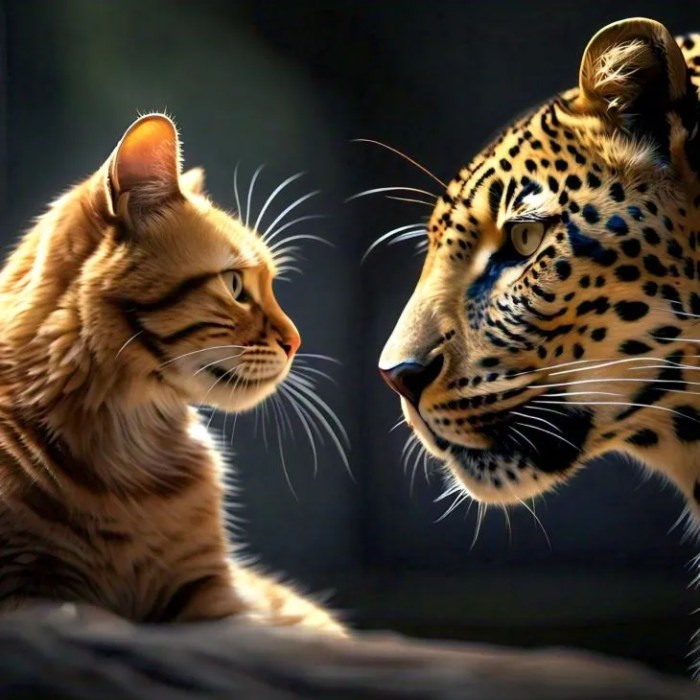
It’s a striking thought – could your fluffy housecat be a miniature version of a powerful leopard? While they’re obviously different species, a closer look reveals some fascinating similarities. From their flexible spines to their hunting instincts, domestic cats share surprising physical traits with their larger, spotted cousins. This post dives deep into what cats look like leopards, exploring everything from skeletal structure and coat patterns to vocalizations and those adorable, twitching whiskers.
We’ll unpack the science behind these resemblances, examining how genetics and selective breeding have played a role in creating cat breeds that echo the appearance of leopards. Get ready to be amazed by the subtle connections between your feline friend and one of the world’s most iconic big cats!
The Striking Resemblance: Domestic Cats and Leopards
It’s a common observation – the way a house cat stalks a toy mouse can echo the predatory grace of a leopard hunting in the savanna. Beyond the superficial similarities, a deeper connection exists between these two felines. This article explores the fascinating parallels in their physical attributes, behaviors, and even genetics, revealing why our beloved domestic companions share so much with their wild, spotted cousins.
From skeletal structure to coat patterns, the echoes of the leopard are surprisingly evident in the domestic cat. Understanding these connections provides a unique perspective on feline evolution and the remarkable adaptability of this species. We’ll delve into the specifics, examining everything from paw structure to vocalizations, and uncovering the genetic roots of these shared traits.
Physical Similarities Between Domestic Cats and Leopards
The underlying blueprint for both domestic cats and leopards is remarkably similar. Their shared ancestry has resulted in a common skeletal structure, efficient muscle distribution, and a flexible spine – all crucial for agility and hunting prowess. While size and scale differ dramatically, the fundamental design remains consistent.
- Skeletal Structure: Both species possess a remarkably flexible spine, allowing for incredible contortion and maneuverability. Limb proportions are also strikingly similar, optimized for both speed and precision. The arrangement of bones in the legs, particularly the powerful hind limbs, facilitates explosive bursts of speed and agile jumps.
- Muscle Mass and Distribution: Leopards, naturally, have significantly more muscle mass than domestic cats, reflecting their larger size and more demanding lifestyle. However, the distribution of muscle groups – particularly in the shoulders, hindquarters, and core – is comparable. This distribution contributes to their agility, allowing for quick turns, powerful leaps, and efficient climbing. Domestic cats, though smaller, exhibit a similar muscle distribution, enabling them to hunt effectively within their environment.
- Coat Patterns: The iconic spotted coat of the leopard is a captivating feature. These patterns, ranging from solid spots to intricate rosettes, serve as camouflage in their natural habitat. Interestingly, these patterns manifest in various domestic cat breeds, a testament to shared genetic heritage and selective breeding.
| Feature | Domestic Cat (Average) | Leopard (Average) |
|---|---|---|
| Length | 20-25 cm (body) | 90-190 cm |
| Height | 23-30 cm | 60-80 cm |
| Weight | 3-7 kg | 37-90 kg |
Coat Patterns: Spot Morphology and Variation
Leopard coat patterns aren’t uniform; they exhibit a fascinating range of variations. Understanding these differences requires a closer look at the morphology of spots and how they change across subspecies and geographic locations. Genetic factors play a crucial role in determining these patterns, influencing both the density and size of spots.
- Spot Pattern Types: Leopards display a spectrum of spot patterns, including solid spots, rosettes (clusters of spots forming a rose-like shape), and patterns resembling those seen in ocelots. The prevalence of each pattern type varies depending on the subspecies and geographic location.
- Density and Size Variation: Spot density and size are not constant. Leopards in denser forests tend to have smaller, more closely packed spots for better camouflage amongst foliage. Conversely, those in more open habitats often have larger, more widely spaced spots.
- Genetic Influence: The development of spot patterns is governed by complex genetic interactions. Genes control the production and distribution of melanin, the pigment responsible for the dark spots. Variations in these genes lead to the diverse patterns observed in leopards and, to a lesser extent, in domestic cats.
Visual Description of a Leopard Rosette: Imagine a central dark spot, roughly circular, surrounded by a ring of smaller, lighter spots. These smaller spots then branch outwards, creating a swirling, rose-like pattern. The color variations within a rosette can range from deep black to a warm brown, often with subtle variations in shade. Internal markings, such as smaller spots within the rosette or faint lines connecting the spots, add to the complexity and uniqueness of each individual leopard’s pattern.
Facial Features and Head Structure
While both domestic cats and leopards share a feline face, subtle differences in skull morphology reveal their distinct evolutionary paths. These differences impact jaw strength, eye placement, and overall facial expression. Furthermore, variations in eye color and whisker patterns contribute to their unique appearances and sensory capabilities.
- Skull Morphology: The leopard skull is generally larger and more robust than that of a domestic cat, reflecting its greater size and predatory power. The snout is typically shorter and broader in leopards, providing a stronger bite force. Eye sockets are positioned to provide excellent binocular vision, crucial for judging distances when hunting.
- Eye Color Variations: Leopard eye color ranges from pale green to yellow-gold, with some individuals exhibiting amber or even brown eyes. These colors are thought to be influenced by environmental factors and may provide camouflage advantages in different habitats.
- Whisker Patterns and Function: Both leopards and domestic cats rely heavily on their whiskers for spatial awareness. These specialized hairs are highly sensitive to vibrations and air currents, allowing them to navigate in low-light conditions and detect objects in their immediate surroundings. The density and arrangement of whiskers can vary slightly between the two species.
- Ear Shape and Hearing: The ears of both species are large and mobile, capable of rotating to pinpoint the source of sounds. Leopards generally have slightly larger ears relative to their head size, enhancing their ability to detect subtle sounds in the environment, crucial for locating prey.
Breed-Specific Resemblances to Leopards
Selective breeding has resulted in several domestic cat breeds that exhibit striking physical resemblances to leopards. These breeds, often developed to mimic the appearance of wild cats, showcase the power of human intervention in shaping feline characteristics.
- Notable Breeds: Bengal, Savannah, and Ocicat breeds are particularly known for their leopard-like features. These breeds often display spotted coats, muscular builds, and confident demeanors reminiscent of their wild counterparts.
- Bengal Cat’s Coat Pattern: The Bengal cat’s coat is arguably the most striking example of leopard mimicry. Its spots and rosettes are remarkably similar to those of a leopard, often exhibiting the same color variations and patterns.
- Genetic Origins and Selective Breeding: These breeds were created by crossing domestic cats with wild cat species, such as the Asian Leopard Cat (in the case of Bengals and Savannahs). Subsequent selective breeding has amplified leopard-like characteristics, resulting in the distinctive appearance of these breeds.
| Breed | Key Leopard-like Features | Estimated % Leopard DNA | |
|---|---|---|---|
| Bengal | Spotted coat, muscular build, confident demeanor | 15-20% (primarily from Asian Leopard Cat) | |
| Savannah | Spotted coat, tall stature, long legs | 25-50% (depending on generation – F1 Savannahs have the highest percentage) | |
| Ocicat | Spotted coat, athletic build, wild appearance | 0% (Ocicats are entirely domestic, but were bred to resemble ocelots) |
| Vocalization | Leopard Meaning | Domestic Cat Meaning | Physiological Mechanism |
|---|---|---|---|
| Roar | Territorial declaration, threat display | N/A (domestic cats cannot roar) | Forced expulsion of air through the larynx |
| Growl | Warning, aggression | Warning, aggression | Constriction of the larynx and vocal cords |
| Purr | Contentment, self-soothing | Contentment, self-soothing | Vibration of the larynx and diaphragm |
| Hiss | Fear, defense | Fear, defense | Forced expulsion of air through partially closed vocal cords |
