Ever scrolled through cat photos and stopped, wondering why some breeds seem to perpetually sport a grumpy expression? It’s a surprisingly common observation, and it goes beyond just a fleeting mood. We’re diving into the fascinating world of “angry looking cat breeds,” exploring the history, facial structures, and even the quirks of human perception that contribute to this impression. It’s not always about actual anger, but a clever combination of genetics, anatomy, and how we interpret feline faces.
From the iconic Russian Blue to the charmingly squished Persian, certain breeds have earned reputations for a stern or displeased look. We’ll unpack the specific features that create this perception, looking at everything from nose shape to fur patterns. Plus, we’ll consider how our own human biases can influence how we read a cat’s expression, and why a seemingly grumpy face might actually hide a sweet and affectionate personality.
The Curious Case of the “Angry” Cat Breeds
We’ve all seen them – those feline faces that seem to perpetually scowl, glare, or just generally look displeased. It’s a common observation, and it’s led to a fascinating cultural perception of certain cat breeds as being inherently “angry looking.” This isn’t necessarily a reflection of their actual temperament, but rather a consequence of their unique physical characteristics and how humans interpret them.
This article delves into the reasons behind this perception, exploring specific breeds, facial structures, and the complexities of feline communication.
The association of certain breeds with a stern expression isn’t new. Historically, cats have been viewed with a mix of reverence and suspicion, and their appearance has often been interpreted through a human lens. Ancient Egyptians revered cats, but even then, their independence and enigmatic nature likely contributed to a sense of mystery. In more recent times, particularly in Western cultures, the emphasis on anthropomorphism – attributing human emotions and characteristics to animals – has amplified this tendency to project feelings onto our feline companions.
We see a furrowed brow and assume displeasure, even when it might simply be a quirk of their anatomy.
Several breeds are frequently cited as having an “angry” appearance. This list isn’t meant to be judgmental, but rather to highlight the breeds most commonly associated with this perception. These include the Russian Blue, Scottish Fold, Persian, British Shorthair, Exotic Shorthair, and occasionally, the Cornish Rex.
The perception of “anger” is largely driven by facial structure and fur patterns. A flattened nose, deep-set eyes, a downturned mouth, or a dense, dark coat can all contribute to this impression. The interplay of light and shadow on the face also plays a significant role, as can the angle from which a photograph is taken.
| Breed | Common Perception | Contributing Facial Features |
|---|---|---|
| Russian Blue | Grumpy, perpetually displeased | Dense, plush silver-blue fur, large green eyes, flattened nose, downturned mouth |
| Scottish Fold | Intense, watchful, sometimes stern | Folded ears, large round eyes, often a slightly furrowed brow |
| Persian | Unhappy, stern, sometimes mournful | Flat face, large round eyes, short nose, dense, luxurious fur |
| British Shorthair | Stoic, disapproving, sometimes grumpy | Round face, large round eyes, full cheeks, dense, plush coat |
| Exotic Shorthair | Similar to Persian, but potentially less intense | Flat face, large round eyes, short nose, short, dense fur |
The Russian Blue: A Prime Example
The Russian Blue is arguably the poster child for the “angry looking” cat breed. Its distinctive appearance, while undeniably striking, often leads to misinterpretations of its emotional state. This breed’s reputation for a perpetually grumpy face is largely due to a combination of its physical characteristics and the way those characteristics interact with light and shadow.
The Russian Blue’s nose is relatively flat, giving it a somewhat squashed appearance. Its eyes are large and round, a vibrant emerald green, and set deep within the skull. The mouth is subtly downturned, creating a slight frown. Perhaps the most significant factor is its dense, plush silver-blue fur, which tends to absorb light, creating shadows around the face and further emphasizing the downturned mouth and deep-set eyes.
Imagine a Russian Blue curled up on a windowsill, basking in the afternoon sun. The shadows cast by its fur accentuate the lines around its mouth, making it appear as though it’s contemplating a particularly difficult problem. Or picture it observing a playful kitten – its intense gaze and slightly furrowed brow might be misinterpreted as disapproval, when in reality, it’s simply focused and observant.
In truth, Russian Blues are known for their gentle and affectionate nature, often forming strong bonds with their human companions.
Visually, picture a cat with a silvery-blue coat so dense it seems to shimmer. The fur is short and plush, almost velvety to the touch. The face is framed by this luxurious coat, with a flattened nose and a subtle downward curve to the mouth. The eyes are the focal point – large, round, and a brilliant emerald green, set deep within the skull.
The fur around the eyes is often slightly darker, creating a mask-like effect that further emphasizes the intensity of the gaze. Color variations can occur, with some Russian Blues exhibiting a slightly more greyish hue, while others have a more pronounced blue tint. Regardless of the exact shade, the overall effect is one of quiet intensity, often mistaken for displeasure.
Scottish Fold: Folded Ears and Intense Gaze
The Scottish Fold’s defining characteristic – its folded ears – significantly impacts the perceived expression. This unique trait alters the way light reflects off the face and can dramatically change the cat’s overall appearance. The folded ears don’t just change the look; they also affect how the eyes are perceived, potentially obscuring or altering their appearance.
With folded ears, the eyes often appear larger and more prominent, contributing to an intense, watchful gaze. The ears themselves can partially cover the upper portion of the face, creating a more compact and somewhat stern appearance. However, the degree of folding varies greatly among Scottish Folds. Some have a gentle, slight fold, while others have a more dramatic, almost complete fold.
This variation significantly impacts the perceived expression.
A Scottish Fold with minimal ear folding might appear more alert and expressive, with a more approachable demeanor. Conversely, a Scottish Fold with tightly folded ears might appear more serious and intense, potentially leading to misinterpretations of its emotional state. It’s important to remember that the folded ears themselves don’t dictate the cat’s personality; they simply alter the way its face is perceived.
Interpreting the expression of a Scottish Fold requires careful observation and consideration of the entire body language. The folded ears can be misleading, and it’s crucial to look beyond the facial features to understand the cat’s true emotional state. A slow blink, a relaxed posture, and a gentle purr are all indicators of contentment, regardless of the appearance of the ears.
Persian: The Flat Face Factor
The Persian’s brachycephalic (flat-faced) structure is the primary reason for its often-stern or unhappy appearance. This facial conformation, while aesthetically pleasing to some, presents several challenges and contributes significantly to the perception of a perpetually displeased expression.
The flat face of the Persian can lead to various health issues, including breathing difficulties and eye problems. The shortened nasal passages can restrict airflow, making it difficult for the cat to breathe comfortably, especially in hot or humid weather. The shallow eye sockets can also make the eyes more vulnerable to injury and irritation. These physical discomforts can, understandably, influence the cat’s behavior and contribute to a perceived unhappy expression.
The Persian’s facial features that contribute to the perceived “angry” look include a short, flattened nose, large, round eyes that are often set wide apart, and a relatively small mouth. The combination of these features creates a somewhat downturned and serious expression. The dense, luxurious fur further accentuates the facial features, adding to the overall impression of intensity.
- Expression: Slightly downturned mouth
- Interpretation: Displeasure, sadness, or contemplation
- Expression: Wide-set, round eyes
- Interpretation: Alertness, curiosity, or a slightly startled expression
- Expression: Flattened nose
- Interpretation: A sense of seriousness or solemnity
- Expression: Fur covering the eyes
- Interpretation: Mystery, aloofness, or a slightly intimidating appearance
British Shorthair: The Round Face and Wide Eyes
The British Shorthair’s round face and large, round eyes can be easily misinterpreted as anger or disapproval. This breed’s facial structure, combined with its tendency towards a somewhat stoic or reserved demeanor, often leads to this misperception. The roundness of the face softens the features, but the large eyes can create an impression of intensity that is often mistaken for displeasure.
British Shorthairs are known for their calm and dignified personalities. They are not typically demonstrative or overly affectionate, preferring to observe their surroundings with a quiet intensity. This reserved demeanor can be misinterpreted as aloofness or even disapproval, especially when combined with their facial expression.
The British Shorthair’s expression can change dramatically depending on lighting and context. In bright light, the eyes may appear more intense, while in dim light, they may appear softer and more relaxed. When the cat is relaxed and content, its facial muscles soften, and the expression becomes more gentle. When the cat is alert or focused, the facial muscles tense, and the expression becomes more intense.
- Expression: Relaxed
-Eyes half-closed, mouth slightly open, relaxed facial muscles. Perceived as contentment and tranquility. - Expression: Alert
-Eyes wide open, ears forward, facial muscles tense. Perceived as curiosity and attentiveness. - Expression: Focused
-Eyes fixed on a target, body still, facial muscles slightly tense. Perceived as concentration and determination. - Expression: Playful
-Eyes bright and sparkling, mouth slightly open, whiskers forward. Perceived as excitement and joy.
Exotic Shorthair: A Persian with a Short Coat
The Exotic Shorthair shares many facial characteristics with the Persian, but the shorter coat can alter the perceived intensity of the facial expression. While both breeds possess the characteristic flat face, the lack of long, flowing fur around the Exotic Shorthair’s face can make its features appear more pronounced and potentially more severe.
The shorter coat of the Exotic Shorthair doesn’t obscure the facial features as much as the Persian’s long fur does. This can make the flattened nose and wide-set eyes appear more prominent, potentially contributing to a perception of a more intense or even grumpy expression. However, the overall effect is often less dramatic than with the Persian, as the shorter fur softens the facial features slightly.
The Exotic Shorthair’s facial structure can be perceived differently than the Persian’s, largely due to the difference in coat length. While both breeds share the same underlying facial conformation, the way that conformation is presented to the world is significantly altered by the presence or absence of long fur.
| Persian Facial Characteristics | Exotic Shorthair Facial Characteristics |
|---|---|
| Long, flowing fur obscures facial features | Short, dense fur allows facial features to be more visible |
| Facial features appear softer and more rounded | Facial features appear more pronounced and potentially more severe |
| Overall impression of a more gentle and serene expression | Overall impression of a more intense or focused expression |
Understanding Cat Facial Communication
Source: dreamstime.com
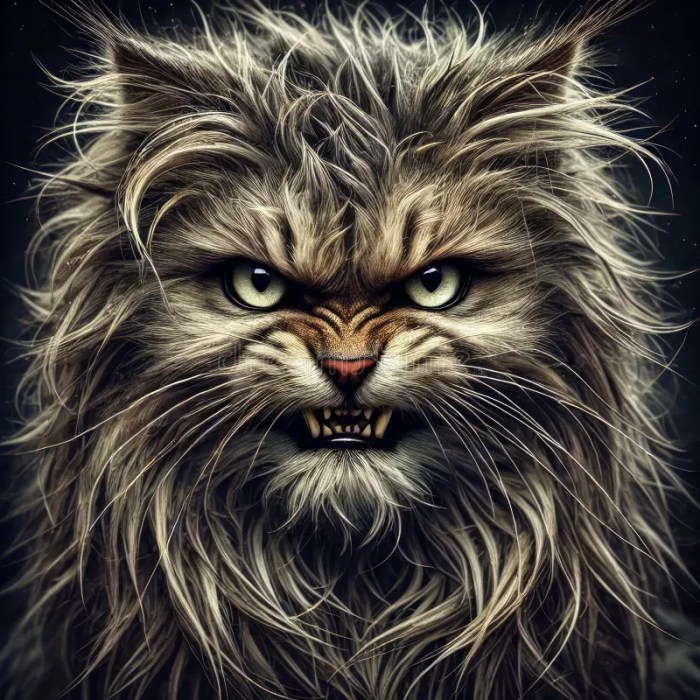
Feline facial expressions and body language are nuanced and complex. While humans often attempt to interpret these signals through the lens of their own emotions, it’s crucial to understand that cats communicate in ways that are distinct from human communication. A seemingly “angry” expression might simply be a sign of alertness or concentration.
Anthropomorphism, the tendency to attribute human emotions and characteristics to animals, can significantly distort our interpretation of feline expressions. We see a furrowed brow and assume anger, when in reality, the cat might be experiencing a completely different emotion, such as curiosity or discomfort.
Assessing a cat’s emotional state requires considering its overall body posture and environment. A cat with flattened ears, dilated pupils, and a tense body is likely feeling threatened or anxious. A cat with relaxed posture, slow blinking, and a gentle purr is likely feeling content and secure. The environment also plays a crucial role – a cat in a new or unfamiliar setting might exhibit signs of stress, even if it’s not inherently aggressive.
- Slow Blink: A sign of trust and affection.
- Dilated Pupils: Can indicate excitement, fear, or stress.
- Flattened Ears: A sign of fear, aggression, or defensiveness.
- Whiskers Forward: Indicates curiosity and alertness.
- Whiskers Back: Indicates fear or anxiety.
Breed-Specific Temperament vs. Expression
It’s essential to distinguish between a cat’s inherent temperament and its perceived facial expression. While certain breeds may be predisposed to certain physical characteristics that contribute to an “angry” appearance, these characteristics don’t necessarily reflect the cat’s actual personality. A typically “angry-looking” breed can display a gentle and affectionate demeanor.
Individual personality traits play a significant role in shaping a cat’s facial expressions. A confident and outgoing cat is more likely to exhibit a relaxed and approachable expression, while a shy and timid cat is more likely to display a more reserved and cautious expression. Even within the same breed, there can be significant variations in personality and expression.
Consider a Russian Blue, often perceived as grumpy. While its facial features might suggest a perpetually displeased expression, many Russian Blues are incredibly affectionate and playful, forming strong bonds with their human companions. Their intense gaze might simply be a sign of focused attention, rather than disapproval.
The factors contributing to a cat’s perceived expression are complex and interconnected:
- Breed: Predisposition to certain facial features.
- Temperament: Individual personality traits.
- Environment: Current surroundings and stressors.
- Human Interpretation: Our own biases and anthropomorphic tendencies.
The Role of Photography and Lighting
Photography techniques, including lighting, angles, and cropping, can significantly exaggerate or distort a cat’s facial expression. A poorly lit photograph or an unflattering angle can easily make a cat appear angrier than it actually is. The way a photograph is composed can also influence the viewer’s perception of the cat’s emotional state.
Different lighting conditions have a profound impact on the perceived intensity of a cat’s expression. Harsh, direct lighting can create deep shadows that accentuate the downturned mouth and deep-set eyes, making the cat appear more stern. Soft, diffused lighting, on the other hand, can soften the facial features and create a more gentle and approachable expression.
A photograph taken from a low angle can make a cat appear more imposing and intimidating, while a photograph taken from a high angle can make it appear smaller and more vulnerable. Cropping the photograph to focus solely on the face can also exaggerate the perceived expression, removing context and potentially misrepresenting the cat’s emotional state.
To accurately represent a cat’s expression in a photograph, consider the following:
- Use soft, diffused lighting.
- Shoot from a level angle.
- Capture the cat’s entire body posture.
- Avoid harsh shadows.
- Be mindful of cropping – don’t isolate the face without context.
Responsible Breeding and Facial Structure
Ethical considerations surrounding breeding practices that prioritize extreme facial features are paramount. While some breeders may focus on exaggerating certain physical traits, it’s crucial to prioritize the health and well-being of the cats above all else. Breeding for extreme facial features can often lead to health problems and compromise the cat’s quality of life.
Brachycephalic breeds, such as Persians and Exotic Shorthairs, are particularly susceptible to health problems related to their facial structure. These problems can include breathing difficulties, eye issues, dental problems, and skin infections. Responsible breeders are aware of these risks and strive to minimize them by selecting breeding pairs with healthy facial structures and prioritizing overall health and temperament.
Responsible breeders prioritize health and temperament over extreme physical traits. They conduct thorough health screenings, carefully select breeding pairs, and are transparent about the potential health risks associated with their breed. They are also committed to educating potential owners about the specific needs of their cats.
- Ask about health screenings: What genetic tests have been performed on the breeding cats?
- Inquire about breeding practices: Does the breeder prioritize health and temperament over extreme physical traits?
- Observe the cats’ living conditions: Are the cats housed in a clean and stimulating environment?
- Meet the breeder’s cats: Do the cats appear healthy and well-adjusted?
- Ask about the breeder’s experience: How long has the breeder been breeding this breed?
Closure
Ultimately, understanding why some cat breeds appear “angry” is about appreciating the complexity of feline communication and the impact of selective breeding. While a Russian Blue’s intense gaze or a Persian’s flat face might initially suggest displeasure, it’s crucial to remember that these are just physical traits. By learning to interpret a cat’s full body language and considering their individual personality, we can move beyond surface appearances and connect with these unique and often misunderstood breeds on a deeper level.
So, next time you see a cat with a serious expression, remember there’s likely a whole lot more going on than meets the eye!
Query Resolution
Why do Russian Blues often look so grumpy?
Their facial structure – a slightly upturned nose, deep-set eyes, and a firm mouth – combined with their dense, silver-grey fur creates a perpetually serious expression. It’s a genetic trait, not a reflection of their personality!
Are Scottish Folds always grumpy?
No! The folded ears can obscure their eyes, making them look intense, but their personality varies greatly. Some are playful and affectionate, while others are more reserved. It’s important to look at their whole body language.
Why are Persian cats’ faces so flat?
They’re a brachycephalic breed, meaning they have a shortened skull. This flat face contributes to their perceived “angry” look, but it also can lead to health problems like breathing difficulties.
Do all British Shorthairs have that “disapproving” look?
Not necessarily. Their round face and large eyes can be misinterpreted, but their stoic demeanor and tendency to observe rather than actively participate can contribute to the impression. Lighting and context also play a big role.
Is it fair to breed for extreme facial features?
It’s a complex ethical issue. Prioritizing extreme features can lead to health problems, and responsible breeders prioritize health and temperament over aesthetics.
How can I tell if a cat is
-actually* angry?
Look beyond the face! Flattened ears, dilated pupils, a twitching tail, hissing, or swatting are all signs of a genuinely upset cat. A slow blink is a sign of trust and relaxation.
Can photography make a cat look angrier than it is?
Absolutely! Lighting, angles, and cropping can exaggerate facial features and create a misleading impression. Always consider the context of a photo.

