Ever seen a cat with fur that looks like it’s been styled into adorable ringlets? The world of feline fashion is surprisingly complex, and the question “are curly cats real?” has sparked a lot of curiosity. We’re diving deep into the fascinating phenomenon of curly-coated cats, exploring their genetics, the breeds that showcase this unique trait, and the responsible breeding practices that ensure their well-being.
It’s more than just a cute look – there’s a whole science and history behind these fluffy wonders!
From ancient mentions of unusual fur textures to modern-day breeders dedicated to preserving these traits, the journey of the curly cat is a captivating one. We’ll unravel the mysteries of Rex genes, distinguish between different types of curls, and discuss the care these special cats require. Get ready to learn everything you ever wanted to know about these uniquely textured felines!
Are Curly Cats Real? Exploring the World of Feline Curls
The internet is full of adorable cat pictures, but some stand out – cats with fur that seems to defy gravity, a riot of curls and waves. These are the “curly cats,” and they’ve captured the hearts of many. But are they a genuine phenomenon, a breed, a genetic quirk, or just a clever trick of the light? This article dives deep into the world of curly-coated cats, exploring their origins, genetics, breeds, and the fascinating science behind their unique appearance.
From online forums buzzing with discussions to dedicated breeders carefully preserving these traits, the curly cat community is thriving. Understanding the nuances of this phenomenon requires a look at its history, the science behind it, and the responsible practices that ensure the health and well-being of these special felines.
Defining “Curly Cats”
Origins and Terminology
Origins and Terminology
The term “curly cat” hasn’t always been a widely recognized term. Its usage has evolved significantly over time, reflecting a growing understanding of the genetic factors at play. Early mentions of cats with unusual coat textures appeared sporadically in feline communities, often within discussions about mixed breeds or unusual litters. The term “curly cat” as a distinct descriptor gained traction primarily through online forums and social media in the late 1990s and early 2000s.
The interpretation of “curly cat” is multifaceted. It can refer to a specific breed (like the Cornish Rex or Devon Rex), a general description of a coat type (regardless of breed), or even a colloquial term for any cat with noticeably curly fur. This ambiguity can lead to confusion, highlighting the need for clearer terminology within the feline community.
The evolution of the term reflects a shift from anecdotal observations to a more scientific understanding. Initially, it was simply a descriptive label. As genetic testing became more accessible, the connection between specific genes and curly coats became clearer, leading to a more precise understanding of the phenomenon.
| Early Usage | Modern Usage | Regional Variations |
|---|---|---|
| Descriptive term for cats with unusual, curly fur, often found in mixed-breed populations. Limited documentation. | Can refer to specific breeds (Cornish Rex, Devon Rex, Selkirk Rex), a general coat type, or a descriptive term. | “Wavy cat” is sometimes used in North America, while “boucled” (French for curled) is occasionally seen in Europe, particularly when referring to Selkirk Rex cats. |
Genetic Basis of Curly Coats in Cats
The curly coat phenotype in cats is primarily driven by genetic mutations affecting the hair follicle structure. These mutations disrupt the normal keratinization process, leading to the formation of curls and crimps. While the Rex gene is the most well-known contributor, other genes may also play a role, particularly in spontaneous mutations.
The Rex gene family includes several variations: the Cornish Rex gene (RE), the Devon Rex gene (DR), and the Selkirk Rex gene (SE). Each gene produces a slightly different coat texture. The Cornish Rex gene results in tight, marcel curls, the Devon Rex gene creates loose, wavy curls, and the Selkirk Rex gene produces a plush, loosely curled coat. These genes exhibit different inheritance patterns, as detailed below.
While the Rex genes are the primary drivers, other, less understood genes can also contribute to curliness. These genes may influence the degree of curl, the density of the coat, or the overall appearance of the fur. Research into these genes is ongoing.
The inheritance patterns of Rex genes are crucial for breeders. The Cornish Rex gene (RE) is autosomal recessive, meaning that both parents must carry the gene for their offspring to exhibit the curly coat. The Devon Rex gene (DR) is also autosomal recessive. The Selkirk Rex gene (SE) is dominant, meaning that only one copy of the gene is needed for the cat to have a curly coat.
However, heterozygous Selkirk Rex cats (carrying one copy of the gene) may have a less pronounced curl.
Flowchart: Inheritance of Rex Genes
- Cornish Rex (RE): Both parents must be RE/N (carrier) -> Offspring: 25% RE/RE (curly), 50% RE/N (carrier), 25% N/N (non-carrier)
- Devon Rex (DR): Both parents must be DR/N (carrier) -> Offspring: 25% DR/DR (curly), 50% DR/N (carrier), 25% N/N (non-carrier)
- Selkirk Rex (SE): One parent SE/N (carrier) or SE/SE (homozygous) -> Offspring: 50% SE/N (curly or less curly), 50% N/N (non-carrier)
Breeds Commonly Associated with Curly Coats
Source: animalko.com
Several cat breeds are known for their curly or crimped fur, each with its own unique characteristics. These breeds represent the culmination of selective breeding efforts aimed at preserving and enhancing the curly coat trait. Beyond the established breeds, spontaneous mutations occasionally occur in non-pedigreed cats, leading to unique curly-coated individuals.
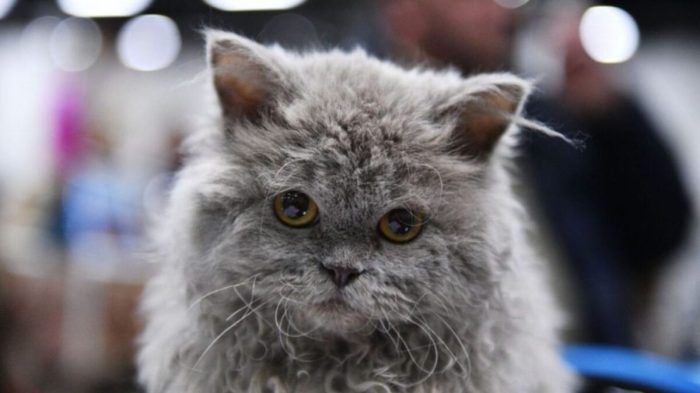
The Cornish Rex, Devon Rex, and Selkirk Rex are the most well-known curly-coated breeds. While all share the characteristic curly fur, their coat textures differ significantly. Cornish Rex cats have tight, marcel curls that lie close to the body. Devon Rex cats have loose, wavy curls that give them a “poodle-like” appearance. Selkirk Rex cats have a plush, loosely curled coat that is often described as “antique” or “romantic.”
Beyond coat texture, these breeds also differ in their physical characteristics. Cornish Rex cats are typically slender and elegant, with large ears and a long, thin tail. Devon Rex cats are often described as having a “pixie-like” appearance, with large, low-set ears and a slightly shorter body. Selkirk Rex cats are generally more robust than the other two breeds, with a heavier bone structure and a more rounded body.
| Breed | Origin | Coat Description | Typical Temperament |
|---|---|---|---|
| Cornish Rex | Cornwall, England | Tight, marcel curls; short, sleek coat | Active, playful, affectionate, intelligent |
| Devon Rex | Devon, England | Loose, wavy curls; soft, downy coat | Mischievous, energetic, social, people-oriented |
| Selkirk Rex | Montana, USA | Plush, loosely curled coat; can vary in curl intensity | Gentle, affectionate, laid-back, adaptable |
Non-Breed Curly-Coated Cats – Spontaneous Mutations
Occasionally, cats that are not part of any recognized breed can exhibit curly coats due to spontaneous genetic mutations. These mutations arise randomly during the formation of egg or sperm cells and are not inherited from the parents. While rare, these occurrences highlight the inherent variability of the feline genome.
Spontaneous mutations can have varying impacts on a cat’s health and well-being. In some cases, the mutation may have no noticeable effect beyond the coat texture. However, in other cases, the mutation may be associated with other health problems. Responsible breeders and owners should carefully monitor these cats for any signs of illness.
Identifying and breeding these cats responsibly presents unique challenges. Without a known genetic background, it can be difficult to predict the inheritance pattern of the mutation. Ethical considerations dictate that breeding should only occur if the cat is healthy and the offspring are unlikely to experience any adverse health effects.
Case Study: Patches Patches was a domestic shorthair found as a stray in rural Ohio. She exhibited a distinct curly coat, unlike any seen in the area. Genetic testing revealed a novel mutation affecting the hair follicle structure. Patches was spayed to prevent uncontrolled breeding and lived a long, healthy life, demonstrating that spontaneous curly coats can occur without associated health problems.
Coat Care and Health Considerations for Curly-Coated Cats
Cats with curly coats require specific grooming routines to maintain their coat’s health and appearance. The curls are prone to matting, especially in breeds with denser fur. Regular brushing is essential to prevent tangles and keep the coat smooth and shiny.
Curly-coated cats may also be more sensitive to temperature fluctuations due to their unique coat structure. The curls trap air, which can provide insulation in cold weather but can also lead to overheating in warm weather. Providing access to cool environments and monitoring for signs of heat stress is crucial.
A balanced diet rich in essential fatty acids can support healthy skin and coat. Omega-3 and omega-6 fatty acids help to maintain moisture and reduce inflammation, contributing to a healthy, lustrous coat.
- Weekly Grooming Routine for a Devon Rex:
- Brush gently with a soft-bristled brush (2-3 times per week)
- Bathe as needed (every 2-4 weeks) using a mild, moisturizing shampoo
- Condition with a lightweight, detangling conditioner
- Check for mats and tangles, paying particular attention to areas behind the ears and under the legs
- Wipe down with a damp cloth to remove loose hair and debris
The Role of Breeders and Responsible Breeding Practices
Breeding curly-coated cats carries ethical responsibilities. Breeders should prioritize the health and welfare of their cats above all else, employing genetic testing and health screening to minimize the risk of passing on inherited diseases.
Reputable breeders are transparent about their breeding practices and are willing to provide potential buyers with information about the health history of their cats. They prioritize genetic diversity to maintain the health and resilience of the curly-coated cat population.
Genetic diversity is crucial for the long-term health of any breed. Inbreeding can lead to a higher incidence of genetic disorders, while a diverse gene pool helps to ensure that the population is able to adapt to changing environmental conditions.
Checklist for Potential Buyers:
- Does the breeder provide health records for their cats?
- Are the cats raised in a clean and stimulating environment?
- Does the breeder allow potential buyers to visit their cattery?
- Does the breeder seem knowledgeable about the breed and its health concerns?
- Does the breeder offer a health guarantee?
Curly Coats and Other Feline Traits – Correlations and Relationships
While research is ongoing, some correlations between curly coats and other feline traits have been observed. For example, Devon Rex cats are known for their exceptionally large ears, a trait that may be linked to the same genetic mutation that causes their curly coat. There’s also anecdotal evidence suggesting that curly-coated cats may be more sensitive to touch.
Personality traits are notoriously difficult to link definitively to coat type, but many owners report that curly-coated cats are particularly affectionate and playful. This may be due to a combination of genetic factors and the early socialization experiences of the cat.
The unique coat structure of curly-coated cats may also impact their sensory perception. The dense curls could potentially muffle sounds, affecting their hearing. However, the increased sensitivity to touch may compensate for any potential hearing loss.
“The relationship between coat type and feline behavior remains a complex and fascinating area of research. While genetic factors undoubtedly play a role, environmental influences and individual experiences also contribute significantly to a cat’s personality and behavior.”
Visual Representations of Curly-Coated Cats – Descriptive Imagery
Imagine a Selkirk Rex cat basking in the afternoon sunlight. The plush, loosely curled fur catches the light, creating a shimmering effect. The curls appear almost velvety, with individual strands reflecting the golden hues of the sun. The overall impression is one of luxurious softness and gentle warmth.
Picture a Devon Rex cat stretching and playing. The loose, wavy fur ripples and flows with its movements, creating a dynamic and graceful display. The curls bounce and sway, giving the cat a playful and energetic appearance. The fur seems almost weightless, as if it’s floating around the cat’s body.
Consider the visual difference between a wet and dry Cornish Rex coat. When dry, the coat is a tight mass of marcel curls. When wet, the curls relax and spread out, revealing the cat’s sleek, underlying body shape. The fur appears smoother and more streamlined, with the curls less defined.
A curly-coated kitten’s coat is noticeably different from that of an adult. The curls are less defined and the coat is thinner and softer. The kitten’s fur appears more downy, with a delicate and fragile texture. As the kitten matures, the curls become more pronounced and the coat becomes denser and more resilient.
Curly Cats in Popular Culture and Media
Curly-coated cats have made sporadic appearances in movies, television shows, and online content. While not always explicitly identified by breed, their distinctive coats have often drawn attention and contributed to their growing popularity. For example, a Devon Rex cat appeared in the film “Alien vs. Predator,” showcasing their unique appearance to a wider audience.
These portrayals have generally shaped public perception of curly-coated cats as being quirky, affectionate, and visually striking. Social media has played a significant role in amplifying this perception, with countless photos and videos of curly-coated cats going viral.
Timeline: Curly Cats in Media
- 1970s: Early mentions of Rex breeds in cat fancier magazines.
- 1980s: Increased visibility in pet-related publications.
- 1990s: Emergence of online forums and communities dedicated to Rex breeds.
- 2000s: Appearances in television shows and commercials.
- 2010s-Present: Viral popularity on social media platforms like Instagram and TikTok.
Distinguishing Curly Coats from Other Coat Variations
While all coat variations offer unique aesthetics, it’s important to differentiate between a curly coat, a crimped coat, and a wavy coat. A curly coat, as seen in Rex breeds, is characterized by tight, defined curls that cover the entire body. A crimped coat has a more subtle, wave-like texture, with less pronounced curls. A wavy coat is the least extreme variation, with gentle undulations in the fur.
Distinguishing a curly coat caused by a genetic mutation from a coat affected by environmental factors can be challenging. Diet, humidity, and grooming practices can all influence a cat’s coat texture. However, a genetically determined curly coat is typically consistent across the entire body and is not easily altered by external factors.
Accurate identification of a curly coat often requires genetic testing. While visual assessment can provide clues, genetic testing is the only definitive way to confirm the presence of the Rex gene.
| Curly Coat | Crimped Coat | Wavy Coat |
|---|---|---|
| Tight, defined curls covering the entire body; caused by Rex gene mutations (RE, DR, SE) | Subtle, wave-like texture; less pronounced curls; may be influenced by environmental factors | Gentle undulations in the fur; minimal curl; often seen in mixed-breed cats |
Concluding Remarks
So, are curly cats real? Absolutely! They’re not just a fleeting trend; they’re the result of fascinating genetic mutations and the dedication of breeders who prioritize health and welfare. Whether you’re a seasoned cat enthusiast or simply curious about these adorable creatures, understanding their origins, genetics, and care needs is essential. The world of curly-coated cats is full of charm and scientific intrigue, and we hope this exploration has deepened your appreciation for these wonderfully unique felines.
Ultimately, responsible breeding and awareness are key to ensuring the continued health and happiness of curly-coated cats, allowing them to continue bringing joy and a touch of whimsical style to our lives.
FAQ Summary
Do all curly cats have the Rex gene?
Not necessarily! While the Rex gene is the most common cause of curly coats, spontaneous mutations can also lead to curly fur in non-pedigreed cats.
Are curly-coated cats hypoallergenic?
Unfortunately, no. While they may produce less dander, they are not truly hypoallergenic. All cats produce allergens.
What’s the difference between a Cornish Rex and a Devon Rex?
Both have curly coats, but Cornish Rexes have a more intensely wavy and open curl, while Devon Rexes have a softer, looser curl and a slightly different head shape.
What are the potential health problems associated with curly coats?
Curly coats can sometimes lead to skin sensitivity, difficulty regulating body temperature, and increased risk of matting. Regular grooming is essential.
How can I tell if a breeder is responsible?
Look for breeders who perform genetic testing, health screenings, prioritize socialization, and are transparent about their breeding practices.
Can I shave a curly-coated cat?
It’s generally not recommended. Their coat provides insulation, and shaving can disrupt their temperature regulation and lead to skin problems.

