Have you ever seen a cat without a tail? It’s a fascinating quirk of feline genetics, and it’s more common than you might think! Certain breeds, most notably the Manx, naturally lack a tail, and exploring the reasons behind this, their history, and the unique challenges and joys of owning one is a truly captivating journey. We’ll delve into the science, the stories, and the special care these tailless companions require, offering a comprehensive look at this charming and distinctive group of cats.
The absence of a tail isn’t just a visual difference; it impacts everything from their balance and movement to their overall health and even their place in popular culture. From ancient folklore to modern-day movies, tailless cats have held a special place in our imaginations. Let’s unpack the mysteries and marvels of these unique felines, starting with the genetic roots of their taillessness.
Tailless Cats: A Unique and Fascinating Breed
The absence of a tail is a striking characteristic, and when it comes to cats, it’s more than just a quirk – it’s a genetic trait found in several breeds. While most people immediately think of the Manx, there’s a surprising amount of history, genetics, and health considerations surrounding these unique felines. This article will delve into the world of tailless cats, exploring their origins, characteristics, and the care they require.
It’s a journey into a world where evolution and selective breeding have resulted in some truly remarkable animals.
Introduction to Tailless Cat Breeds
The lack of a tail in cats isn’t always the result of an accident. It’s often a naturally occurring genetic mutation, though the specific genes and their expression can vary significantly between breeds. Historically, taillessness has appeared sporadically in feline populations, often in isolated areas where genetic mixing was limited. These mutations can arise spontaneously, and in some cases, have been intentionally selected for by breeders over time.
There’s a compelling story about a colony of feral cats on the Isle of Man, where the Manx breed originated, that highlights this phenomenon. Legend has it that a particularly harsh winter decimated the island’s cat population, leaving only a small group of tailless survivors. This isolation led to the consolidation of the tailless gene, eventually forming the basis of the Manx breed we know today.
The Manx Cat: The Most Well-Known Example
The Manx cat’s taillessness is primarily attributed to a dominant gene, often referred to as the “M” gene. However, it’s not a simple on/off switch. The M gene has several variations, denoted as R, r1, and r2. The “R” allele is responsible for the complete absence of a tail (Rumpy). The “r” alleles represent varying degrees of tail presence, with r1 often resulting in a very short “stumpy” tail and r2 potentially leading to a longer, more defined tail.
The inheritance pattern is complex, as a cat needs to inherit two copies of the mutated gene (MM) to be completely tailless. One copy (Mm) can result in a shortened tail, while two normal genes (mm) result in a full-length tail.Here’s a table summarizing the different tail types observed in Manx cats:
| Tail Type | Description | Frequency | Potential Health Concerns |
|---|---|---|---|
| Rumpy | Completely tailless; no tail vertebrae. | Most common (around 40%) | Highest risk of spinal issues. |
| Stumpy | Short tail, typically 2-5 vertebrae. | Second most common (around 30%) | Moderate risk of spinal issues. |
| Longy | Near-normal tail length, often with a kink or twist. | Less common (around 20%) | Lowest risk of spinal issues. |
| Pomp | A “pom-pom” tail, a short, tufted tail. | Rare (around 10%) | Similar risk to Stumpy. |
Beyond their tail, Manx cats are known for their rounded bodies, short backs, and hind legs that are often longer than their front legs, giving them a distinctive, almost rabbit-like hop. Their heads are typically rounded with a broad muzzle and large, expressive eyes. Manx cats are generally known for their playful and affectionate personalities. They are intelligent, often described as dog-like in their loyalty and ability to be trained.
They enjoy interactive games and can be quite vocal, communicating with a variety of chirps and trills.
Other Breeds with Occasional Taillessness
While the Manx is the most well-known tailless breed, other breeds can occasionally produce tailless kittens due to recessive genetic variations. These include the Japanese Bobtail, American Bobtail, and Kurilian Bobtail. The genetic basis of taillessness in these breeds differs from the Manx. In Japanese Bobtails, the gene responsible for the short, pom-pom tail is recessive and doesn’t typically cause spinal abnormalities.
American and Kurilian Bobtails also have recessive genes that result in shortened or absent tails, but the specific genes and their effects can vary. The prevalence of taillessness is significantly lower in these breeds compared to the Manx, often occurring in less than 5% of litters.Here’s a flowchart illustrating the inheritance patterns of taillessness in the Japanese Bobtail:[Imagine a flowchart here.
It would show: Parent 1 (Bb) x Parent 2 (Bb), where ‘B’ represents the dominant gene for a normal tail and ‘b’ represents the recessive gene for a short tail. The resulting offspring would have the following probabilities: BB (Normal Tail – 25%), Bb (Normal Tail – 50%), bb (Short Tail – 25%)]
Health Considerations for Tailless Cats
The absence of a tail can be associated with several health concerns, particularly in Manx cats. The M gene, while responsible for taillessness, can also cause spinal and neurological issues if the cat inherits two copies of the mutated gene (MM). These issues stem from the disruption of the sacral vertebrae and the spinal cord.Manx Syndrome is a complex condition resulting from the homozygous M gene (MM).
It’s characterized by a range of symptoms, including spinal deformities, bowel and bladder dysfunction, paralysis, and neurological abnormalities. The severity of Manx Syndrome varies greatly, with some cats exhibiting mild symptoms while others experience severe disabilities. Preventative measures include responsible breeding practices that avoid breeding two Manx cats together (to minimize the chance of producing MM kittens) and regular veterinary checkups.
Owners should be vigilant for any signs of neurological problems.Here’s a list of signs owners should watch for that might indicate a spinal problem in a tailless cat:
- Difficulty walking or incoordination
- Loss of bladder or bowel control
- Weakness in the hind legs
- Dragging of the hind legs
- Pain or sensitivity when touched
- Changes in appetite or behavior
Physical Adaptations and Anatomy
The musculature and skeletal structure of tailless cats differ significantly from those of cats with tails. The absence of a tail means the muscles that would normally stabilize the spine and aid in balance are either reduced or re-distributed. The spine itself is often shortened and fused, particularly in Rumpy Manx cats. This lack of a tail impacts balance and agility.
Tailless cats compensate by developing stronger hindquarters and a more flexible spine. They rely more on their hind legs for stability and use their bodies in a unique way to maintain equilibrium. A Manx cat moving often appears to “bunny hop,” using powerful pushes from their hind legs to propel themselves forward. Their bodies are incredibly flexible, allowing them to twist and turn with surprising agility despite the lack of a tail.
Caring for a Tailless Cat
Grooming a tailless cat is generally straightforward, but their unique anatomy requires some consideration. Gentle handling is essential, especially around the spine. Regular brushing helps maintain a healthy coat and reduces shedding. Exercise is crucial for maintaining muscle strength and mobility. Interactive toys, climbing structures, and puzzle feeders can provide mental and physical stimulation.
Dietary considerations should focus on maintaining a healthy weight and providing adequate nutrients for strong bones and muscles.Here’s a list of essential items for a Manx cat’s environment:
- Soft, comfortable bedding
- Interactive toys (feather wands, laser pointers, puzzle toys)
- Scratching posts (various textures and heights)
- Climbing structures (cat trees, shelves)
- Food and water bowls
- Litter box
The History and Development of Manx Breeding
The Manx cat breed originated on the Isle of Man, a small island in the Irish Sea. As mentioned earlier, the breed’s origins are likely rooted in a genetic bottleneck caused by a harsh winter. Early breeders on the Isle of Man unknowingly selected for the tailless trait, gradually consolidating it within the population. Historical breeding practices were often unregulated, leading to the unintentional production of kittens with Manx Syndrome.
Efforts to preserve the breed and minimize the incidence of Manx Syndrome have focused on responsible breeding practices, including genetic testing and careful selection of breeding pairs.Here’s a timeline illustrating the key milestones in the history of the Manx cat breed:[Imagine a timeline here. It would include: 1700s – Early mentions of tailless cats on the Isle of Man; 1860s – First documented Manx cats exhibited in cat shows; 1920s – Formation of the Manx Cat Club; 1960s – Increased awareness of Manx Syndrome and efforts to reduce its incidence; 2000s – Genetic testing becomes available to screen for the M gene.]
Tailless Cats in Popular Culture
Tailless cats have appeared in literature, film, and art throughout history. They often symbolize good luck, mystery, and resilience. The Manx cat, in particular, has been portrayed in media as a quirky and endearing character. While not always the central focus, their unique appearance often adds a touch of charm and intrigue to stories.[Imagine a mock movie poster here. It would feature a striking image of a Rumpy Manx cat with the title “The Isle of Manxter” and a tagline like “He’s got no tail, but he’s got heart!”]
Distinguishing Tailless Cats from Cats with Short Tails
It’s important to distinguish between a naturally tailless cat and a cat that has had its tail shortened due to injury or docking. Naturally tailless cats have a shortened or absent tail due to a genetic mutation. They typically have a rounded body shape and a unique gait. Cats with shortened tails due to injury may have a jagged or uneven tail stump.
Tail docking, the practice of surgically removing a portion of a cat’s tail, is now widely considered unethical and is illegal in many countries.
Tail docking is a painful and unnecessary procedure that deprives cats of a vital tool for balance, communication, and temperature regulation. Responsible breeders and pet owners should prioritize the health and well-being of their cats and avoid any procedures that compromise their quality of life.
Visual Descriptions of Tailless Cat Characteristics
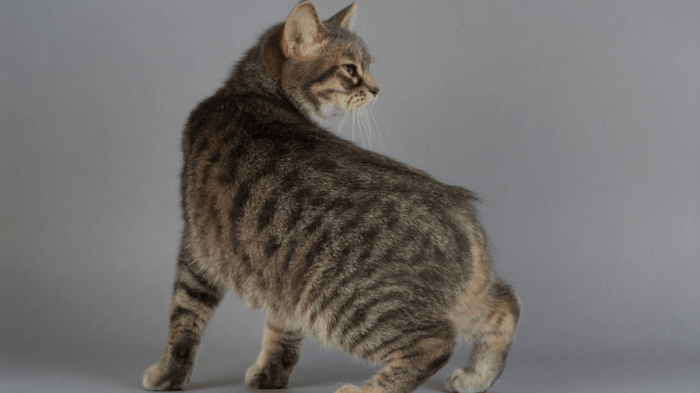
A Rumpy Manx cat is instantly recognizable by its complete lack of a tail. Their body is round and compact, with a deep chest and short back. Their coat can be any color or pattern, and their fur is typically soft and dense. Their face is broad with large, expressive eyes and a sweet, gentle expression. A Stumpy Manx cat has a short, stubby tail, typically 2-5 vertebrae long.
The tail is often slightly curved or kinked. Their body shape is similar to that of a Rumpy Manx, but the presence of a tail adds a slightly different silhouette. A Longy Manx cat possesses a near-normal tail, although it may be slightly kinked or twisted. Their overall appearance is similar to other domestic cats, but the tail provides a distinctive feature.
A Manx cat’s hind legs are noticeably longer than their front legs, giving them a distinctive, almost rabbit-like stance. They are powerfully muscled, allowing them to jump and hop with ease.
Concluding Remarks
Source: felinus.cl
From the Isle of Man’s legendary Manx cats to the rarer bobtails found in Japan and America, the world of tailless cats is full of surprises. Understanding the genetic factors, potential health concerns, and the unique adaptations these cats have developed is key to providing them with the best possible care. Whether you’re a seasoned cat lover or just curious about these remarkable animals, we hope this exploration has deepened your appreciation for the diversity and wonder of the feline world.
These tailless wonders are a testament to the beauty of natural variation and the enduring bond between humans and cats.
Ultimately, owning a tailless cat is a rewarding experience, filled with unique quirks and endearing qualities. With proper knowledge and care, these special companions can live long, happy, and healthy lives, bringing joy and companionship to their human families.
Query Resolution
Why do some cats have no tails?
It’s usually due to a genetic mutation, often a dominant gene that affects tail development. The specific gene and its expression vary between breeds.
What is Manx Syndrome?
It’s a collection of spinal and neurological defects that can occur in Manx cats due to the M gene. Symptoms can range from mild to severe and affect the hind legs, bladder, and bowel.
Can tailless cats balance okay?
Yes, they often compensate for the lack of a tail with stronger hind legs and a more flexible spine. They develop excellent balance and agility.
Is it ethical to breed Manx cats?
It’s a complex issue. Responsible breeders focus on minimizing the risk of Manx Syndrome through careful pairing and genetic testing, but concerns about the potential for health problems remain.
How can I tell if my tailless cat is in pain?
Look for signs like reluctance to jump, difficulty using the litter box, changes in appetite, sensitivity to touch, or unusual posture.
Do tailless cats need special bedding?
Soft, supportive bedding is a good idea, especially for Manx cats, as it can help cushion their spine and prevent discomfort.
What’s the difference between a naturally tailless cat and one that’s had its tail docked?
Naturally tailless cats are born without a tail, while docked cats have had their tail surgically shortened. Docking is now illegal in many countries due to ethical concerns.

