Have you ever seen a cat without a tail, or with just a tiny stump? It’s a fascinating quirk found in a few special breeds, and it’s more than just a visual difference. These cats have a rich history, unique genetics, and sometimes, specific health considerations. Let’s dive into the world of cat breeds no tail, exploring their origins, characteristics, and what it takes to care for these charming companions.
The absence of a tail isn’t a recent phenomenon; folklore and legends surrounding these tailless felines stretch back centuries, particularly in the Isle of Man. Genetic mutations are the key, and understanding these mutations is crucial for responsible breeding and ensuring the health and well-being of these unique cats. From the iconic Manx to the playful Japanese Bobtail, there’s a lot to discover about these captivating creatures.
Introduction to Cat Breeds Lacking Tails
The absence of a tail, or a significantly shortened tail, is a fascinating characteristic found in a handful of cat breeds. It’s not a result of injury, but rather a naturally occurring genetic trait. While it might seem unusual, these cats have adapted remarkably well, and their unique appearance often makes them highly sought after. This article will delve into the world of tail-less cats, exploring their history, genetics, health considerations, and the appeal that draws so many people to these charming felines.Historically, cats without tails have been shrouded in folklore and legend.
In some cultures, they were considered symbols of good luck, while in others, they were associated with mystery and the supernatural. The rarity of the trait likely contributed to these beliefs, as people often attributed extraordinary qualities to things they didn’t fully understand. The genetic basis for this trait is rooted in a dominant gene that affects tail development. A mutation in the
- T* gene, specifically a recessive allele
- t*, is responsible for the absence or reduction of the tail. Cats with two copies of the
- t* allele (tt) are completely tail-less, while those with one copy (Tt) will have a shortened tail. The presence of two dominant
- T* alleles (TT) results in a full-length tail.
The Manx Breed: The Most Well-Known Example
The Manx cat is undoubtedly the most recognized breed exhibiting this trait. Originating from the Isle of Man, a small island in the Irish Sea, the Manx has a rich and unique history. Isolated on the island for centuries, a natural mutation occurred, leading to the development of the tailless characteristic. The limited gene pool on the island resulted in a high prevalence of the
t* allele, making tail-less cats the norm rather than the exception.
Within the Manx breed, tail length varies considerably, leading to different classifications. These classifications aren’t just about tail length; they also influence breeding practices and show standards. Understanding these variations is key to appreciating the diversity within the Manx breed.
| Tail Type | Description | Common Characteristics | Health Considerations |
|---|---|---|---|
| Rumpy | Completely tailless; no tail vertebrae. | Short, rounded rump; often considered the “classic” Manx look. | Highest risk of Manx Syndrome; requires careful breeding. |
| Stumpy | Has a short tail of 1-3 vertebrae. | A short, stubby tail; may be slightly kinked. | Moderate risk of Manx Syndrome; still requires responsible breeding. |
| Longy | Has a tail of 4-6 vertebrae. | A noticeably longer tail, though still shorter than a typical cat’s tail. | Lowest risk of Manx Syndrome; considered less genetically “fixed” for the tailless trait. |
| Cymric | Has a tail of 7+ vertebrae, often with a pom-pom appearance. | A longer, plumed tail; often described as resembling a fox’s tail. | Very low risk of Manx Syndrome; generally considered healthier. |
Beyond their lack of a tail, Manx cats possess several other distinctive physical traits. They typically have a rounded body shape, short legs, and a deep, broad chest. Their hind legs are often slightly longer than their front legs, giving them a unique gait. Their heads are rounded with a broad muzzle and large, expressive eyes. The overall impression is one of a sturdy, compact, and undeniably charming feline.Manx cats are known for their affectionate and playful personalities.
They are often described as being loyal and devoted to their families, forming strong bonds with their human companions. They are intelligent and easily trained, and their playful nature makes them entertaining companions. Many owners report that Manx cats have a dog-like loyalty and enjoy following their owners around the house.
Other Breeds with Reduced or Absent Tails
While the Manx is the most famous example, several other cat breeds occasionally exhibit a lack of tail or a very short tail. These breeds have different genetic origins for their tail variations, and understanding these differences is crucial for responsible breeding and health management.The Kurilian Bobtail, Japanese Bobtail, and American Bobtail all share the characteristic of a shortened tail, but the underlying genetics and tail shapes differ significantly.
The Kurilian Bobtail, originating from the Kuril Islands between Russia and Japan, has a flexible, often kinked tail that resembles a squirrel’s tail. The Japanese Bobtail, as the name suggests, hails from Japan and has a short, pom-pom-like tail. The American Bobtail, developed in the United States, exhibits a variety of tail lengths, ranging from a short stub to a half-length tail.
- Kurilian Bobtail: Approximately 30-45% typically present with a shortened or absent tail.
- Japanese Bobtail: Roughly 95-100% are born with a shortened tail.
- American Bobtail: Around 80-85% have a shortened tail.
The genetic mechanisms behind tail reduction in these breeds differ from the Manx. The Manx mutation is a dominant gene affecting tail vertebrae development. In contrast, the Kurilian Bobtail, Japanese Bobtail, and American Bobtail have different genes influencing tail length, often involving incomplete dominance or polygenic inheritance. This means that multiple genes contribute to the tail phenotype, resulting in a wider range of tail lengths and shapes.
Health Considerations for Tail-Less Cats
Source: cattipper.com
The absence of a tail can be associated with certain health concerns, particularly in the Manx breed. The most significant of these is Manx Syndrome, a complex congenital condition affecting the spine and nervous system. Understanding the causes, symptoms, and potential complications of Manx Syndrome is essential for responsible ownership and breeding.Manx Syndrome is caused by a homozygous (tt) genotype for the Manx gene, meaning the cat inherits two copies of the recessive allele.
This leads to abnormal development of the spinal cord and caudal (tail) vertebrae. The severity of the syndrome varies greatly, ranging from mild symptoms to severe, life-threatening conditions. Symptoms can include bowel and bladder dysfunction, hind limb paralysis, spinal deformities, and neurological problems.Veterinary screenings are crucial for Manx cats and other tail-less breeds to detect and manage potential health issues.
Recommended screenings include:
- Neurological examination: To assess nerve function and reflexes.
- Radiographs (X-rays): To evaluate the spine and identify any abnormalities.
- Bowel and bladder function assessment: To monitor for signs of dysfunction.
- Genetic testing: To identify carriers of the Manx gene and reduce the risk of producing affected kittens.
Responsible breeding practices are paramount in minimizing the risk of Manx Syndrome. Breeders should avoid breeding two Manx cats together (tt x tt), as this will invariably produce kittens with the syndrome. Breeding a Manx (Tt) with a cat with a full tail (TT) is a safer option, but genetic testing is still recommended to identify carriers.
Physical Adaptations and Functionality
Despite lacking a tail, tail-less cats have remarkably adapted to maintain balance and agility. The absence of a tail doesn’t significantly impair their ability to move and navigate their environment.The spine and muscles play a crucial role in compensating for the lack of a tail. The lumbar vertebrae (lower back) are often more flexible in tail-less cats, allowing for greater range of motion and improved balance.
Stronger hind leg muscles also contribute to stability and maneuverability.Imagine a Rumpy Manx gracefully leaping onto a windowsill. Its powerful hind legs propel it upwards, while its flexible spine allows it to adjust its body position mid-air. Upon landing, its strong core muscles absorb the impact, ensuring a smooth and controlled descent. On uneven terrain, a tail-less cat might widen its stance and use its legs to maintain balance, much like a human would.
Their movements are often described as being more deliberate and controlled than those of cats with full tails.Behaviorally, tail-less cats may exhibit subtle differences in communication. They rely more on body posture, ear position, and vocalizations to express their emotions.
Grooming and Care Specific to Tail-Less Cats
Grooming requirements for tail-less cats are generally similar to those of other short-haired breeds. However, there are a few specific considerations related to the absence of a tail.The area where a tail would normally be can be prone to hygiene issues, particularly in long-haired Manx cats. Regular cleaning is essential to prevent the buildup of dirt and debris. A damp cloth or pet wipes can be used to gently clean the area.It’s important to monitor the skin around the tail area for any signs of irritation or infection.
Redness, swelling, or discharge should be promptly addressed by a veterinarian.To properly clean the area, gently wipe away any dirt or debris with a soft, damp cloth. Avoid using harsh soaps or chemicals, as these can irritate the skin. Regular brushing can also help to remove loose hair and prevent matting.Keeping a tail-less cat comfortable involves providing a clean and dry environment, as well as regular grooming.
Some cats may benefit from wearing a protective garment, especially during colder months.
Breed Standards and Recognition
Breed standards for the Manx and other tail-less breeds Artikel the ideal physical characteristics, including tail length. These standards are used by cat registries to classify and evaluate cats for show purposes.The Cat Fanciers’ Association (CFA) and The International Cat Association (TICA) are two of the most prominent cat registries. They have specific standards for the Manx breed, as well as for the Kurilian Bobtail, Japanese Bobtail, and American Bobtail.
| Registry | Manx Standard (Tail) | Other Breed Standard (Tail) |
|---|---|---|
| CFA | Rumpy: No tail. Stumpy: Short tail. Longy: Full tail. Cymric: Plumed tail. | Japanese Bobtail: Short, pom-pom tail. American Bobtail: Short, bobbed tail. Kurilian Bobtail: Flexible, squirrel-like tail. |
| TICA | Similar to CFA standards for tail types. | Similar to CFA standards for tail types. |
Judges at cat shows evaluate tail length and conformation based on the breed standards. They assess the overall appearance of the cat, including its body shape, head, and tail (or lack thereof). Points are awarded based on how closely the cat conforms to the ideal standard.
The Appeal and Popularity of Tail-Less Cats
Tail-less cats hold a unique appeal for many cat owners. Their distinctive appearance, coupled with their affectionate personalities, makes them highly desirable companions.Culturally, tail-less cats have been associated with various meanings and symbolism. In some regions, they are considered lucky charms, while in others, they are seen as symbols of resilience and adaptability.The perceived personality traits of tail-less cats contribute to their popularity.
They are often described as being loyal, playful, and intelligent. Many owners report that their tail-less cats are exceptionally affectionate and enjoy cuddling.One owner shared a story about her Rumpy Manx, “Shadow,” who would follow her from room to room, always wanting to be near her. “He’s like a little shadow,” she said, “and he’s the most loving cat I’ve ever had.”
Visual Descriptions: Illustrating Tail-Less Cats
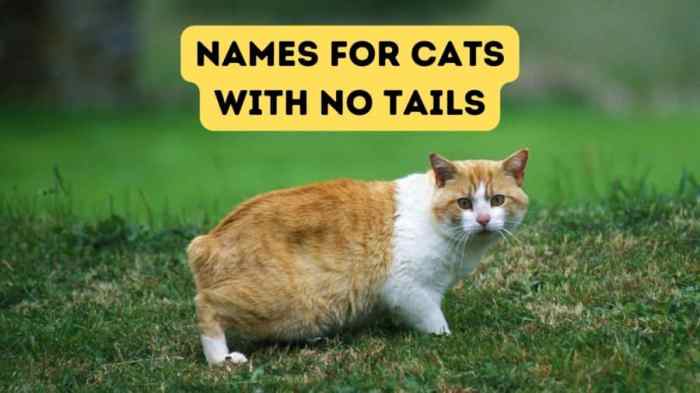
A Rumpy Manx cat presents a striking image. Its body is compact and rounded, with a deep chest and short, sturdy legs. The absence of a tail emphasizes the roundedness of its rump, giving it a unique and almost comical appearance. Its head is broad and rounded, with large, expressive eyes that convey intelligence and affection. The overall impression is one of a sturdy, charming, and undeniably unique feline.A Cymric Manx, while sharing the overall body type of the Rumpy, possesses a subtle but noticeable difference: a plumed tail.
This tail, though shorter than a typical cat’s tail, is full and fluffy, resembling a fox’s brush. The Cymric’s tail adds a touch of elegance and refinement to its appearance.Imagine a Japanese Bobtail cat gracefully leaping from a windowsill. Its short, pom-pom tail bobs playfully as it lands, adding a touch of whimsy to its movements. The tail’s distinctive shape is instantly recognizable, making it a defining characteristic of the breed.Picture a Kurilian Bobtail cat curled up asleep on a plush cushion.
Its flexible, squirrel-like tail curves gracefully around its body, providing warmth and comfort. The tail’s unique shape and texture are captivating, adding to the cat’s overall charm.
Responsible Breeding and Ethical Considerations
Breeding practices for tail-less cats, particularly the Manx, raise significant ethical considerations. The risk of Manx Syndrome necessitates a responsible and cautious approach to breeding.Genetic testing is essential for breeders to identify carriers of the Manx gene and minimize the risk of producing affected kittens. Responsible breeders prioritize the health and well-being of their cats above all else.Breeders have a crucial role in educating potential owners about the specific needs and challenges of tail-less cats.
They should be transparent about the potential health risks and provide ongoing support to owners.Here are some resources for finding reputable breeders of Manx and other tail-less breeds:
- The Manx Breed Club: [Insert Link to Manx Breed Club Website]
- The Cat Fanciers’ Association (CFA): [Insert Link to CFA Website]
- The International Cat Association (TICA): [Insert Link to TICA Website]
Final Summary
From the distinctive Manx with its varying tail lengths to the pom-pom tails of the Japanese Bobtail, cat breeds no tail offer a captivating glimpse into the diversity of the feline world. While their appearance is striking, it’s essential to understand the potential health implications, particularly Manx Syndrome, and prioritize responsible breeding practices. Ultimately, these tailless cats are beloved companions, offering affection, playfulness, and a unique charm that resonates with many cat lovers.
Whether you’re a seasoned cat enthusiast or just curious about these unusual breeds, appreciating their history, understanding their needs, and supporting ethical breeders are key to ensuring a happy and healthy life for these special felines.
FAQ Corner
Why do some cats lack a tail?
It’s usually due to a genetic mutation that affects tail development. This mutation can result in a complete absence of a tail, a shortened tail, or a uniquely shaped tail.
What is Manx Syndrome?
Manx Syndrome is a collection of birth defects that can occur in Manx cats due to the same gene that causes the taillessness. It can affect the spine, bladder, and bowel, and can range in severity.
Are tail-less cats less agile?
Surprisingly, no! They compensate for the lack of a tail by using their strong spine and muscles to maintain balance and agility. They often develop unique movement patterns to navigate their environment.
What are the different tail types in Manx cats?
There are four main tail types: Rumpy (no tail), Stumpy (short tail), Longy (full-length tail), and Cymric (short, slightly curved tail).
Do tail-less cats need special grooming?
Yes, it’s important to regularly clean the area where a tail would normally be to prevent skin irritations or infections. Pay close attention to hygiene in that area.
How can I find a reputable breeder of Manx cats?
Look for breeders who prioritize health testing, are knowledgeable about Manx Syndrome, and are transparent about their breeding practices. Check with cat registries like CFA or TICA for registered breeders.
What is the cultural significance of tailless cats?
In some cultures, particularly on the Isle of Man, tailless cats are considered lucky and are often associated with folklore and legends.

