Cats have captivated humans for centuries, and their diverse appearances are a huge part of that appeal. Whether you’re a seasoned cat lover or just starting to explore the world of feline breeds, images are often the first point of connection. We’re constantly scrolling through social media, searching online, and admiring the unique looks of different breeds. This guide dives into the visual characteristics that make certain cats so popular, from striking eye colors to luxurious fur patterns, and explores how social media has amplified their visual presence.
From the fluffy Persian to the sleek Siamese, each breed boasts a distinct set of features that contribute to its overall charm. We’ll examine the science behind coat colors, eye variations, and body shapes, and even offer some photography tips to help you capture the perfect picture of your feline friend. Get ready to appreciate the incredible visual diversity within the cat world!
Introduction to Cat Breeds & Visual Appeal
Source: vecteezy.com
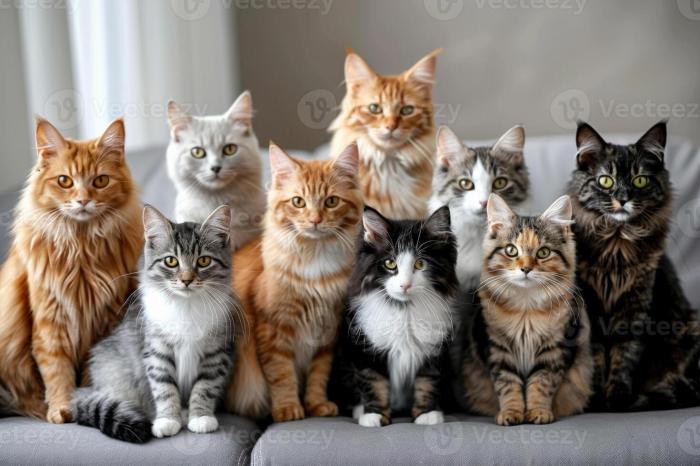
The internet is overflowing with cat pictures, and for good reason! People are captivated by the sheer variety and beauty of different cat breeds. From fluffy Persians to sleek Siamese, the visual appeal of these felines is a major draw. This fascination isn’t just about cuteness; it’s about appreciating the unique characteristics that define each breed. We’ll explore why people search for images of different cat breeds, what makes certain breeds visually popular, and how social media has amplified this appreciation.
The reasons behind the search for cat breed images are multifaceted. Some are simply looking for a pet to adopt and want to research different breeds to find the perfect match. Others are fascinated by the genetics and selective breeding that have created such a diverse range of appearances. Still others are just enjoying the visual feast of adorable cat pictures.
Several factors contribute to a breed’s visual popularity. Eye color plays a significant role – striking blue eyes, vibrant green eyes, or mesmerizing gold eyes can instantly capture attention. Fur patterns, like the classic tabby markings or the dramatic spots of a Bengal, are also key. Body shape, from the cobby build of a British Shorthair to the slender elegance of an Abyssinian, adds to the overall appeal.
Finally, social media platforms like Instagram and TikTok have become powerful showcases for cat breeds, allowing breeders, owners, and enthusiasts to share stunning images and videos, further fueling the demand for breed-specific visuals.
Popular Cat Breeds: Visual Characteristics
Let’s delve into the visual traits of some of the most beloved cat breeds. Each possesses a unique combination of features that contribute to its distinctive appearance and widespread popularity.
- Persian Cat: The Persian is instantly recognizable by its long, flowing fur, which requires regular grooming. Their flat face and large, round eyes add to their sweet and gentle expression. Color variations are extensive, ranging from solid white and black to calico and tabby patterns. The luxurious fur and distinctive facial structure make the Persian a timeless favorite. Imagine a cat with a cloud of white fur, its face framed by a luxurious mane, gazing at you with large, expressive blue eyes.
- Maine Coon: Known as the “gentle giant,” the Maine Coon is one of the largest domestic cat breeds. Their shaggy, water-resistant fur, bushy tail, and tufted ears are hallmarks of their rugged appearance. They come in a wide array of colors and patterns, including tabby, tortoiseshell, and solid colors. The sheer size and impressive fur coat of a Maine Coon are visually striking.
Picture a large, muscular cat with a long, flowing tail, its fur a mix of brown, black, and ginger stripes.
- Siamese Cat: The Siamese cat is renowned for its striking blue almond-shaped eyes and short, sleek coat. Their distinctive colorpoint pattern, where the body is lighter and the extremities (ears, face, paws, tail) are darker, is a defining characteristic. Point colors include seal (dark brown), chocolate, blue (gray), and lilac (pale gray). The contrast between the light body and dark points creates a visually arresting effect.
Envision a cat with a creamy white body and dark brown “points” on its face, ears, and tail, its piercing blue eyes captivating your gaze.
- Ragdoll Cat: Ragdolls are known for their docile and relaxed temperament, which is reflected in their posture. They have beautiful blue eyes and semi-long fur that is soft and silky. Common colors include seal, blue, chocolate, and lilac, often with pointed patterns. Their gentle nature and stunning blue eyes make them incredibly appealing. Imagine a large, fluffy cat with bright blue eyes, lounging peacefully, its fur a soft shade of gray.
- Bengal and Abyssinian: These breeds offer a fascinating contrast in coat patterns. Bengals boast a leopard-like spotted coat, a result of their wild ancestry. Abyssinians, on the other hand, have a ticked tabby pattern, where each hair has bands of different colors, creating a shimmering effect. The bold spots of the Bengal and the subtle shimmer of the Abyssinian provide distinct visual experiences.
Picture a cat with a coat resembling a miniature leopard, or a cat whose fur seems to glow with subtle bands of color.
Uncommon & Exotic Cat Breeds: Visual Exploration
Beyond the popular breeds, a world of unique and exotic felines awaits. These breeds often possess striking and unusual features that set them apart.
- Sphynx Cat: The Sphynx is perhaps best known for its lack of fur. Their wrinkled skin, large ears, and expressive eyes create a unique and often endearing appearance. Skin color can vary from solid colors to patterns like tabby and tortoiseshell. The absence of fur highlights the cat’s musculature and allows their skin texture to take center stage. Imagine a cat with large, bat-like ears and wrinkled skin, its eyes full of curiosity.
- Turkish Van: The Turkish Van is distinguished by its distinctive white body and colored tail and head. The color on the tail and head can range from black to cream to tabby patterns. This striking contrast creates a visually appealing and memorable appearance. Picture a cat with a pristine white body and a vibrant red tail and head, a truly unique combination.
- Norwegian Forest Cat: Adapted to harsh climates, the Norwegian Forest Cat has a thick, water-resistant coat and a bushy tail. Common color patterns include tabby, tortoiseshell, and solid colors. Their rugged appearance and impressive fur coat reflect their resilience. Imagine a large, sturdy cat with a thick, shaggy coat, its tail providing warmth and balance.
- Cornish Rex: The Cornish Rex is characterized by its curly coat, which is a result of a genetic mutation. Their large ears and slender build add to their distinctive appearance. Coat colors and patterns are diverse, ranging from solid colors to tabby and tortoiseshell. The unique texture of their coat sets them apart from other breeds. Picture a cat with a soft, wavy coat and large, alert ears, its appearance both elegant and playful.
- Peterbald: Similar to the Sphynx, the Peterbald is known for its hairlessness. However, Peterbalds can have varying degrees of hair coverage, from completely hairless to having a fine down. Their skin texture can range from velvety to wrinkled, and they come in a variety of colors and patterns. The subtle variations in skin texture and hair coverage make each Peterbald unique.
Imagine a cat with a velvety-smooth skin, its color a striking shade of gray.
Coat Patterns & Colors: A Visual Guide
The diversity of cat coat patterns and colors is truly remarkable. Understanding these variations can enhance your appreciation for the visual beauty of these animals.
| Pattern Name | Description | Example Breeds | Visual Characteristics |
|---|---|---|---|
| Tabby (Classic) | Swirled or blotched markings | Maine Coon, American Shorthair | Distinct ‘M’ marking on forehead |
| Tabby (Mackerel) | Narrow, parallel stripes | Abyssinian, Bengal | Resembles a fish skeleton |
| Tortoiseshell | Mixture of black and red (or diluted versions like blue and cream) | American Shorthair, British Shorthair | Often patchy and unpredictable |
| Calico | White with patches of black and red (or diluted versions) | Persian, Maine Coon | Typically female |
Solid coats feature a single color throughout the body. Bi-color coats have a combination of two colors, often white with another color. Tri-color coats include three colors, typically white, black, and red. Calico coats are a specific type of tri-color coat with predominantly white, black, and red patches. The genetics behind coat colors are complex, involving multiple genes that interact to determine the final appearance.
Black, white, red, cream, blue (gray), and chocolate are just a few of the colors that can be expressed. Colorpoint patterns, as seen in Siamese cats, develop due to a temperature-sensitive enzyme that restricts pigment production to the cooler areas of the body. Rare coat colors and patterns, such as lilac and smoke, are highly sought after and add to the visual diversity of cats.
Eye Color Variations in Cats: A Visual Spectrum
Cat eyes are captivating, and their color is a fascinating reflection of genetics and biology.
Different eye colors in cats – blue, green, gold, copper, and hazel – are determined by the amount and distribution of melanin in the iris. Blue eyes are often associated with albinism or a lack of melanin, while green and gold eyes contain more melanin. Copper eyes are a rich, reddish-brown color. Hazel eyes are a mix of colors, often appearing green or gold with brown flecks.
| Eye Color | Associated Breeds | Visual Impact |
|---|---|---|
| Blue | Siamese, Ragdoll | Striking contrast with lighter coats |
| Green | Emerald, Havana Brown | Adds a vibrant and lively touch |
| Gold | Maine Coon, Persian | Warm and inviting |
Eye color can be linked to coat color and genetics. For example, Siamese cats with their colorpoint patterns often have blue eyes. Odd-eyed cats, with one blue eye and one eye of a different color, are a result of a genetic mutation. Heterochromia, where different colored irises are present within the same eye, is a rare but visually striking condition.
Body Shape & Size: Visual Diversity
Just as coat colors and patterns vary, so too does the body shape and size of different cat breeds. This diversity contributes to the overall visual appeal of the feline world.
Body shapes range from the cobby build of a British Shorthair to the slender elegance of an Abyssinian. Muscular breeds like Bengals have a powerful physique, while delicate breeds like Siamese have a more refined appearance. Size variations are equally dramatic, with small breeds like Munchkins standing in contrast to large breeds like Maine Coons. Body shape and size contribute significantly to a cat’s overall visual appeal, influencing how we perceive their strength, grace, and personality.
Imagine a compact, round cat versus a long, lithe feline – each evokes a different impression.
Breed-Specific Visual Quirks & Features
Certain cat breeds possess unique physical features that set them apart and add to their charm.
- Scottish Fold: The Scottish Fold’s most distinctive feature is its folded ears, which are caused by a genetic mutation. This gives them an owl-like appearance.
- Manx Cat: The Manx cat is known for its naturally short or absent tail, a result of a genetic mutation.
- Exotic Shorthair: The Exotic Shorthair shares the flat face and large, round eyes of the Persian, but with a short, plush coat.
- Munchkin Cat: The Munchkin’s short legs are a result of a genetic mutation, giving them a distinctive waddling gait.
- American Curl: The American Curl’s backward-curving ears are a defining characteristic, creating a unique and expressive appearance.
Visual Presentation & Photography Tips (for cat pictures)
Capturing flattering images of cats requires a bit of skill and patience. Proper lighting and composition are essential for showcasing a cat’s beauty. Natural light is generally best, avoiding harsh shadows. Experiment with different angles to find the most flattering perspective. Showcasing a cat’s personality through photography is just as important as capturing their physical appearance.
A playful pose or a curious expression can add a lot of character to a picture. Highlighting a cat’s unique features, such as their eye color or coat pattern, can also enhance the visual appeal. Techniques like shallow depth of field (blurring the background) and the rule of thirds (placing the cat off-center) can create more visually engaging images. For cats with dark coats, use bright lighting to bring out their details.
For cats with light coats, avoid overexposure.
Outcome Summary
Exploring the visual landscape of cat breeds is a journey of discovery, revealing a stunning array of colors, patterns, and shapes. Understanding the genetics behind these traits adds another layer of appreciation for the artistry of nature. Whether you’re drawn to the exotic Sphynx or the classic Maine Coon, there’s a cat breed out there to capture your heart – and your camera lens! Hopefully, this guide has sparked your curiosity and inspired you to delve deeper into the fascinating world of feline aesthetics.
So, next time you’re browsing cat breeds pic online, take a moment to appreciate the intricate details that make each one so unique and beautiful. And don’t forget to share your favorite feline photos – the world needs to see them!
FAQ Insights
Why are some cat breeds more popular visually than others?
Popularity often stems from a combination of factors like striking eye color, unique fur patterns (like the tabby), and appealing body shapes. Social media trends also play a significant role in showcasing certain breeds.
What causes the different point colors in Siamese cats?
Point colors in Siamese cats are due to a temperature-sensitive enzyme that affects pigment production. Cooler areas of the body (like the face, ears, paws, and tail) develop pigment, while warmer areas remain lighter.
Why do some cats have odd eyes (one blue, one different color)?
Odd-eyed cats typically have a genetic mutation that affects melanin production in one eye. It’s often linked to the white spotting gene, which can also cause deafness in the blue eye.
What’s the difference between a calico and a tortoiseshell cat?
Both are color patterns resulting from the X chromosome. Calicos have white patches in addition to the tortoiseshell pattern (black and orange/red), while tortoiseshells lack the white patches.
How can I take better pictures of my cat?
Good lighting is key! Natural light is best. Get down to your cat’s level, use a shallow depth of field to blur the background, and try to capture their personality – a playful pounce or a cozy nap.
Are there any health concerns associated with specific coat colors or patterns?
While not always the case, certain colors like chocolate or lilac can be linked to specific genetic conditions in some breeds. It’s always a good idea to research the breed’s potential health issues.

