Ever watched your cat leap effortlessly onto a counter or gracefully navigate a narrow space? It’s all thanks to their incredible hind legs! These powerful limbs are a marvel of feline engineering, combining intricate skeletal structures, robust muscles, and lightning-fast reflexes. This guide dives deep into the world of your cat’s hind legs, exploring everything from their anatomy and biomechanics to common injuries, rehabilitation, and even breed-specific considerations.
Whether you’re a curious cat owner or simply fascinated by animal movement, get ready to appreciate the amazing capabilities of your feline friend’s back legs.
We’ll break down the complex systems that allow cats to jump, run, climb, and maintain their balance with such impressive agility. Beyond the mechanics, we’ll also cover essential care tips, potential health concerns, and how to recognize signs of discomfort or injury. Understanding these aspects can help you ensure your cat enjoys a long, active, and pain-free life.
The Marvel of a Cat’s Hind Legs: Anatomy, Movement, and Care
Cats are renowned for their agility, grace, and incredible jumping abilities. Much of this stems from the sophisticated design of their hind legs. They’re not just for walking; they’re powerful levers, springs, and shock absorbers, allowing cats to navigate complex environments with remarkable precision. This article delves into the fascinating world of feline hind leg anatomy, biomechanics, common issues, and how to keep your cat’s back legs healthy and happy.
1. Anatomy of a Cat’s Hind Legs
Understanding the structure of a cat’s hind leg is key to appreciating its functionality. It’s a complex system of bones, muscles, ligaments, and tendons working in perfect harmony. Let’s break down the key components.
- Skeletal Structure: The hind leg consists of the femur (thigh bone), patella (kneecap), tibia and fibula (lower leg bones), and tarsals, metatarsals, and phalanges (ankle, foot, and toes). The femur is the longest and strongest bone, providing leverage for powerful movements. The tibia bears most of the weight, while the fibula provides stability. The tarsals and metatarsals form the ankle and foot, allowing for flexibility and shock absorption.
- Major Muscle Groups: The hind legs are powered by a network of muscles. Flexors shorten the leg, bringing the foot closer to the body (e.g., biceps femoris, semitendinosus, semimembranosus). Extensors straighten the leg, pushing the foot away from the body (e.g., quadriceps femoris group). The balance between these muscle groups is crucial for controlled movement.
- Ligaments and Tendons: Ligaments connect bone to bone, providing stability to the joints. Tendons connect muscle to bone, transmitting the force generated by the muscles. The cruciate ligaments within the knee are particularly important for stability.
| Bone Name | Muscle Name | Function | Attachment Points |
|---|---|---|---|
| Femur | Biceps Femoris | Flexion of the hip and extension of the stifle (knee) | Ischial tuberosity to tibial crest and fibular head |
| Tibia | Quadriceps Femoris | Extension of the stifle | Femoral condyles to tibial tuberosity |
| Tarsals | Tibialis Anterior | Dorsiflexion of the ankle | Tibial tuberosity to tarsal bones |
| Phalanges | Extensor Digitorum Longus | Extension of the toes | Tibial tuberosity to dorsal surface of toes |
2. Gait and Locomotion
A cat’s hind legs are marvels of biomechanical engineering, enabling a wide range of movements. The way they move depends heavily on the activity at hand.
- Biomechanics of Movement: During walking, the hind legs swing forward and backward in a coordinated manner, with the hip and knee joints flexing and extending to propel the cat forward. Running involves a faster cycle of these movements, with increased power and stride length. Jumping requires a rapid and forceful extension of the hind legs, storing elastic energy in the tendons and releasing it for a powerful launch.
- Balance and Agility: The hind legs play a vital role in maintaining balance. The cat’s spine and tail also contribute, but the hind legs’ ability to quickly adjust their position allows for rapid corrections to prevent falls. The flexible ankle joints and padded paws further enhance agility.
- Activity-Specific Movements: Stalking involves slow, deliberate movements with careful weight shifting. Pouncing is a burst of explosive energy, with a rapid extension of the hind legs to launch the cat forward. Climbing utilizes a combination of gripping and pushing movements, with the hind legs providing the primary force.
- Jump Breakdown: A typical jump begins with a crouch, storing energy in the muscles and tendons. The cat then rapidly extends its hind legs, pushing off the ground. The elastic energy stored in the tendons is released, providing an extra boost. The muscles activate in a specific sequence: first, the quadriceps extend the stifle, followed by the hip extensors (gluteals and hamstrings) to propel the cat upward.
Finally, the ankle muscles adjust the foot position for landing.
3. Common Injuries and Conditions
Despite their robust design, a cat’s hind legs are susceptible to injuries and conditions. Recognizing the signs and taking preventative measures is crucial for maintaining their health.
- Potential Injuries: Fractures (broken bones) are often caused by trauma, such as falls or car accidents. Sprains involve stretching or tearing of ligaments. Dislocations occur when bones are forced out of their normal position.
- Symptoms: Mild sprains may cause limping or stiffness. Severe fractures typically result in inability to bear weight and obvious deformity. Dislocations can cause pain, swelling, and an inability to move the leg normally.
- Common Conditions: Arthritis is a degenerative joint disease causing pain and stiffness. Hip dysplasia is a malformation of the hip joint, often seen in certain breeds. Luxating patella is a condition where the kneecap dislocates.
- Preventative Measures: Maintaining a healthy weight can reduce stress on the joints. Providing a safe environment free from hazards like steep stairs or unstable furniture can prevent falls. Regular exercise helps maintain muscle strength and joint flexibility.
4. Neurological Considerations
The hind legs’ movement is intricately controlled by the nervous system. Damage or dysfunction within this system can significantly impact their function.
- Role of Spinal Cord and Nerves: The spinal cord transmits signals from the brain to the muscles in the hind legs, controlling their movement. Nerves branch off the spinal cord to innervate specific muscles.
- Neurological Conditions: Intervertebral disc disease (IVDD) can compress the spinal cord, causing pain and weakness. Nerve damage, resulting from trauma or disease, can impair muscle function.
- Signs and Symptoms: Neurological problems can manifest as weakness, paralysis, incoordination, dragging of the hind legs, or an abnormal gait.
- Diagnostic Process: Initial observation might reveal hind leg weakness or paralysis. A neurological exam assesses reflexes and sensation. X-rays can identify spinal abnormalities. MRI or CT scans provide detailed images of the spinal cord. Blood tests can rule out underlying medical conditions.
5. Hind Leg Amputation and Prosthetics
In some cases, amputation of a hind leg may be necessary due to severe injury or disease. While a significant adjustment, cats can adapt remarkably well to life on three legs.
- Reasons for Amputation: Amputation may be required for irreparable fractures, severe infections, tumors, or congenital deformities.
- Surgical Procedure and Post-Operative Care: The surgery involves removing the affected leg at a specific point. Post-operative care includes pain management, wound care, and physical therapy to strengthen the remaining limbs.
- Prosthetic Limbs: Prosthetic limbs can provide additional support and mobility for some cats. However, they require careful fitting and training.
| Prosthetic Type | Advantages | Disadvantages |
|---|---|---|
| Custom-fitted socket and paw | Improved balance and stability, potential for increased activity | Can be expensive, requires regular adjustments, may cause skin irritation |
| Spring-loaded prosthetic | Assists with propulsion, reduces strain on remaining limbs | May not be suitable for all cats, can be noisy |
| Simple sleeve-type prosthetic | Easy to apply, relatively inexpensive | Limited functionality, primarily provides protection |
6. Grooming and Hygiene
Maintaining good hygiene around a cat’s hind legs is essential for preventing skin problems and ensuring comfort.
- Importance of Grooming: Regular grooming removes dirt, debris, and mats from the fur, preventing irritation and infections.
- Cleaning and Care: Gently wipe the hind legs with a damp cloth. Pay attention to areas between the toes. Older or less mobile cats may require more frequent cleaning.
- Skin Conditions: Fleas, ticks, and allergies can cause skin irritation. Yeast infections can occur in moist areas.
- Signs of Irritation or Infection: Redness, swelling, itching, hair loss, and discharge are signs of potential problems.
7. Breed-Specific Considerations
Certain cat breeds are predisposed to specific hind leg issues due to their unique anatomy or genetics.
- Maine Coons: Prone to hip dysplasia and arthritis due to their large size and rapid growth.
- Bengals: Can be susceptible to patellar luxation.
- Persians: May develop arthritis due to their brachycephalic (flat-faced) conformation.
Maine Coons require careful monitoring of their hip joints during development. Bengals benefit from regular checks for patellar stability. Persians may need joint supplements to manage arthritis.
8. Rehabilitation and Physical Therapy
Physical therapy can be incredibly beneficial for cats recovering from hind leg injuries or managing chronic conditions.
- Principles of Physical Therapy: The goal is to restore strength, flexibility, and mobility.
- Exercises and Techniques: Passive range-of-motion exercises gently move the joints through their full range. Strengthening exercises involve encouraging the cat to use its legs.
- Assistive Devices: Slings can provide support during walking. Ramps can help cats access elevated surfaces.
- Range-of-Motion Exercises: Gently flex and extend the hip, knee, and ankle joints, holding each position for a few seconds.
9. Visualizing Hind Leg Movement
Observing a cat’s hind leg movement can provide valuable insights into its health and well-being.
- Slow-Motion Pounce: In slow motion, you can see the powerful contraction of the quadriceps as the stifle extends, followed by the forceful extension of the hip by the gluteal muscles. The ankle muscles adjust the foot position for a precise landing.
- Signs of Pain or Discomfort: A hunched posture, reluctance to move, or a stiff gait can indicate pain.
- Hind Leg Weakness: A cat with hind leg weakness may drag its toes, have a shuffling gait, or be unable to jump.
10. Hind Leg Postures and Communication
A cat’s hind leg posture can reveal a surprising amount about its mood and intentions.
| Posture | Description | Possible Meaning |
|---|---|---|
| Relaxed | Legs extended and loosely positioned | Contentment, calmness |
| Alert | Legs slightly bent and poised for action | Interest, readiness to respond |
| Defensive | Legs braced and tense | Fear, aggression |
Outcome Summary
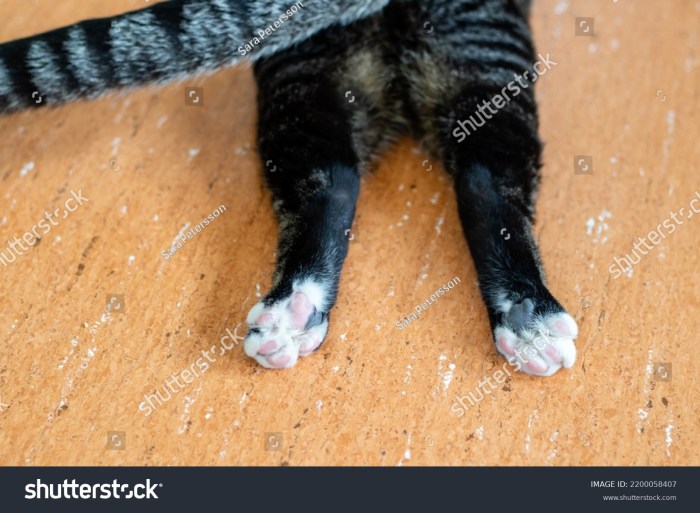
Source: shutterstock.com
From the intricate network of bones and muscles to the subtle nuances of posture and communication, the cat’s hind legs are a testament to evolutionary adaptation. We’ve explored the biomechanics of movement, potential health issues, and the importance of proper care and rehabilitation. By understanding the complexities of these vital limbs, you can better appreciate your cat’s athleticism and proactively address any concerns that may arise, ensuring they continue to move with grace and confidence for years to come.
Remember, observing your cat’s movements and being aware of any changes can be crucial for early detection of potential problems. Regular vet checkups and a proactive approach to their well-being will contribute significantly to their overall health and happiness.
FAQ Overview
Why do cats land on their feet?
Cats possess a “righting reflex” – an incredible ability to twist their bodies mid-air to orient themselves for a safe landing. This is due to their flexible spine, lack of a collarbone, and inner ear balance mechanisms.
What does it mean if my cat is dragging their hind leg?
Dragging a hind leg can indicate a variety of issues, from a minor sprain to a more serious fracture or neurological problem. A vet visit is essential to determine the cause and appropriate treatment.
Can arthritis affect a cat’s hind legs?
Yes, arthritis is a common condition in older cats, causing pain and stiffness in the joints of the hind legs. Treatment options include pain medication, joint supplements, and physical therapy.
What is luxating patella in cats?
Luxating patella is a condition where the kneecap (patella) dislocates or moves out of its normal position. It’s more common in certain breeds and can cause lameness and pain.
How can I help my cat with hip dysplasia?
Management of hip dysplasia often involves weight management, pain medication, physical therapy, and in severe cases, surgery. Consult with your veterinarian for a personalized treatment plan.
Are prosthetic limbs a viable option for cats?
While not always necessary, prosthetic limbs can significantly improve the quality of life for cats who have undergone hind leg amputation, allowing them to regain mobility and independence.

