Ever wondered what’s going on inside your feline friend? A deep dive into a cats organs diagram reveals a fascinating world of interconnected systems working in harmony. From the powerful pump of the heart to the intricate filtering of the kidneys, each organ plays a vital role in a cat’s health and well-being. This exploration will guide you through the major organ systems, their functions, and common health concerns, all visualized with helpful diagrams.
We’ll be breaking down everything from the cardiovascular and respiratory systems to the digestive, urinary, and endocrine systems. Understanding the layout and function of these organs isn’t just interesting; it can help you better recognize signs of illness and advocate for your cat’s health. Get ready to learn about the amazing complexity within your furry companion!
Understanding Your Cat’s Internal World: A Guide to Feline Anatomy
Cats are fascinating creatures, and beneath their sleek fur and playful antics lies a complex and efficient body. This article delves into the inner workings of your feline friend, exploring the major organ systems and how they contribute to their overall health and well-being. We’ll break down the anatomy in a way that’s easy to understand, complete with diagrams to help visualize the location and function of each vital organ.
Think of it as a peek under the hood – a chance to appreciate the incredible engineering that makes your cat tick!
Introduction to Feline Anatomy – Organs Overview
The feline body, like any mammal’s, is organized into several major organ systems, each with a specific role to play. These include the cardiovascular, respiratory, digestive, urinary, hepatic, endocrine, reproductive, nervous, and musculoskeletal systems. Understanding how these systems interact is key to appreciating the overall health of your cat. The relative size and position of these organs are crucial for efficient function; for example, the heart’s central location allows for rapid distribution of oxygen throughout the body, while the kidneys’ placement near the spine protects them from external trauma.
| Organ | Location & Representation |
|---|---|
| Heart | Located in the chest cavity, slightly left of center. Imagine a roughly cone-shaped structure nestled between the lungs. |
| Lungs | Two spongy organs filling the majority of the chest cavity, flanking the heart. They appear as paired, elongated structures. |
| Liver | The largest internal organ, occupying the upper right quadrant of the abdomen. It’s a large, lobed structure, often extending towards the diaphragm. |
| Kidneys | Two bean-shaped organs located towards the rear of the abdomen, against the spine. |
| Stomach | A J-shaped organ located in the upper abdomen, just below the liver. |
| Intestines (Small & Large) | A long, coiled tube extending throughout the abdomen. The small intestine is longer and thinner, while the large intestine is shorter and wider. |
| Pancreas | A flat, elongated organ nestled behind the stomach and in front of the small intestine. |
Cardiovascular System – The Heart and Blood Vessels
The cardiovascular system is the engine that keeps everything running, and in cats, it’s remarkably efficient. The heart is a four-chambered organ – two atria and two ventricles – responsible for pumping blood throughout the body. Valves within the heart ensure that blood flows in the correct direction. Major blood vessels, including the aorta, pulmonary artery, and vena cava, transport blood to and from the heart.
A resting cat’s heart rate typically ranges from 140 to 220 beats per minute, significantly faster than a human’s. During activity, this rate can increase dramatically. Blood pressure also varies depending on the cat’s state; a healthy resting blood pressure is generally between 80 and 120 mmHg. These differences are due to the cat’s higher metabolic rate and need for rapid oxygen delivery.
| Vessel Name | Description | Illustration (Textual) |
|---|---|---|
| Aorta | The largest artery in the body, carrying oxygenated blood from the heart to the rest of the body. | A thick, reddish-brown tube branching out from the heart, resembling a tree trunk with many smaller branches extending outwards. |
| Pulmonary Artery | Carries deoxygenated blood from the heart to the lungs. | A slightly smaller artery than the aorta, branching towards the lungs. |
| Vena Cava (Caudal & Cranial) | Large veins returning deoxygenated blood to the heart. | Large, bluish-purple vessels entering the heart, appearing as wide channels. |
Common cardiovascular diseases in cats include hypertrophic cardiomyopathy (HCM), a thickening of the heart muscle, and feline aortic thromboembolism (blood clots in the aorta). HCM can lead to heart failure, while aortic thromboembolism can cause sudden paralysis and pain. Both conditions severely impact organ function by reducing blood supply.
Respiratory System – Lungs and Airways
The respiratory system is responsible for bringing oxygen into the body and removing carbon dioxide. In cats, this system is comprised of the trachea (windpipe), bronchi, bronchioles, and alveoli (tiny air sacs in the lungs). The trachea is a rigid tube reinforced with cartilage, ensuring it remains open. The bronchi branch off from the trachea into the lungs, further dividing into smaller bronchioles, which ultimately lead to the alveoli.
Breathing in cats involves the coordinated action of the diaphragm and intercostal muscles. The diaphragm, a large muscle at the base of the chest cavity, contracts and flattens, increasing the volume of the chest cavity and drawing air in. The intercostal muscles, located between the ribs, also contract to expand the chest cavity. Kittens have smaller lung capacity compared to adult cats, reflecting their smaller body size and metabolic needs.
- Trachea: The main airway, connecting the throat to the lungs.
- Bronchi: Two branches that carry air into the left and right lungs.
- Bronchioles: Smaller airways within the lungs, leading to the alveoli.
- Alveoli: Tiny air sacs where gas exchange (oxygen and carbon dioxide) occurs.
The feline lung is divided into zones, each with a specific function. The apical zone (top) receives the most air during exercise, while the basal zone (bottom) is more active during quiet breathing. The middle zone provides a balance between the two.
Digestive System – From Mouth to Anus
The feline digestive system is uniquely adapted for processing meat-based diets. It’s a long, continuous tube extending from the mouth to the anus, comprising the esophagus, stomach, small intestine, large intestine, and rectum. Each organ plays a crucial role in breaking down food, absorbing nutrients, and eliminating waste.
- Esophagus: Transports food from the mouth to the stomach.
- Stomach: Stores food and begins the process of digestion using acids and enzymes.
- Small Intestine: The primary site of nutrient absorption.
- Large Intestine: Absorbs water and electrolytes, forming feces.
- Rectum: Stores feces until elimination.
Cats have a relatively short digestive tract compared to herbivores, reflecting the ease of digesting meat. Their stomach is also smaller, and they produce less saliva than other mammals. This is because they obtain most of their moisture from their food.
| Stage | Description | Enzymes Involved | Resulting Products |
|---|---|---|---|
| Ingestion | Food enters the mouth. | Salivary amylase (minimal in cats) | Partially moistened food |
| Stomach Digestion | Food is mixed with gastric juices. | Pepsin, hydrochloric acid | Chyme (partially digested food) |
| Small Intestine Digestion & Absorption | Nutrients are absorbed into the bloodstream. | Pancreatic amylase, lipase, protease; intestinal enzymes | Absorbed nutrients, undigested material |
| Waste Elimination | Undigested material is eliminated as feces. | None | Feces |
Urinary System – Kidneys, Bladder, and Urethra
The urinary system is responsible for filtering waste products from the blood and eliminating them as urine. The kidneys are the primary organs of the urinary system, containing millions of tiny filtering units called nephrons. These nephrons filter blood, removing waste products and excess water, while reabsorbing essential nutrients.
The bladder stores urine until it’s eliminated through the urethra. The urethra is the tube that carries urine from the bladder to the outside of the body. Common urinary tract diseases in cats include cystitis (inflammation of the bladder) and kidney disease, which can significantly impair kidney function and lead to a buildup of toxins in the bloodstream.
The filtration process within the kidneys begins with blood entering the glomerulus, a network of capillaries. Here, small molecules like water, salts, glucose, and waste products are forced through the capillary walls into Bowman’s capsule. This filtrate then passes through the nephron tubules, where essential substances are reabsorbed back into the bloodstream, and waste products are further concentrated. Finally, the remaining fluid, now urine, is collected and transported to the bladder.
| Component | Function |
|---|---|
| Kidneys | Filter waste products from the blood and regulate fluid balance. |
| Nephrons | Microscopic filtering units within the kidneys. |
| Bladder | Stores urine. |
| Urethra | Transports urine from the bladder to the outside of the body. |
Hepatic System – The Liver and Gallbladder
The liver is a remarkably versatile organ, playing a crucial role in metabolism, detoxification, and bile production. It processes nutrients absorbed from the intestines, detoxifies harmful substances, and produces bile, which aids in the digestion of fats. The gallbladder stores and concentrates bile, releasing it into the small intestine when needed.
The feline liver is a large, lobed organ located in the upper right quadrant of the abdomen. The gallbladder is a small, pear-shaped sac nestled beneath the liver. Common liver diseases in cats, such as hepatic lipidosis (fatty liver disease), can severely impact overall health by disrupting metabolic processes and impairing detoxification.
| Connected Organ | Function of Connection |
|---|---|
| Stomach | Receives bile from the gallbladder to aid in fat digestion. |
| Small Intestine | Receives nutrients processed by the liver. |
| Kidneys | The liver helps filter toxins from the blood, which are then excreted by the kidneys. |
Endocrine System – Glands and Hormones
The endocrine system regulates various bodily functions through the production and release of hormones. In cats, the major endocrine glands include the pancreas, thyroid gland, and adrenal glands. These glands produce hormones that control metabolism, growth, reproduction, and other vital processes.
- Pancreas: Produces insulin and glucagon, regulating blood sugar levels.
- Thyroid Gland: Produces thyroid hormones, regulating metabolism.
- Adrenal Glands: Produce hormones like cortisol and aldosterone, regulating stress response and electrolyte balance.
Common endocrine disorders in cats include hyperthyroidism (overactive thyroid gland) and diabetes mellitus (insulin deficiency), which can significantly impact organ function and overall health.
| Gland | Primary Hormones |
|---|---|
| Pancreas | Insulin, Glucagon |
| Thyroid Gland | T3, T4 |
| Adrenal Glands | Cortisol, Aldosterone |
Reproductive System – Male and Female Anatomy
The reproductive system is responsible for enabling reproduction. In male cats, the system includes the testes (where sperm is produced), epididymis (where sperm matures), vas deferens (which transports sperm), and prostate gland (which contributes to seminal fluid). In female cats, the system includes the ovaries (where eggs are produced), uterus (where pregnancy occurs), and vagina (the birth canal).
Female cats experience estrous cycles, also known as “heat,” during which they are receptive to mating. The timing and duration of these cycles vary depending on the cat’s age, breed, and environmental factors.
| Feature | Male Anatomy | Female Anatomy |
|---|---|---|
| Primary Reproductive Organ | Testes | Ovaries |
| Sperm Transport | Vas Deferens | N/A |
| Pregnancy | N/A | Uterus |
Nervous System – Brain and Spinal Cord
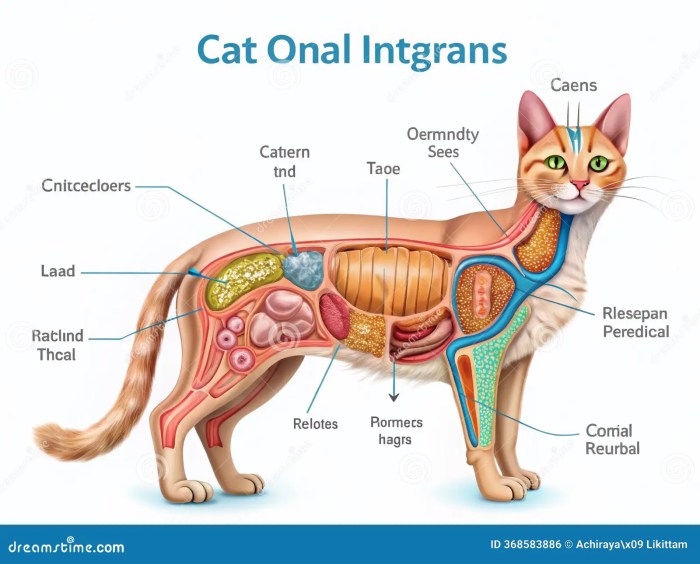
Source: dreamstime.com
The nervous system is the body’s control center, responsible for coordinating all bodily functions. In cats, the brain and spinal cord form the central nervous system, while nerves extend throughout the body. The brain processes sensory information, controls motor movements, and regulates behavior.
Different regions of the brain have specialized functions. The cerebrum is responsible for higher-level thinking and learning, the cerebellum coordinates movement, and the brainstem controls basic life functions like breathing and heart rate. The feline nervous system responds to stimuli through reflexes and complex behavioral patterns.
- Cerebrum: Higher-level thinking, learning, and memory.
- Cerebellum: Coordination of movement and balance.
- Brainstem: Control of basic life functions (breathing, heart rate).
Skeletal and Muscular Systems – Supporting Organs
The skeletal and muscular systems provide support, protection, and movement for the body. The skeletal system forms a framework that protects internal organs, while the muscular system allows for movement. Muscles also play a role in organ function; for example, the diaphragm, a large muscle, is essential for breathing.
The rib cage, a bony structure surrounding the chest cavity, provides crucial protection for the heart and lungs. The vertebral column protects the spinal cord, while the skull protects the brain. The coordinated action of muscles and bones allows cats to perform a wide range of movements, from pouncing on prey to gracefully navigating obstacles.
| Organ Protected | Protective Structure |
|---|---|
| Heart & Lungs | Rib Cage |
| Brain | Skull |
| Spinal Cord | Vertebral Column |
Epilogue
Navigating the intricacies of feline anatomy can feel overwhelming, but hopefully, this journey through a cats organs diagram has shed some light on the remarkable systems that keep our cats thriving. By understanding the location and function of these vital organs, we can become more informed pet parents, better equipped to recognize potential problems and ensure our feline companions live long, healthy, and happy lives.
It’s a testament to the incredible design of nature and a reminder of the importance of preventative care and attentive observation.
Essential Questionnaire
Why are cat kidneys so important?
Cat kidneys are crucial for filtering waste from the blood, regulating blood pressure, and producing hormones. They’re essentially the body’s cleaning crew!
What’s the difference between arteries and veins?
Arteries carry oxygen-rich blood
-away* from the heart, while veins carry oxygen-poor blood
-back* to the heart.
Why do cats have a unique digestive system?
Cats are obligate carnivores, meaning they require meat to thrive. Their digestive system is specifically adapted to efficiently process animal protein and absorb essential nutrients from meat-based diets.
What is the diaphragm’s role in breathing?
The diaphragm is a large muscle that contracts and relaxes to create changes in the chest cavity, allowing air to flow in and out of the lungs during breathing.
How does the liver detoxify the body?
The liver filters toxins from the blood, metabolizes drugs, and breaks down harmful substances, essentially acting as the body’s primary detoxification center.
What are some common endocrine disorders in cats?
Common endocrine disorders include hyperthyroidism (overactive thyroid) and diabetes mellitus (high blood sugar).

