Classic tabby cats – with their swirling, mesmerizing patterns – are instantly recognizable and endlessly captivating. These aren’t just pretty faces; their markings are rooted in fascinating genetics, evolutionary history, and selective breeding practices. We’ll dive deep into what makes a classic tabby unique, exploring the science behind the swirls, the variety of colors, and how these patterns have shaped beloved cat breeds throughout history.
From the agouti gene’s crucial role to the subtle differences between classic, mackerel, and spotted tabbies, this guide will unravel the mysteries of this iconic feline pattern. We’ll also look at how breeders have influenced these markings and how you can identify a classic tabby kitten, even at a young age.
Understanding the Classic Tabby Cat Pattern
Classic tabby cats, with their swirling, mesmerizing markings, are among the most recognizable and beloved feline patterns. But beyond their aesthetic appeal, there’s a fascinating world of genetics and evolution at play. This article dives deep into the classic tabby pattern, exploring its genetic basis, color variations, breed distribution, and much more. Whether you’re a seasoned cat breeder or simply a curious cat lover, you’ll gain a deeper appreciation for these beautiful creatures.
Defining the Classic Tabby Pattern
The classic tabby pattern isn’t just a visual trait; it’s a result of complex genetic interactions. At the heart of it all lies the agouti gene. This gene dictates whether a cat will express its true color or a muted, “tabby” version. When the agouti gene is “on,” it allows for banding patterns – the stripes, swirls, and spots we associate with tabby cats.
Conversely, when the agouti gene is “off,” the cat displays a solid color.
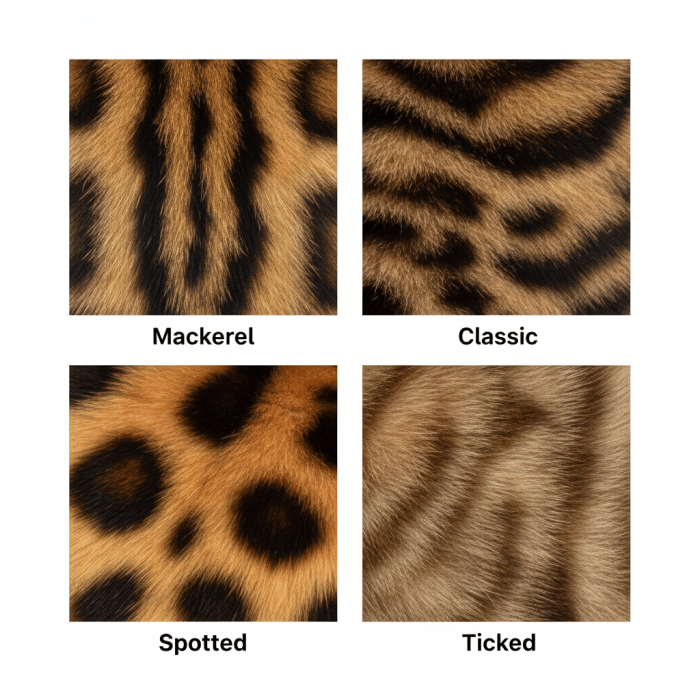
The defining characteristic of the classic tabby is its “swirled” or “marble” pattern. Unlike the straight, parallel stripes of a mackerel tabby, classic tabbies exhibit broad, swirling bands that resemble a marble cake. These swirls are most prominent on the sides of the cat, creating a distinctive and elegant appearance. The pattern is symmetrical, with mirrored markings on each side of the body.
Distinguishing the classic tabby from other tabby patterns requires a keen eye. Mackerel tabbies, also known as tiger stripes, have narrow, parallel stripes running down their sides. Spotted tabbies, as the name suggests, have spots instead of stripes or swirls. Ticked tabbies, like Abyssinians, lack distinct stripes or spots; instead, each hair is banded with different colors, creating a shimmering, agouti effect.
Historically, understanding the genetics of tabby patterns evolved gradually. Early breeders observed these patterns but lacked the tools to understand their underlying causes. The discovery of the agouti gene in the mid-20th century revolutionized our understanding, providing a genetic basis for these variations.
Color Variations within the Classic Tabby Pattern
Source: tabbycatsociety.com
Classic tabby cats come in a stunning array of colors, adding to their visual appeal. The most common colors include brown (often referred to as “seal” or “seal point”), silver, blue (a diluted gray), cream, and red/orange (also known as “ginger” or “marmalade”). The base color is determined by other genes, while the tabby pattern overlays this foundation.
The colorpoint restriction gene plays a significant role in modifying the classic tabby pattern. When this gene is active, it limits pigment production to the extremities – the face, ears, paws, and tail – creating a Himalayan or Birman variation. In these cats, the body is lighter in color than the points, and the tabby markings are often more subtle on the body but prominent on the points.
Dilute genes further expand the color palette. A dilute gene modifies the intensity of the base color, resulting in softer shades. For example, a brown classic tabby becomes a blue classic tabby, and a red classic tabby becomes a cream classic tabby. The interplay of these genes creates a remarkable diversity of classic tabby colors.
| Color Name | Description | Genetic Code | Example Breed |
|---|---|---|---|
| Brown Classic Tabby | Rich, dark brown with swirling markings. | B/b; A/a; Ta/ta | British Shorthair |
| Silver Classic Tabby | Grayish-white with dark gray swirling markings. | B/b; A/a; Ta/ta; Si/si | Persian |
| Blue Classic Tabby | Diluted gray with swirling markings. | d/d; A/a; Ta/ta | Maine Coon |
| Cream Classic Tabby | Diluted red/orange with swirling markings. | d/d; A/a; Ta/ta | Exotic Shorthair |
Breed Distribution of Classic Tabby Patterns
The classic tabby pattern is prevalent in several popular breeds, though its prominence varies. The British Shorthair is perhaps the most iconic classic tabby breed, known for its round face and plush coat. Persians also frequently display the classic tabby pattern, often with a luxurious, long coat. Maine Coons, with their large size and gentle nature, can also exhibit classic tabby markings.
Breeders have played a significant role in shaping the prevalence of the classic tabby pattern. In some breeds, like the British Shorthair, breeders have actively emphasized the pattern, selecting for cats with well-defined swirls and markings. In others, like the Persian, breeders have sometimes de-emphasized the pattern in favor of solid colors or other patterns. This selective breeding has resulted in variations in the intensity and clarity of classic tabby markings across different breeds.
- Highly Prominent: British Shorthair, Persian
- Moderately Common: Maine Coon, Exotic Shorthair
- Occasionally Seen: American Shorthair, Norwegian Forest Cat
Visual Characteristics and Markings
A hallmark of the classic tabby is the distinctive “bullseye” markings on the sides of the body. These are circular or oval markings that resemble targets, with a darker color surrounding a lighter center. The size and shape of the bullseyes can vary, but they are a consistent feature of the pattern.
Facial markings are also characteristic of classic tabbies. Most have a prominent “M” marking on their forehead, a defining feature of all tabby patterns. However, the surrounding markings can vary. Some have bold stripes extending from the “M,” while others have more subtle swirls or patches. The eyes are often framed by dark markings, enhancing their expressiveness.
Leg and paw markings typically consist of darker bands or swirls that wrap around the legs. The paws often have darker markings on the tops and sides, creating a visually appealing contrast. The tail usually has rings or bands of darker color, continuing the swirling pattern.
Imagine a cat with a silver classic tabby pattern. Its coat is a soft, silvery gray, overlaid with swirling markings in a darker shade of gray. The sides of its body are adorned with prominent bullseye markings, creating a mesmerizing effect. A dark “M” is clearly visible on its forehead, and its eyes are framed by dark markings that accentuate their golden hue.
The legs and tail are marked with rings of darker gray, completing the classic tabby look.
Distinguishing Classic Tabby from Other Patterns
The key difference between a classic tabby and a mackerel tabby lies in the arrangement of the markings. Classic tabbies have swirling, marble-like patterns, while mackerel tabbies have straight, parallel stripes. Think of it this way: classic tabbies resemble a marble cake, while mackerel tabbies resemble a tiger’s stripes.
Differentiating a classic tabby from a spotted tabby is relatively straightforward. Spotted tabbies have distinct spots, whereas classic tabbies have swirls. The spots in a spotted tabby can vary in size and shape, but they are always clearly defined.
Ticked tabbies, like Abyssinians, present a different challenge. They lack the distinct stripes or swirls of classic and mackerel tabbies. Instead, each hair is banded with different colors, creating a shimmering, agouti effect. This pattern is more subtle and requires a closer examination to appreciate.
Classic Tabby: Swirling, marble-like patterns.
Mackerel Tabby: Straight, parallel stripes.
Spotted Tabby: Distinct spots.
Ticked Tabby: Banded hairs, no distinct stripes or spots.
Genetic Interactions and Rare Variations
The presence of white spotting genes can significantly modify the classic tabby pattern. These genes can create patches of white fur, interrupting the swirling markings and creating a “patched tabby” appearance. The amount of white can vary from small patches on the paws to extensive white markings covering a large portion of the body.
Torbie patterns, a combination of tortoiseshell and tabby markings, can arise from the classic tabby pattern. This occurs when a cat inherits both the tabby gene and the genes responsible for tortoiseshell coloration (red and black). The result is a cat with a mix of red, black, and tabby markings.
Rare variations and mutations affecting the classic tabby pattern are occasionally observed. These can include unusual swirling patterns, altered color intensities, or even the complete absence of markings in certain areas. While these variations are uncommon, they highlight the complexity of feline genetics.
Patched tabby patterns arise from the interaction of the tabby gene with white spotting genes. The white spotting genes interrupt the tabby pattern, creating patches of solid color interspersed with the swirling markings. The size and distribution of these patches can vary greatly.
The Role of the Tabby Gene in Cat Evolution
The tabby pattern is believed to be the ancestral pattern in domestic cats, dating back to their wild ancestors. All domestic cats carry the tabby gene, although it may be masked by other genes. The tabby pattern is thought to have originated in wild cats as a form of camouflage, helping them blend in with their surroundings.
The potential functions of tabby markings extend beyond camouflage. Some researchers believe that tabby markings may also play a role in communication, helping cats recognize each other and establish social hierarchies. The specific patterns and colors may convey information about a cat’s age, sex, or health.
Selective breeding has preserved and modified the tabby pattern in domestic cats. Breeders have selected for cats with specific tabby patterns and colors, resulting in the diverse range of tabby variations we see today. The tabby pattern remains a fundamental aspect of feline appearance and genetics.
- Early Cats (Thousands of Years Ago): Tabby pattern prevalent in wild ancestors.
- Ancient Egypt (3000 BC – 30 BC): Tabby patterns depicted in art and revered as sacred.
- Medieval Europe (5th – 15th Centuries): Tabby patterns common in domestic cats.
- Modern Era (20th Century – Present): Selective breeding intensifies and diversifies tabby patterns in various breeds.
Identifying Classic Tabby Patterns in Kittens
Tabby markings typically begin to develop in kittens around 2-3 weeks of age. Initially, the markings are faint and indistinct, but they gradually become more pronounced as the kitten grows. The agouti gene starts to influence hair banding during this period.
Identifying the classic tabby pattern in young kittens can be challenging, but it’s possible to look for subtle clues. Even before the full markings are visible, you may notice faint swirls or bands on the sides of the kitten’s body. The “M” marking on the forehead is usually present early on, although it may be less distinct.
The intensity and clarity of tabby markings can be influenced by several factors, including genetics, nutrition, and temperature. Kittens that are well-nourished and kept in a warm environment tend to develop more vibrant and distinct markings.
| Age Range | Markings Visible | Description | Potential Variations |
|---|---|---|---|
| 2-3 Weeks | Faint swirls/bands | Subtle markings, often difficult to discern. | Markings may be very light or almost invisible. |
| 4-6 Weeks | “M” marking, faint bullseyes | “M” marking becomes more visible. Bullseyes start to appear. | Bullseyes may be incomplete or irregularly shaped. |
| 8-12 Weeks | More defined swirls, stripes | Markings become clearer and more distinct. | Color intensity may still be developing. |
| Adult | Full classic tabby pattern | Well-defined swirls, bullseyes, and facial markings. | Markings may vary in intensity and clarity depending on genetics and coat type. |
Classic Tabby Pattern and Coat Length
The classic tabby pattern is observed in cats with short, medium, and long coats. The pattern itself doesn’t change based on coat length; it’s the visual presentation that differs.
In cats with short coats, the swirling markings are typically more visible and defined. In cats with long coats, the markings may appear softer and more blended due to the length and density of the fur. The swirling pattern is still present, but it’s less distinct.
Grooming practices can affect the visibility of classic tabby markings. Regular brushing helps to remove loose fur and prevent matting, allowing the markings to shine through. Neglecting grooming can obscure the markings, making them appear less defined.
Imagine a British Shorthair with a classic tabby pattern and a short coat. The swirling markings are crisp and clear, creating a striking visual contrast. Now picture a Persian with the same pattern and a long, flowing coat. The markings are softer and more blended, creating a more subtle and elegant appearance.
Classic Tabby Pattern and Eye Color
Classic tabby cats are commonly associated with gold, green, and hazel eye colors. These eye colors complement the warm tones often found in classic tabby markings.
Eye color can either complement or contrast with the classic tabby markings. For example, a brown classic tabby with gold eyes creates a harmonious and warm appearance. Conversely, a silver classic tabby with blue eyes creates a striking and contrasting look.
There are some correlations between specific classic tabby colors and eye color. Brown classic tabbies are more likely to have gold or green eyes, while silver classic tabbies are more likely to have green or hazel eyes. However, these are just general trends, and there can be exceptions.
- Brown Classic Tabby – Gold/Green Eyes
- Silver Classic Tabby – Green/Hazel Eyes
- Blue Classic Tabby – Green/Yellow Eyes
- Cream Classic Tabby – Gold/Amber Eyes
Wrap-Up
The classic tabby pattern is more than just a visual delight; it’s a testament to the intricate interplay of genetics and evolution. Whether you’re a seasoned cat enthusiast or simply curious about the beautiful markings on your feline friend, understanding the classic tabby pattern offers a deeper appreciation for the wonders of the cat world. From their evolutionary origins to the subtle nuances of color and coat length, these cats truly embody a timeless elegance.
So, next time you admire a cat with those distinctive swirling markings, remember the fascinating story behind the classic tabby pattern – a story written in genes and etched in fur.
FAQ Compilation
Why are tabby patterns so common in cats?
Tabby patterns are genetically dominant, meaning they’re very likely to appear in cats, regardless of their breed. They’re also thought to be an ancient trait, present in the wild ancestors of domestic cats.
Can a solid-colored cat suddenly produce tabby kittens?
Yes! If a solid-colored cat carries the recessive tabby gene, it can pass it on to its kittens. The kittens might display a tabby pattern if they inherit the gene from both parents.
What does “agouti” mean in relation to tabby patterns?
The agouti gene controls whether a cat’s hair shaft is banded (agouti) or solid. Agouti cats have banded hairs, which is essential for creating tabby patterns. Without it, cats would be solid-colored.
What is a “torbie” cat?
A torbie (tortoiseshell tabby) is a cat with both tortoiseshell (patches of black and orange) and tabby markings. It’s a fascinating combination resulting from specific genetic interactions.
How can I tell if a kitten will be a classic tabby?
Even young kittens often show hints of their tabby pattern. Look for faint markings, especially an “M” shape on their forehead. As they grow, the markings will become more defined.
Do different eye colors affect the appearance of the classic tabby pattern?
While not a strict rule, certain eye colors often complement classic tabby patterns. For example, gold or green eyes are frequently seen in brown classic tabbies, while blue eyes can create a striking contrast with silver classic tabbies.

