There’s something undeniably charming about a cat with a uniquely textured coat – and the world of curly-haired cat breeds is full of them! From the iconic Devon Rex with its pixie-like appearance to the Selkirk Rex’s plush, poodle-like curls, these felines are captivating. But their adorable looks aren’t just a matter of chance; they’re the result of fascinating genetic mutations that have shaped their evolution.
Let’s dive into the history, characteristics, and care of these wonderfully unique companions.
The curly coat phenomenon in cats stems from naturally occurring genetic mutations. Essentially, a gene disrupts the normal formation of hair, causing it to curl instead of lying flat. It’s a bit like a tiny, internal hair stylist working overtime! These mutations aren’t new; they’ve popped up sporadically throughout history, but it wasn’t until relatively recently that breeders began to intentionally cultivate these traits, leading to the distinct breeds we know and love today.
Understanding this genetic basis is key to appreciating the beauty and potential health considerations of these special cats.
Introduction to Curly-Haired Cats
Curly-haired cats are a captivating breed group, instantly recognizable for their unique, often whimsical, coat textures. They’ve steadily gained popularity among cat lovers seeking something a little different from the standard short or long-haired feline. From the playful Devon Rex to the regal Selkirk Rex, these breeds offer a delightful combination of charm and distinctive appearance. This article will delve into the fascinating world of curly-haired cats, exploring their genetics, history, and the specific characteristics of some of the most beloved breeds.
The curly coat isn’t a result of a single gene, but rather a complex interplay of genetic mutations. The most common mutation involves a recessive gene that affects the hair follicle structure. Normally, hair grows straight out from the follicle. In curly-haired cats, this gene causes the follicle to be misshapen, often curved or looped. This altered shape results in the hair growing in a spiral or wave, creating the characteristic curl.
Different breeds have different versions of this gene, leading to variations in curl tightness and overall coat appearance. It’s a fascinating example of how genetics can dramatically alter a physical trait.
The history of curly-haired cats is relatively recent, with most breeds emerging in the mid-20th century. While anecdotal accounts of cats with unusual coats have existed for centuries, the deliberate breeding and development of these breeds began more recently. The Devon Rex, for example, was discovered in England in 1950, while the Selkirk Rex emerged in Montana in 1987. These discoveries sparked interest in breeding programs aimed at stabilizing and refining the curly coat trait, leading to the breeds we know and love today.
Devon Rex: The Classic Curly Cat
Breed Standard and Physical Characteristics
The Devon Rex is perhaps the most well-known curly-haired cat breed, and its breed standard reflects its distinctive appearance. They have a slender, lithe body with long legs and large ears that often extend beyond the head. Their defining feature, of course, is their coat – a loose, wavy, and often sparse covering that feels remarkably soft to the touch.
The curls are generally not tight, but rather a gentle wave. Devon Rex cats have large, expressive eyes and a distinctive “elfin” face due to their prominent cheekbones and slightly upturned nose. Their tails are long and whip-like, also exhibiting a gentle wave.
History of the Devon Rex
The Devon Rex’s story began in 1950 on a farm in Cornwall, England. A barn cat named Prudence gave birth to a litter of kittens, one of which, named Kallibunker, possessed an unusual curly coat. Kallibunker became the foundation of the Devon Rex breed, and breeders began selectively breeding him and his offspring to establish and refine the curly coat trait.
The breed faced challenges in its early years, including a feline parovirus outbreak that nearly wiped out the population. However, dedicated breeders persevered, and the Devon Rex eventually gained recognition as a distinct breed.
Personality and Temperament
Devon Rex cats are renowned for their playful, mischievous, and affectionate personalities. They are often described as “pixie-like” due to their energetic and inquisitive nature. They are highly intelligent and enjoy interactive games and puzzles. Devon Rex cats are known to be very people-oriented and thrive on human companionship, often following their owners around and seeking attention. Compared to breeds like Persians, which are often more reserved, Devon Rex cats are significantly more active and outgoing.
They are also known for their vocalizations, often “chatting” with their owners.
Devon Rex Characteristics
| Characteristic | Description | Value |
|---|---|---|
| Coat Length | Short to Medium | Short to Medium |
| Weight Range | Male: 8-12 lbs, Female: 5-8 lbs | 8-12 lbs (Male), 5-8 lbs (Female) |
| Lifespan | 11-15 years | 11-15 years |
| Common Health Concerns | Hypertrophic Cardiomyopathy (HCM), Luxating Patella | HCM, Luxating Patella |
Cornish Rex: A Close Relative
Differences Between Devon Rex and Cornish Rex
While both the Devon Rex and Cornish Rex share the characteristic curly coat, there are key differences in their appearance and genetics. The Cornish Rex has a tighter, wavier curl than the Devon Rex, often described as a “ripple” effect. Their body structure is also different; Cornish Rex cats are generally more slender and have longer legs and larger ears than Devon Rexes.
Genetically, the curly coat trait in these two breeds is caused by different mutations on different genes. This explains why they don’t interbreed to produce fertile offspring.
History of the Cornish Rex
The Cornish Rex breed also originated in Cornwall, England, but in 1950, independently of the Devon Rex. A barn cat named Roman gave birth to a litter containing a kitten with a unique curly coat. This kitten, named Kallibos, was the ancestor of the Cornish Rex breed. Breeders carefully selected and bred Kallibos’s descendants to establish the breed’s distinctive characteristics.
Like the Devon Rex, the Cornish Rex faced challenges in its early development, but dedicated breeders ensured its survival and recognition.
Distinctive Physical Traits
Beyond their curly coat, Cornish Rex cats are known for their elegant and athletic build. Their long legs allow for impressive leaps and bounds, and their large ears contribute to their alert and inquisitive expression. They have a refined head shape with a slightly Roman nose and large, oval eyes. Their coat is incredibly soft and fine, feeling almost like velvet to the touch.
The lack of an undercoat makes them particularly sensitive to temperature changes.
Grooming Requirements
- Brushing: Cornish Rex cats require minimal brushing, typically once or twice a week. Due to their lack of an undercoat, they don’t shed as much as other breeds.
- Bathing: Bathing is generally only needed every few months, or as needed if the cat becomes dirty. Use a mild, cat-specific shampoo.
- Drying: Thoroughly dry the cat after bathing to prevent chills. A towel and a low-heat hairdryer can be used.
- Coat Maintenance: Regular inspection of the coat is important to identify any mats or tangles, although these are rare.
Selkirk Rex: The “Poodle Cat”
Unique Curly Coat
The Selkirk Rex is instantly recognizable for its plush, curly coat, often likened to a Poodle’s fur. Unlike the tighter curls of the Devon or Cornish Rex, the Selkirk Rex’s curls are looser and more voluminous. The curl tightness can vary significantly, with some cats having very tight curls and others having a more relaxed wave. The coat is also exceptionally soft and dense, giving the cat a teddy bear-like appearance.
Breed History
The Selkirk Rex’s story is one of accidental discovery. In 1987, a shelter worker in Montana rescued a pregnant cat named Miss DePesto. One of her kittens, named Curly, had a distinctive curly coat. Breeders recognized the potential of this unique trait and began selectively breeding Curly’s offspring, establishing the Selkirk Rex breed. The breed’s name honors Jeri Newman, a breeder who played a crucial role in its development.
Temperament and Suitability as a Family Pet
Selkirk Rex cats are known for their gentle, affectionate, and laid-back personalities. They are generally good-natured and tolerant, making them excellent family pets. They enjoy human companionship and are often described as “easygoing.” While they are playful, they are not as hyperactive as some other breeds. Their calm demeanor and affectionate nature make them well-suited for households with children and other pets.
Coat Changes with Age and Season
The Selkirk Rex’s coat can change in appearance with age and seasonal variations. Kittens often have tighter curls, which tend to loosen as they mature. During the winter months, the coat may become thicker and curlier to provide insulation. In the summer, the coat may thin out slightly and the curls may become less pronounced. These changes are a natural response to environmental factors and are not cause for concern.
American Curl: The Ears and the Coat
Interaction of Ears and Coat
The American Curl is best known for its distinctive curled ears, which are the defining characteristic of the breed. While not all American Curls have a curly coat, many do exhibit a gentle wave or curl to their fur, complementing their unique ear shape. The degree of curl in both the ears and the coat can vary significantly from cat to cat, adding to the breed’s individual charm.
Origin Story and Breed Development
The American Curl’s story began in 1981 when a stray, longhaired cat gave birth to a litter of kittens in California. One of the kittens, named Shulamith, had ears that curled backward. Her owner, Joe Fragale, recognized the uniqueness of this trait and began breeding Shulamith with other cats. The resulting kittens often inherited the curled ear trait, and the American Curl breed was established.
The breed was officially recognized by the Cat Fanciers’ Association (CFA) in 1995.
Personality Compared to Other Breeds
American Curl cats are known for their affectionate, gentle, and playful personalities. They are often described as “dog-like” in their loyalty and willingness to follow their owners around. They are generally good-natured and tolerant, making them excellent companions for families and individuals alike. Their affectionate nature is comparable to breeds like Ragdolls and Burmese, although they tend to be slightly more active.
Ear Curl Types
| Curl Type | Description |
|---|---|
| Set | Ears curve gently backward, forming a soft arc. |
| Single | Ears curl backward in a single, distinct curve. |
| Tight | Ears curl tightly backward, almost touching the head. |
Genetic Considerations & Health
Like all breeds, curly-haired cats are predisposed to certain health concerns. Hypertrophic Cardiomyopathy (HCM), a heart condition, is a particular concern in Devon Rex and Cornish Rex breeds. Responsible breeders screen their cats for HCM and other genetic conditions to minimize the risk of passing these traits on to their kittens. Regular veterinary checkups are essential for maintaining the health and well-being of curly-haired cats.
The inheritance patterns of curly coats in cats are complex and not fully understood. However, it is generally believed that the curly coat trait is caused by recessive genes. This means that a cat must inherit two copies of the mutated gene (one from each parent) to exhibit the curly coat phenotype. Carriers of the gene (those with only one copy) will not have a curly coat but can pass the gene on to their offspring.
Genetic testing is crucial for breeders of curly-haired cats. It allows them to identify carriers of genetic diseases and make informed breeding decisions to minimize the risk of producing affected kittens. Responsible breeders prioritize the health and well-being of their cats above all else.
Caring for a Curly-Haired Cat
Grooming Tips
Maintaining a curly coat requires specific grooming techniques. Regular brushing, typically 2-3 times a week, helps to prevent mats and tangles. Use a soft-bristled brush or a grooming glove. Bathing is generally only needed every few months, unless the cat becomes particularly dirty. When bathing, use a mild, cat-specific shampoo and rinse thoroughly.
After bathing, dry the cat completely to prevent chills.
Dietary Needs
A high-quality diet is essential for supporting coat health and overall well-being. Look for cat food that is rich in omega-3 and omega-6 fatty acids, which promote healthy skin and a shiny coat. A balanced diet also provides the nutrients necessary for maintaining overall health and vitality.
Environmental Factors
Humidity and temperature can affect a curly-haired cat’s coat. In dry environments, the coat may become brittle and prone to static. In humid environments, the coat may become limp and heavy. Maintaining a comfortable and consistent environment can help to minimize these effects.
Devon Rex Grooming Routine Flowchart
- Weekly: Brush coat gently with a soft-bristled brush.
- Bi-Weekly: Check for mats and tangles, paying attention to areas behind the ears and under the legs.
- Monthly: Bathe as needed with a mild, cat-specific shampoo.
- After Bath: Thoroughly dry the cat with a towel and a low-heat hairdryer.
- Yearly: Veterinary checkup, including HCM screening.
Finding a Curly-Haired Cat
Locating a reputable breeder of curly-haired cat breeds is essential for ensuring you acquire a healthy and well-socialized kitten. Look for breeders who are registered with recognized cat associations and who prioritize the health and temperament of their cats. Visit the breeder’s cattery and meet the parent cats to assess their health and personality.
Adopting a curly-haired cat from a shelter or rescue organization can be a rewarding experience. While purebred curly-haired cats are less common in shelters, you may find a mixed-breed cat with a curly coat who is in need of a loving home. Adoption offers a second chance for a deserving cat and can be a more affordable option than purchasing a kitten from a breeder.
Questions to Ask a Breeder
- What health screenings do you perform on your breeding cats?
- Can I meet the parent cats?
- What is your kitten socialization program?
- Do you offer a health guarantee?
- What is your return policy if I am unable to care for the kitten?
Resources: The Cat Fanciers’ Association (CFA), The International Cat Association (TICA), Breed-specific online forums and social media groups.
Visual Descriptions for Illustrations
Imagine a Devon Rex kitten, no older than a few months, playfully batting at a feather toy. Its curly fur is a soft, silvery-gray, and the texture is clearly visible as it moves. The kitten’s large, expressive eyes are a bright emerald green, filled with curiosity and mischief. The overall impression is one of playful energy and undeniable charm.
Picture a Selkirk Rex curled up asleep on a plush, cream-colored blanket. The cat’s coat is incredibly dense and soft, with tight, luxurious curls that create a fluffy, teddy bear-like appearance. The blanket accentuates the softness of the fur, and the cat’s relaxed posture conveys a sense of contentment and peace.
Envision an American Curl gracefully leaping onto a cat tree. The unique curve of its ears is clearly visible as it arches its back, and the sleekness of its fur contrasts beautifully with the textured bark of the tree. The cat’s posture is elegant and athletic, showcasing its agility and grace.
Visualize a Cornish Rex meticulously grooming itself. The fine, wavy texture of its coat is clearly visible as it licks its paw and carefully cleans its fur. Its posture is elegant and refined, reflecting the breed’s inherent grace and sophistication.
Ultimate Conclusion
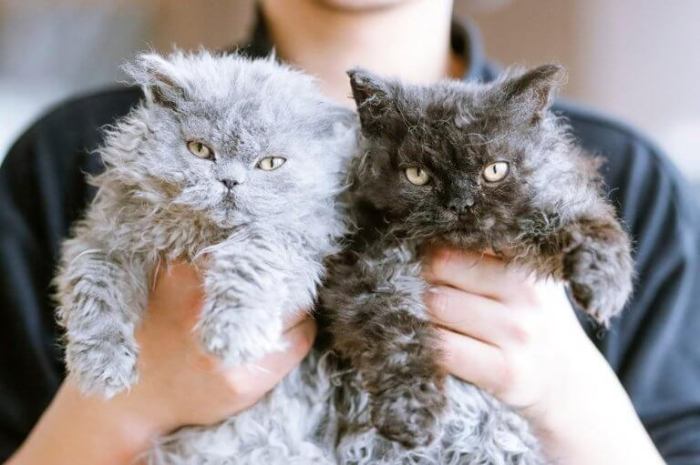
Source: cats.com
Exploring the world of curly-haired cat breeds reveals a delightful blend of history, genetics, and personality. Whether you’re drawn to the Devon Rex’s mischievous charm, the Cornish Rex’s sleek elegance, the Selkirk Rex’s cuddly softness, or the American Curl’s distinctive ears, there’s a curly-coated feline out there to steal your heart. With proper care and understanding of their unique needs, these breeds can bring years of joy and playful companionship to your home.
Ultimately, owning a curly-haired cat is a rewarding experience, but it’s important to be prepared for the specific grooming and health considerations that come with these breeds. By doing your research and choosing a reputable breeder or rescue, you can ensure a happy and healthy life for your new furry friend.
Key Questions Answered
Are curly-haired cats hypoallergenic?
While no cat is truly hypoallergenic, curly-haired cats often produce less Fel d 1, the primary allergen, which can result in fewer allergy symptoms for some people. However, individual reactions vary.
Do curly-haired cats require special grooming?
Yes, they do! While their coats don’t mat like long-haired cats, regular brushing (1-2 times a week) is important to remove loose hair and distribute natural oils. Bathing is typically needed less frequently, perhaps every few months.
What is HCM and why is it a concern in these breeds?
Hypertrophic cardiomyopathy (HCM) is a heart condition where the heart muscle thickens. It’s a genetic predisposition that can affect several cat breeds, including Devon Rex and Cornish Rex. Responsible breeders screen for HCM to minimize the risk.
Can I adopt a curly-haired cat from a shelter?
It’s less common, but possible! Shelters and rescues sometimes receive curly-haired cats. Be prepared to be patient and persistent in your search.
What’s the difference between a Devon Rex and a Cornish Rex?
While both have curly coats, Devon Rexes have looser, wavier curls and a more slender build, while Cornish Rexes have tighter, more defined curls and a more athletic physique.
How much do curly-haired cat breeds typically cost?
Prices vary widely depending on the breed, breeder reputation, and kitten’s lineage. Expect to pay anywhere from $800 to $3000 or more for a kitten from a reputable breeder.

