The mackerel striped cat, instantly recognizable by its distinctive “tiger stripes,” holds a fascinating place in feline history and genetics. From ancient art to modern breeds, this pattern has captivated humans for centuries. We’ll delve into the origins of this striking coat, explore the science behind it, and uncover the unique characteristics that make these cats so special. It’s more than just a pretty pattern; it’s a window into the complex world of cat genetics and evolution.
This exploration will cover everything from the historical prevalence of mackerel tabbies across different cultures and their connection to wild ancestors, to the intricate genetic mechanisms that dictate the stripe pattern itself. We’ll also look at how this pattern manifests in various breeds, the different color combinations possible, and even touch on health considerations and care tips for these beautiful felines.
Origins and History of Striped Mackerel Cats
The mesmerizing stripes of a mackerel tabby cat have captivated humans for centuries. This isn’t just a random pattern; it’s a deeply ingrained characteristic with a fascinating history intertwined with the evolution of domestic cats and their wild ancestors. Understanding the origins of this pattern provides a glimpse into the genetic heritage of our feline companions.The mackerel tabby pattern, characterized by its narrow, parallel stripes resembling a fish’s scales, is remarkably prevalent in domestic cats.
It’s one of the most common tabby patterns, appearing across numerous breeds and mixed breeds worldwide. Its widespread distribution suggests a long history of presence in the domestic cat gene pool, likely stemming from early domestication processes.Early depictions of cats, particularly in ancient Egyptian art and literature, frequently showcase animals exhibiting tabby patterns, including the mackerel variety. Wall paintings, sculptures, and hieroglyphs often portray cats with striped coats, indicating their significance and recognition as a distinct characteristic.
Similarly, in medieval European tapestries and illuminated manuscripts, tabby cats are frequently illustrated, demonstrating the pattern’s continued presence and appreciation throughout history. These artistic representations offer valuable insights into how humans perceived and valued cats with this distinctive coat pattern.Historically, mackerel tabby cats have been found across a broad geographical range, from Europe and Asia to Africa and the Americas.
Their adaptability and prevalence suggest they thrived alongside humans in various environments. The pattern’s presence in feral cat populations worldwide further supports its ancient origins and widespread distribution.The mackerel tabby pattern likely has deep roots in the genetics of wild cat ancestors. The African wildcat (Felis lybica), a primary ancestor of the domestic cat, exhibits a similar striped pattern.
This suggests that the genetic basis for the mackerel tabby pattern was already present in the wildcat population and was subsequently inherited by early domestic cats. Further genetic research continues to refine our understanding of this evolutionary connection.
Genetics of the Mackerel Tabby Pattern
Source: alamy.com
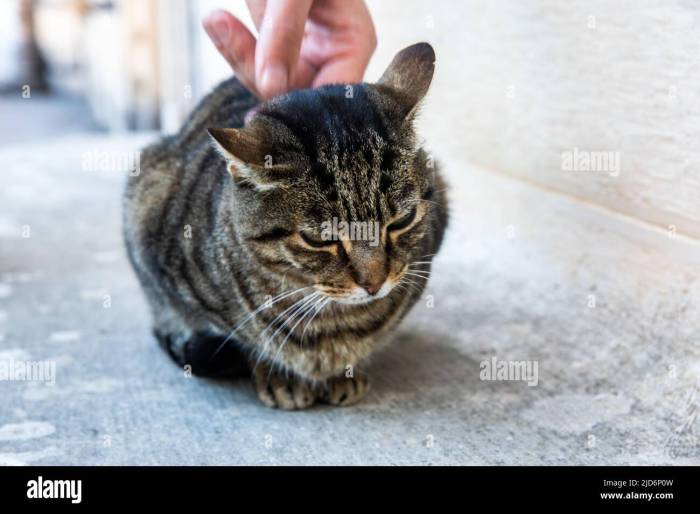
The striking mackerel tabby pattern isn’t just a matter of chance; it’s governed by specific genes and their interactions. Understanding these genetic mechanisms allows us to appreciate the complexity behind this beautiful coat pattern.The Agouti gene (A) plays a pivotal role in determining whether a cat will express a tabby pattern at all. This gene controls the distribution of pigment within individual hairs, creating bands of color.
Without the Agouti gene being expressed, a cat will typically have a solid color coat.The Agouti gene has several different alleles, each influencing the resulting coat pattern. A^w (wide band) produces a patched tabby pattern, A^t (typical tabby) results in the classic tabby pattern, A (dominant) allows for tabby patterns to be expressed, and at (non-agouti) leads to solid or smoke colors.
The presence and specific combination of these alleles significantly impact the final coat appearance.The Tabby S gene (TS) is crucial for the expression of the mackerel pattern. It acts in conjunction with the Agouti gene to create the characteristic narrow stripes. Without the Tabby S gene, even with the appropriate Agouti allele, a cat will not display a mackerel tabby pattern.The “ticked” appearance often seen in mackerel tabbies arises from the way the Agouti gene affects pigment distribution.
Each hair shaft has alternating bands of light and dark pigment, creating a shimmering, ticked effect. This is particularly noticeable in silver mackerel tabbies.
| Genotype | Pattern Description | Example Color | Notes |
|---|---|---|---|
| A^w A^w | Patched Tabby (Torbie) | Tortoiseshell with tabby markings | Female only (typically) |
| A^t A^t | Classic Tabby | Brown with swirling patterns | “Blotched” tabby pattern |
| A A^t | Tabby (Mackerel or Classic) | Silver tabby with narrow stripes | Dominant Agouti allele |
| at at | Solid or Smoke | Black | No tabby pattern expressed |
Variations within the Mackerel Tabby Pattern
While the core characteristic of the mackerel tabby pattern is the presence of narrow, parallel stripes, there’s a surprising degree of variation within this pattern. These variations are influenced by other genes and random genetic factors, resulting in a diverse range of appearances.The width of the stripes can vary considerably, ranging from very narrow, almost pencil-like lines to slightly wider, more defined stripes.
Some cats exhibit a swirling or wavelike pattern within the stripes, adding a unique visual element.The intensity of the stripes can also differ significantly. Some mackerel tabbies have bold, dark stripes that contrast sharply with the background color, while others have more subtle, muted stripes. This variation is often influenced by the cat’s overall coat color and the presence of other modifying genes.Other genes, such as the dilution gene (D), can significantly alter the appearance of the mackerel tabby pattern.
The dilution gene reduces the intensity of pigment, resulting in lighter shades. For example, a brown mackerel tabby might become a blue (gray) mackerel tabby due to the dilution gene.Mackerel tabbies are distinguished from classic tabbies by the arrangement of their stripes. Mackerel tabbies have narrow, parallel stripes running vertically down the body, while classic tabbies have swirling, blotched patterns.
The difference lies in the expression of the Tabby S gene and the specific Agouti allele present.Imagine a mackerel tabby: Picture long, thin, parallel stripes running from the shoulders down the sides, like the scales on a fish. Now, envision a classic tabby: Instead of stripes, picture swirling, marble-like patterns, often resembling a bullseye on the sides. The key difference is the direction and arrangement of the markings.
Mackerel Tabby Patterns in Different Cat Breeds
The mackerel tabby pattern isn’t limited to a single breed; it appears in a wide variety of cat breeds, each showcasing the pattern in its own unique way.The Abyssinian breed is renowned for its stunning mackerel tabby coats. The “ticked” appearance is particularly pronounced in Abyssinians, creating a shimmering, agouti effect. Their coats often display a warm, ruddy brown color with dark, well-defined stripes.The Somali breed, often referred to as the “Abyssinian longhair,” also exhibits the mackerel tabby pattern.
The longer fur accentuates the ticked appearance, giving the Somali a particularly luxurious and striking look.The Bengal breed, known for its wild appearance, frequently displays the mackerel tabby pattern, often in the form of rosettes. Rosettes are larger, more rounded markings that resemble miniature leopard spots, a result of a modified Tabby S gene.Maine Coons and American Shorthairs can also display the mackerel tabby pattern, although it’s less common than in breeds like Abyssinians and Somalis.
In these breeds, the pattern tends to be more subtle and blended with the overall coat color.Here’s a list of cat breeds commonly exhibiting the mackerel tabby pattern:
- Abyssinian: Distinctive ticked appearance with narrow, well-defined stripes.
- Somali: Similar to the Abyssinian, but with longer fur.
- Bengal: Often displays rosettes instead of traditional stripes.
- Maine Coon: More subtle mackerel tabby pattern, often blended with other markings.
- American Shorthair: Can exhibit a mackerel tabby pattern, particularly in silver and brown varieties.
- Egyptian Mau: Characterized by unique spot patterns, but can also display a mackerel tabby pattern.
Coat Colors and Mackerel Tabby Combinations
The mackerel tabby pattern isn’t limited to a single color; it combines beautifully with a wide range of coat colors, creating a stunning array of variations.Common coat colors found in mackerel tabby cats include brown (or seal), silver, blue (gray), and red (orange). Each of these colors takes on a unique character when combined with the mackerel tabby pattern.The dilution gene plays a significant role in creating different shades.
For example, a brown mackerel tabby can become a blue (gray) mackerel tabby, while a red mackerel tabby can become a cream mackerel tabby.Chocolate, lilac, cinnamon, and fawn mackerel tabbies are less common but equally captivating. These colors result from specific modifications to the base pigment, creating softer, more muted tones.The orange gene (O) interacts with the mackerel tabby pattern to produce orange mackerel tabbies.
These cats have a predominantly orange coat with distinct mackerel stripes.
| Base Color | Mackerel Tabby Variation | Description |
|---|---|---|
| Brown | Brown Mackerel Tabby | Rich brown coat with dark brown stripes. |
| Silver | Silver Mackerel Tabby | Silver-gray coat with dark gray stripes, often with a shimmering effect. |
| Blue (Gray) | Blue Mackerel Tabby | Gray coat with darker gray stripes. |
| Red (Orange) | Orange Mackerel Tabby | Orange coat with darker orange stripes. |
Health Considerations Related to Mackerel Tabby Cats
The mackerel tabby pattern itself isn’t directly linked to any specific health conditions. However, certain breeds that commonly display the mackerel tabby pattern are predisposed to particular health concerns.Breeds like Abyssinians and Somalis are known to be susceptible to conditions such as pyruvate kinase deficiency (PKD), a genetic disorder affecting red blood cells, and progressive retinal atrophy (PRA), a degenerative eye disease.
Responsible breeders screen their cats for these conditions to minimize the risk of transmission.Responsible breeding practices are crucial for minimizing genetic health issues in all cat breeds, regardless of coat pattern. This includes careful selection of breeding pairs, genetic testing, and thorough health evaluations.Preventative care measures, such as regular veterinary checkups, vaccinations, parasite control, and a balanced diet, are essential for maintaining the health and well-being of all cats, regardless of their coat pattern.
Maintaining the health of your mackerel tabby cat involves regular veterinary checkups, a nutritious diet, and preventative care measures. Responsible breeding practices within specific breeds are also vital for minimizing the risk of genetic health issues.
Final Thoughts
Ultimately, the mackerel striped cat represents a beautiful intersection of genetics, history, and feline charm. Understanding the science behind their stripes, appreciating their diverse appearances across breeds, and providing them with the proper care allows us to truly appreciate these captivating creatures. Whether you’re a seasoned cat enthusiast or simply curious about the world of feline patterns, the mackerel tabby offers a wealth of fascinating insights and a whole lot of visual appeal.
So, next time you encounter a cat sporting those classic tiger stripes, remember the rich history and complex genetics that contribute to its unique beauty. It’s a testament to the incredible diversity and wonder of the feline world.
Commonly Asked Questions
Why are they called “mackerel” tabbies?
The name comes from the resemblance of the stripes to the markings of a mackerel fish – narrow, parallel lines running down the body.
Can all cats have a mackerel tabby pattern?
Not all cats can, it’s determined by specific genes. However, the potential for the pattern is present in most cat populations.
What’s the difference between a mackerel and a classic tabby?
Mackerel tabbies have narrow, parallel stripes, while classic tabbies have swirling, blotched patterns. Think of mackerel as “tiger stripes” and classic as “marble swirls.”
Do mackerel tabbies have any specific personality traits?
While not definitively proven, many owners report that mackerel tabbies are often energetic, playful, and intelligent cats.
Is the “ticked” appearance unique to mackerel tabbies?
No, but it’s a prominent feature. The “ticked” appearance, where individual hairs have bands of color, is a result of the Agouti gene and is more noticeable in mackerel tabbies.
Are there any health concerns specific to breeds with mackerel tabby patterns?
Certain breeds like Abyssinians and Somalis, which commonly display the pattern, are predisposed to specific health issues. Responsible breeding practices are crucial to minimize these risks.

