There’s something undeniably captivating about a cat sporting the bold, striking stripes of a mackerel tabby. These aren’t just random markings; they’re a fascinating display of genetics, history, and breed-specific characteristics. From the classic “tiger stripe” look to the subtle variations in color and pattern, mackerel tabbies offer a visual feast for cat lovers. This guide dives deep into everything you need to know about these gorgeous felines, exploring their genetics, common breeds, health considerations, and even a bit of their history.
We’ll explore the science behind the pattern, looking at how the Agouti gene plays a crucial role in creating those distinctive stripes. You’ll discover which breeds are most likely to showcase this pattern, and how it manifests differently in each. Plus, we’ll cover essential care tips to keep your mackerel tabby kitten or adult cat happy and healthy, from grooming to diet and recognizing potential health concerns.
Understanding the Enchanting Mackerel Tabby Cat
The mackerel tabby pattern is one of the most recognizable and beloved markings in the feline world. It’s a captivating blend of stripes and swirls that evokes the image of a miniature tiger. This article delves into the genetics, breeds, colors, and care associated with these stunning cats, providing a comprehensive guide for cat lovers and enthusiasts. We’ll explore everything from the science behind the stripes to the best ways to keep your mackerel tabby thriving.
Defining Mackerel Tabby Patterns
The mackerel tabby pattern, also known as the “tiger stripe” pattern, is a dominant trait governed by a complex interplay of genes. At its core lies the Agouti gene, which dictates whether a cat expresses a banded hair pattern (agouti) or a solid color. In mackerel tabbies, the Agouti gene is expressed, resulting in hairs with alternating bands of light and dark pigment.
This banding creates the characteristic stripes. The intensity and width of these stripes are further influenced by other modifying genes.The “tiger stripe” appearance is defined by narrow, vertical stripes that run along the cat’s body, resembling the markings of a mackerel fish – hence the name. These stripes are typically darker than the base coat color and are most prominent on the sides of the body.
The face features an “M” marking on the forehead, a hallmark of tabby cats.Variations within the mackerel tabby pattern exist, adding to its visual appeal. Scalloped tabbies exhibit curved, wave-like stripes, while classic tabbies (though technically a different pattern) can sometimes display a mackerel influence with more defined stripes. Spotted tabbies, while distinct, can also share genetic links with mackerel patterns, sometimes showing a broken or fragmented stripe appearance.
| Pattern | Stripe Width | Swirl Presence | Overall Appearance |
|---|---|---|---|
| Mackerel | Narrow, vertical | Minimal | “Tiger stripes,” distinct vertical markings |
| Classic | Wider, swirling | Prominent swirls and blotches | Bold, swirling patterns, often resembling a bullseye |
| Ticked | Virtually no stripes; agouti hairs create a salt-and-pepper effect | Absent | “Salt and pepper” appearance, minimal markings |
| Spotted | Broken or fragmented stripes | Variable | Distinct spots, often derived from broken stripes |
Mackerel Tabby Cat Breeds
The mackerel tabby pattern is remarkably widespread, appearing in a diverse range of cat breeds. At least ten breeds commonly exhibit this striking pattern, each showcasing it in a unique way.Breeds like Bengals display a bold, vibrant mackerel tabby pattern, often with rosettes that mimic the spots of their wild ancestors. Abyssinians, known for their ticked coats, can also display a subtle mackerel pattern, particularly in their darker color variations.
Maine Coons, with their long, flowing fur, showcase the mackerel pattern beautifully, creating a dramatic and luxurious appearance. Other breeds frequently seen with mackerel tabby markings include: American Shorthairs, British Shorthairs, Egyptian Maus, Japanese Bobtails, Norwegian Forest Cats, Ocicats, and Savannahs.Consider a Siamese cat versus a British Shorthair, both displaying the mackerel tabby pattern. The Siamese, with its short, sleek coat and wedge-shaped head, presents a more refined and angular expression of the pattern.
The stripes are clearly defined against the lighter body color. In contrast, the British Shorthair, with its dense, plush coat and round face, displays a softer, more muted version of the pattern. The stripes are less sharply defined and blend more seamlessly into the overall coat. The British Shorthair’s stockier build also contributes to a different overall impression.Famous cats, both real and fictional, have captivated audiences with their mackerel tabby markings.
Think of the iconic cartoon tiger, Bagheera fromThe Jungle Book*, whose stripes immediately evoke the mackerel tabby pattern. In the real world, many beloved family cats sport this pattern, becoming cherished members of their households.
Color Variations of Mackerel Tabby Cats
The beauty of the mackerel tabby pattern is amplified by the wide range of base coat colors it can combine with. Black, red, cream, blue, chocolate, and lilac are just a few of the colors that can interact with the tabby pattern, creating a stunning array of appearances.A silver mackerel tabby exhibits a shimmering, silvery sheen due to a recessive gene that inhibits pigment production.
This creates a lighter, almost metallic appearance, with the stripes standing out against the silver base. Conversely, a charcoal mackerel tabby displays a darker, more intense coloration, with the stripes appearing almost black against a deep gray background.Certain color combinations within the mackerel tabby pattern are relatively rare, adding to their desirability. Torbie mackerel tabbies, a combination of tortoiseshell and tabby markings, are particularly sought after.
These cats display a mix of red or cream patches alongside the classic mackerel stripes, creating a truly unique and eye-catching appearance.
The visual impact of a blue cream mackerel tabby is breathtaking. The cool, muted tones of the blue base coat are beautifully contrasted by the warm, creamy stripes, creating a harmonious and elegant aesthetic. The tabby markings add depth and dimension, resulting in a cat that is both striking and serene.
Health Considerations & Mackerel Tabby Cats
It’s important to note that the mackerel tabby pattern itself doesn’t inherently predispose cats to any specific health problems. However, certain breeds that commonly exhibit the pattern may have breed-specific health concerns. For example, Maine Coons are prone to hypertrophic cardiomyopathy (HCM), a heart condition, while Bengals can be susceptible to progressive retinal atrophy (PRA), an eye disease.Regular grooming is essential for all cats, but particularly important for mackerel tabby cats, especially those with long or dense coats.
Brushing several times a week helps prevent mats and tangles, reduces shedding, and distributes natural oils, keeping the coat healthy and shiny.Identifying potential skin issues in cats with dense mackerel tabby coats can be challenging due to the thickness of the fur. Regularly check for signs of allergies (itching, redness, hair loss), parasites (fleas, ticks), or infections. Pay close attention to areas where the fur is thin or easily parted.For maintaining a healthy coat in mackerel tabby breeds, consider cat foods with a high protein content (around 30-40%) and ample essential fatty acids (Omega-3 and Omega-6).
Look for foods containing ingredients like fish oil, flaxseed, or chicken fat. A balanced diet supports healthy skin and a lustrous coat.
Mackerel Tabby Markings: Specific Features
Identifying the “M” marking on a mackerel tabby’s forehead is a simple yet definitive way to confirm the tabby pattern. This marking, shaped like the letter “M,” is formed by the darker stripes converging on the forehead. Its presence is a key characteristic of all tabby cats, regardless of the specific pattern.The stripes on a mackerel tabby’s legs typically run vertically, mirroring the pattern on the body.
They are often narrower on the legs than on the body and may fade slightly towards the paws. The tail exhibits a continuation of the stripes, often widening towards the tip.Variations in stripe density and contrast are common among different mackerel tabby cats. Some cats have bold, sharply defined stripes, while others have more subtle, muted markings. This variation is influenced by genetics and the cat’s overall coat color.
| Body Part | Typical Stripe Pattern | Description |
|---|---|---|
| Face | “M” marking on forehead | Dark stripes converging to form an “M” shape |
| Chest | Vertical stripes | Narrow, vertical stripes extending down the chest |
| Back | Continuous vertical stripes | Distinct, parallel stripes running along the spine |
| Legs | Vertical stripes | Narrow, vertical stripes, often fading towards paws |
| Tail | Continuation of body stripes | Stripes widening towards the tail tip |
Caring for a Mackerel Tabby Kitten
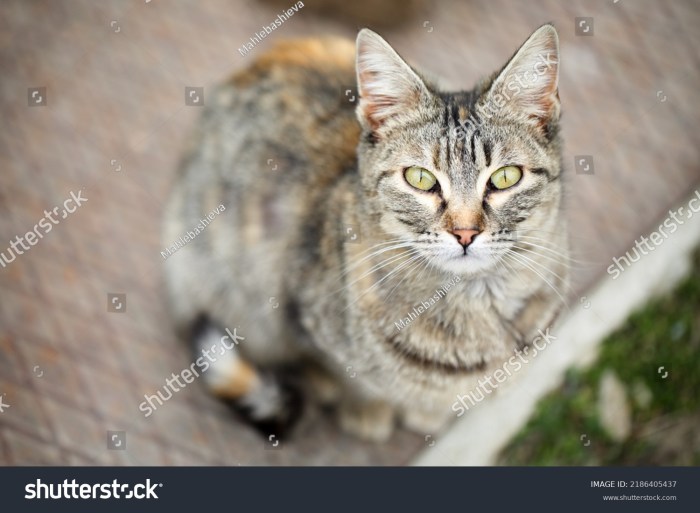
Source: shutterstock.com
The development of a mackerel tabby kitten’s coat pattern is a gradual process. Initially, newborn kittens may have faint or indistinct markings. As they grow, the stripes become more defined, typically reaching full clarity around 6-8 weeks of age. The final pattern may continue to refine slightly as the kitten matures.Socialization is crucial for all kittens, but particularly important for active and playful breeds like Bengals or Abyssinians.
Expose your mackerel tabby kitten to a variety of sights, sounds, and people from a young age to help them develop into well-adjusted adults. Gentle handling and positive reinforcement are key.Introducing a mackerel tabby kitten to other pets in the household requires a gradual and supervised approach. Start by allowing the kitten and resident pets to sniff each other under the door.
Then, allow brief, supervised interactions, gradually increasing the duration as they become more comfortable. Provide separate food and water bowls to avoid competition.Here’s a checklist of essential supplies for a new mackerel tabby kitten:
- High-quality kitten food
- Litter box and litter
- Scratching post
- Interactive toys (feather wands, puzzle toys)
- Soft cat bed
- Grooming brush
- Nail clippers
- Carrier
The History and Evolution of the Pattern
The mackerel tabby pattern likely originated in wild cat populations, serving as effective camouflage in various environments. The vertical stripes help break up the cat’s Artikel, making it more difficult for predators to spot them and allowing them to stalk prey effectively.Human breeding practices have significantly influenced the prevalence and expression of the mackerel tabby pattern in domestic cats. Selective breeding for specific coat colors and patterns has amplified the visibility and intensity of the markings in certain breeds.Historical accounts and folklore often associate cats with tabby markings with good luck and prosperity.
In some cultures, tabby cats were believed to possess mystical powers or to be symbols of protection.Here’s a timeline illustrating the documented history of specific breeds known for their mackerel tabby patterns:
- Ancient Egypt (c. 4000 BC): Depictions of tabby cats found in Egyptian art, suggesting the pattern was already well-established.
- Abyssinia (19th Century): The Abyssinian breed, with its distinctive ticked coat and subtle mackerel markings, was first imported to Europe.
- Bengal (1960s): Jean Mill developed the Bengal breed by crossing Asian Leopard Cats with domestic cats, resulting in a striking mackerel tabby pattern.
- Maine Coon (19th Century): The Maine Coon breed, known for its large size and long, flowing fur, has long been associated with the mackerel tabby pattern.
Distinguishing Mackerel from Other Tabby Types
The key differences between mackerel, classic, ticked, and spotted tabby patterns lie in the arrangement and appearance of the stripes and markings. Mackerel tabbies have narrow, vertical stripes, while classic tabbies exhibit wider, swirling patterns. Ticked tabbies have virtually no stripes, with agouti hairs creating a salt-and-pepper effect. Spotted tabbies display distinct spots, often derived from broken stripes.Differentiating a mackerel tabby from a “torbie” (tortoiseshell tabby) cat can be tricky.
Torbie cats have a combination of tabby markings and patches of red or cream, while mackerel tabbies primarily display the classic striped pattern. The presence of distinct red or cream patches is the key indicator of a torbie.Identifying tabby patterns can be challenging due to subtle nuances and variations. Factors like coat color, lighting, and individual genetics can influence the appearance of the markings.
Careful observation and comparison with established patterns are essential for accurate identification.Here’s a flowchart to help users identify the tabby pattern of an unknown cat:
- Step 1: Are there distinct vertical stripes?
- Yes: Is the stripe pattern narrow and continuous? -> Mackerel Tabby
- No: Are there swirling patterns and blotches? -> Classic Tabby
- No: Are there distinct spots? -> Spotted Tabby
- No: Is there a salt-and-pepper appearance with minimal markings? -> Ticked Tabby
End of Discussion
From their wildcat ancestry to their beloved status as domestic companions, mackerel tabbies have a rich and compelling story. Understanding the nuances of their patterns, the breeds that proudly display them, and the specific care they require allows us to appreciate these beautiful cats even more. Whether you’re a seasoned cat owner or considering welcoming a mackerel tabby into your home, this guide provides a comprehensive overview to help you navigate the wonderful world of these striped beauties.
So, next time you see a cat with those distinctive stripes, you’ll know exactly what you’re looking at – and why it’s so special!
Key Questions Answered
Why are they called “mackerel” tabbies?
The name comes from the resemblance of their stripes to the bones in a mackerel fish – long, parallel lines running down the body.
Can a cat be both a mackerel tabby and a tortoiseshell?
Yes! These are known as “torbie” cats. It’s a combination of the tabby pattern and the tortoiseshell coloration, often resulting in a unique and striking appearance.
What does the “M” marking on a mackerel tabby’s forehead signify?
It’s a characteristic marking present in all tabby cats, regardless of the specific pattern. It’s thought to be a remnant of their wildcat ancestors and is a key identifier of the tabby gene.
Are mackerel tabbies prone to any specific health problems?
Generally, the mackerel tabby pattern itself doesn’t cause health issues. However, certain breeds that commonly exhibit the pattern (like Maine Coons or Bengals) may have breed-specific predispositions. It’s important to research the health concerns associated with your cat’s breed.
What’s the difference between a silver and a charcoal mackerel tabby?
Silver mackerel tabbies have a silvery-white background with dark stripes, while charcoal mackerel tabbies have a darker, more muted background color with less contrast between the stripes.
How can I best groom a mackerel tabby with a long coat?
Regular brushing (several times a week) is essential to prevent mats and tangles. Use a stainless steel comb to reach the undercoat and a soft brush to smooth the fur. Pay special attention to areas prone to matting, like behind the ears and under the legs.

