Have you ever seen a cat with adorably short legs and wondered about their story? The world of feline breeds is full of surprises, and short-legged cats are definitely among the most captivating. From the well-known Munchkin to the rarer Scottish Kiltie and the charming Napoleon, these breeds have captured hearts with their distinctive appearance and playful personalities. Let’s dive into the fascinating history, genetics, and care of these unique companions, exploring what makes them so special.
The phenomenon of short legs in cats isn’t a recent development. Breeders have been intentionally selecting for this trait for decades, driven by a desire to create a visually striking and endearing feline. Understanding the genetic underpinnings of this trait, and the ethical considerations surrounding it, is crucial to appreciating these breeds fully. We’ll explore the science behind the short legs, the different breeds that showcase this characteristic, and the joys – and responsibilities – of owning one of these charming cats.
Short-Legged Cat Breeds: A Unique and Growing Phenomenon
The world of feline breeds is constantly evolving, and among the more recent and captivating additions are those boasting delightfully short legs. These cats, often described as “low-riders,” have captured the hearts of many with their charming waddle and endearing appearance. But the trend isn’t just about aesthetics; it’s rooted in a fascinating history of selective breeding and genetic mutations.
This article delves into the world of short-legged cat breeds, exploring their origins, genetics, health considerations, and the unique joys of sharing a home with these adorable companions.
The appeal of shorter legs in cats isn’t entirely new. Throughout history, breeders have occasionally sought out and perpetuated traits that deviate from the norm. However, the deliberate and systematic breeding for shorter legs is a relatively modern development, gaining significant traction in the late 20th and early 21st centuries. The initial focus was on creating a novelty breed, but as these cats gained popularity, breeders began to refine their characteristics and address potential health concerns.
The genetic basis for short legs in cats primarily revolves around mutations affecting bone development. Achondroplasia, a genetic disorder that causes dwarfism in humans and other animals, is the key player in many of these breeds. This condition results from a defect in cartilage formation, leading to shortened limbs while the torso remains relatively normal. Understanding these genetic factors is crucial for responsible breeding practices and ensuring the health and well-being of these unique felines.
| Breed Name | Average Leg Length (cm) | Origin Country |
|---|---|---|
| Munchkin | 8-13 | United States |
| Scottish Kiltie | 10-15 | Scotland |
| Napoleon (Minuet) | 10-17 | United States |
The Munchkin Breed: The Pioneer
The Munchkin breed stands as the undisputed pioneer in the world of short-legged cats. Its story began in the 1980s when a domestic cat in Louisiana gave birth to a litter containing a kitten with unusually short legs. This kitten, nicknamed “Sparky,” captured the attention of breeders, and a breeding program was initiated to establish the Munchkin breed. The breed’s recognition by major cat registries has been a long and sometimes controversial journey, but its popularity remains undeniable.
The genetic mutation responsible for the Munchkin’s short legs is achondroplasia, a dominant gene that affects bone growth. This means that a Munchkin only needs one copy of the gene to exhibit the characteristic short legs. While achondroplasia can cause health problems in other species, the effects in Munchkins appear to be relatively mild, although careful monitoring is still essential.
The Munchkin breed has faced considerable ethical scrutiny. Critics argue that breeding for such a significant physical mutation can lead to health problems and compromise the cat’s quality of life. Proponents, however, emphasize responsible breeding practices, genetic testing, and veterinary care to minimize risks and ensure the well-being of Munchkins. The debate highlights the ongoing discussion about the ethics of breeding for specific traits in animals.
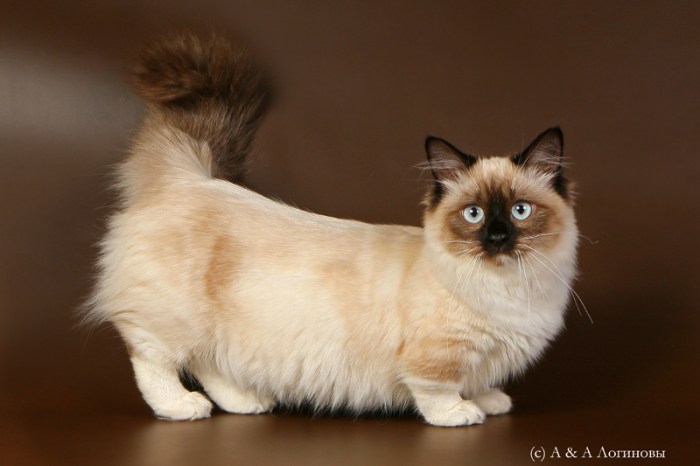
Imagine a Munchkin cat: its body is proportionally similar to that of a standard cat, but its legs are significantly shorter, often measuring only 8-13 centimeters. This creates a distinctive, low-slung appearance. Their gait is often described as a waddle or a bunny hop, adding to their charm. Munchkins come in a wide variety of coat colors and patterns, including solid colors, tabby patterns, and colorpoint variations.
Their large eyes and expressive faces contribute to their endearing appeal.
Beyond skeletal issues, Munchkins can be prone to certain health concerns, including lordosis (curvature of the spine), and dental problems. Responsible breeders screen their cats for these conditions and provide appropriate veterinary care. Regular checkups and a healthy diet are crucial for maintaining the overall health of a Munchkin.
Scottish Kiltie: A Less Common Breed
The Scottish Kiltie is a less widely known but equally charming short-legged cat breed. Developed in Scotland in the 1990s, the breed was created by crossing a Persian cat with a Munchkin. The goal was to combine the Munchkin’s short legs with the Persian’s luxurious coat and sweet temperament. While not as popular as the Munchkin, the Scottish Kiltie has a dedicated following of enthusiasts.
The Scottish Kiltie’s leg length is generally slightly longer than that of a Munchkin, typically ranging from 10 to 15 centimeters. This subtle difference contributes to a slightly less exaggerated appearance. Like the Munchkin, the short legs are a result of the achondroplasia mutation.
Scottish Kilties are known for their gentle and affectionate personalities. They are typically described as being calm, playful, and devoted companions. Here’s a breakdown of their common temperament traits:
- Affectionate: They enjoy cuddling and being close to their owners.
- Playful: Despite their short legs, they are active and enjoy playing with toys.
- Calm: They are generally relaxed and not overly demanding of attention.
- Intelligent: They can be trained to perform simple tricks and enjoy interactive games.
- Adaptable: They typically adjust well to different living environments and routines.
Napoleon (Minuet) Breed: A Hybrid Marvel
The Napoleon, also known as the Minuet, is a relatively new breed created by crossing a Persian cat with a Munchkin. The breeding program, which began in the 1990s, aimed to combine the Persian’s elegant appearance and luxurious coat with the Munchkin’s short legs. The result is a cat that embodies both breeds’ best qualities.
Breeders sought to create a cat with a refined appearance, a sweet temperament, and, of course, short legs. The desired characteristics include a round face, large expressive eyes, a long flowing coat, and a playful yet gentle personality. The breed standard allows for variations in leg length, with some Napoleons having shorter legs than others.
Leg length in Napoleons can vary considerably, ranging from 10 to 17 centimeters. This variation is due to the inheritance of different combinations of genes from the Persian and Munchkin parents. Some Napoleons may have legs that are barely noticeable, while others may have a more pronounced short-legged appearance.
The Napoleon’s appearance is a striking blend of Persian and Munchkin features. They possess the Persian’s round face, large eyes, and luxurious coat, but their short legs give them a unique and endearing charm. Their body is typically stocky and well-proportioned, with a low-slung profile.
Grooming requirements for a Napoleon are similar to those of a Persian cat. Their long, flowing coat requires daily brushing to prevent mats and tangles. Regular bathing is also recommended to keep their coat clean and healthy. Due to their Persian heritage, Napoleons can be prone to tear staining, so regular cleaning around the eyes is important.
Other Breeds with Short Legs (or Potential for Them)
While Munchkins, Scottish Kilties, and Napoleons are the most well-known short-legged cat breeds, shorter-than-average legs occasionally appear in other breeds. This can be due to spontaneous mutations or the inheritance of recessive genes. The occurrence is typically rare and not consistently bred for.
Spontaneous mutations can occur in any breed, leading to unexpected physical traits. While most mutations are detrimental, some can be harmless or even desirable. The appearance of short legs in a non-traditional breed is often a result of such a spontaneous mutation.
Breeding for short legs in breeds other than Munchkin, Scottish Kiltie, and Napoleon is genetically complex. The achondroplasia gene is dominant, making it relatively straightforward to establish in a breed. However, achieving the desired leg length and overall conformation while maintaining the breed’s other characteristics requires careful selection and breeding practices. The risk of introducing other genetic health problems is also a significant consideration.
| Breed Name | Leg Length Variation | Origin | Known Genetic Factors |
|---|---|---|---|
| American Curl | Slightly shorter | United States | Possible spontaneous mutation |
| Exotic Shorthair | Occasionally short | United States | Recessive gene influence |
| British Shorthair | Rarely short | United Kingdom | Unknown |
| Selkirk Rex | Very rarely short | United States | Spontaneous mutation |
Physical Characteristics Beyond Leg Length
The short legs of these breeds significantly impact a cat’s movement and agility. While they can still run and play, their movements are noticeably different from those of cats with longer legs. Their gait is often described as a waddle or a bunny hop, which can be quite endearing to watch.
To compensate for their shorter legs, these cats often exhibit subtle changes in body structure. Their spines may be slightly more flexible, allowing them to maneuver more easily. Their torsos may also be proportionally longer, providing greater reach and balance.
Short legs can affect a cat’s ability to climb and jump. They may struggle to reach high places and may require assistance to get onto furniture or into cat trees. However, they can still enjoy playing and exploring their environment, albeit in a slightly modified way.
A typical play session for a short-legged cat might involve chasing toys across the floor, batting at dangling objects, and engaging in playful wrestling with their owners. Their unique gait and movements add a comical and charming element to their play style. They might also enjoy exploring tunnels and boxes, using their flexibility to navigate tight spaces.
Temperament and Behavior of Short-Legged Cats
While the direct influence of short legs on a cat’s personality is debatable, anecdotal evidence suggests that these breeds often share similar temperament traits. It’s more likely that the shared genetic background and breeding practices contribute to these similarities rather than the leg length itself.
Munchkins, Scottish Kilties, and Napoleons are generally known for being affectionate, playful, and adaptable. They tend to be moderately active, enjoying interactive games and exploring their surroundings. Their playful styles often involve rolling, pouncing, and chasing toys on the ground.
Owners frequently describe these breeds as being exceptionally affectionate and devoted companions. They enjoy cuddling, being petted, and spending time with their human families. Their gentle and playful nature makes them excellent companions for people of all ages.
“My Munchkin, Winston, is the most loving cat I’ve ever had. He follows me everywhere and loves to snuggle up on the couch. His short legs don’t slow him down when it comes to playtime, though! He’s a little bundle of energy.”
Sarah M.
“We adopted a Scottish Kiltie named Fiona, and she’s brought so much joy into our lives. She’s incredibly gentle and affectionate, and she loves to play with our children. Her short legs just make her even more adorable!”
David L.
“Our Napoleon, Leo, is a real character. He’s playful, affectionate, and always up for an adventure. His short legs give him a unique waddle that we find endlessly amusing.”
Emily K.
Health Considerations Specific to Short-Legged Breeds
The altered limb structure in short-legged cats can predispose them to certain orthopedic issues, such as arthritis, hip dysplasia, and lordosis. These conditions can cause pain, stiffness, and reduced mobility. Responsible breeders screen their cats for these conditions and strive to minimize the risk of passing them on to future generations.
Responsible breeding practices are paramount in minimizing health risks associated with short-legged breeds. This includes genetic testing, careful selection of breeding pairs, and providing appropriate veterinary care. Avoiding inbreeding and ensuring that breeding cats are healthy and well-tempered are also essential.
Regular veterinary checkups and preventative care are crucial for maintaining the health of short-legged cats. This includes annual vaccinations, parasite control, and dental care. Early detection and treatment of any health problems can significantly improve the cat’s quality of life.
Owners should watch for signs that could indicate a health problem related to leg structure, including:
- Limping or stiffness
- Difficulty getting up or down
- Reluctance to jump or climb
- Pain when touched
- Changes in appetite or behavior
Caring for a Short-Legged Cat
Providing a comfortable and supportive environment is essential for short-legged cats. Certain environmental adjustments can benefit their mobility and reduce stress on their joints. Ramps can help them access furniture and cat trees, while lower litter boxes can make it easier for them to eliminate.
Maintaining a healthy weight is crucial for short-legged cats. Excess weight puts additional stress on their joints, increasing the risk of arthritis and other orthopedic problems. A balanced diet and regular exercise can help them maintain a healthy weight.
Appropriate exercise and enrichment are important for keeping short-legged cats physically and mentally stimulated. Interactive toys, puzzle feeders, and regular playtime can help them stay active and engaged. Short walks on a leash can also provide a change of scenery and opportunities for exploration.
| Care Aspect | Recommendations for Short-Legged Cats |
|---|---|
| Diet | High-quality, balanced diet to maintain a healthy weight. |
| Exercise | Interactive play sessions, puzzle feeders, short walks on a leash. |
| Environment | Ramps to access furniture, lower litter boxes, soft bedding. |
| Grooming | Regular brushing to prevent mats and tangles (especially for long-haired breeds). |
The Future of Short-Legged Cat Breeds
Source: pets-wiki.com
Ongoing efforts focus on refining the health and conformation of short-legged cat breeds. Breeders are working to identify and eliminate genetic health problems, while also striving to improve the overall appearance and temperament of these cats. Genetic testing is playing an increasingly important role in these efforts.
The possibility of new short-legged cat breeds emerging remains a distinct possibility. As breeders continue to experiment with different crosses and breeding practices, it’s conceivable that new breeds with unique combinations of traits could be developed. However, ethical considerations will continue to guide these efforts.
The ethical considerations surrounding the continued breeding of cats with genetic mutations are complex and multifaceted. While many people find these breeds endearing, others raise concerns about the potential for health problems and the welfare of the animals. Responsible breeding practices, genetic testing, and veterinary care are essential for mitigating these risks.
Imagine a “future” short-legged cat breed, tentatively named the “Pygmy Persian.” This breed would combine the Persian’s luxurious coat and sweet temperament with even shorter legs than the Napoleon, but with a focus on improved skeletal health. Genetic screening would be mandatory, and breeders would prioritize conformation and temperament alongside leg length. The desired characteristics would include a round face, large expressive eyes, a long flowing coat, a playful yet gentle personality, and a robust skeletal structure free from orthopedic problems.
The goal would be to create a charming and healthy companion that embodies the best qualities of both breeds.
Closure
From the pioneering Munchkin to the elegant Napoleon, short-legged cat breeds offer a unique blend of charm, playfulness, and a touch of the unexpected. While responsible breeding and careful consideration of potential health concerns are paramount, these cats bring immense joy to their owners. As we look to the future, ongoing efforts to improve their health and refine their conformation promise even more delightful short-legged feline companions for years to come.
Whether you’re a seasoned cat lover or just curious about these adorable breeds, there’s a lot to appreciate about the world of short legs!
Frequently Asked Questions
Are short-legged cats always healthy?
While breeders strive for health, short legs can sometimes be associated with orthopedic issues. Regular vet checkups and responsible breeding practices are essential.
Do short legs affect a cat’s personality?
Generally, no. Personality is more influenced by genetics and environment. Short-legged cats are often playful, affectionate, and energetic.
What’s the difference between a Munchkin and a Scottish Kiltie?
Both have short legs, but Scottish Kilties typically have slightly longer legs than Munchkins. They also have a different body type and coat texture.
What is achondroplasia, and why is it relevant?
Achondroplasia is a genetic disorder that causes dwarfism, and it’s the mutation responsible for the short legs in Munchkin cats.
How can I help my short-legged cat navigate their home?
Ramps, lower litter boxes, and easily accessible food and water bowls can make life easier for a short-legged cat.
Are Napoleon cats difficult to groom?
Yes, due to their Persian heritage, Napoleons require regular brushing to prevent mats and tangles.
What are some signs of orthopedic problems in short-legged cats?
Limping, stiffness, reluctance to jump, and changes in gait are all potential signs of orthopedic issues. Consult a vet if you notice any of these.

