The spotted brown tabby – a captivating blend of wild appearance and domestic charm. These felines, with their distinctive markings and warm brown hues, are increasingly popular, and for good reason! They’re more than just pretty faces; understanding their genetics, history, and care needs is key to ensuring a happy and healthy life for these unique companions. This guide dives deep into everything you need to know about these stunning cats, from their origins to their quirky personalities.
We’ll explore the fascinating science behind their spotted patterns, trace their lineage through various breeds like Bengals and Abyssinians, and offer practical advice on everything from diet and grooming to recognizing potential health concerns. Whether you’re a seasoned cat lover or considering welcoming a spotted brown tabby into your home, this is your comprehensive resource.
The Allure of the Spotted Brown Tabby: A Comprehensive Guide
[Introductory Paragraph – Briefly introduce the spotted brown tabby, its appeal, and the purpose of the article.]The spotted brown tabby is a captivating feline, instantly recognizable by its unique coat pattern. Beyond the striking visuals, these cats possess a rich history, distinct personality traits, and specific care requirements. This guide aims to delve into every aspect of the spotted brown tabby, from genetics to temperament, providing you with the knowledge to appreciate and care for these remarkable animals.
Defining the Spotted Brown Tabby Breed
Understanding the genetics behind a spotted coat is key to appreciating its beauty. The spotted pattern is primarily controlled by the Agouti gene (A), which dictates whether a cat’s hairs are banded (agouti) or solid in color. The presence of the “spotted” allele (Sp) further modifies this, creating distinct spots rather than stripes or swirls. Multiple genes interact to influence spot size, density, and distribution.
Brown coloration is determined by the B gene, with variations leading to different shades like chocolate and cinnamon.The difference between a spotted tabby and a marbled tabby lies in the pattern’s formation. Spotted tabbies have clearly defined, individual spots, while marbled tabbies exhibit swirling, flowing patterns that can resemble abstract art. While both are tabby variations, the distinctness of the markings is the key differentiator.Spotted brown tabbies typically range in size from medium to large, depending on their breed heritage.
Weight can vary significantly, from 8 to 15 pounds or more. Coat length varies; they can be short-haired, medium-haired, or long-haired, influencing grooming needs. Eye color is diverse, including shades of green, gold, copper, and hazel, often complementing the brown coat beautifully.
| Feature | Description (Spotted Brown Tabby) | Description (Marbled Brown Tabby) | Key Difference |
|---|---|---|---|
| Pattern | Distinct, individual spots | Swirling, flowing patterns | Spot definition vs. swirling pattern |
| Markings | Clear-cut spots | Abstract, blended markings | Sharpness of markings |
| Overall Appearance | More “patchy” look | More fluid and continuous | Visual texture and flow |
Origins and History
The spotted tabby pattern isn’t a recent development; it has appeared sporadically throughout cat history, often linked to natural mutations and breed development. Early depictions of spotted cats are scarce, but anecdotal evidence suggests their presence in various cultures.Several breeds are commonly associated with the spotted brown tabby appearance. The Bengal, with its wild ancestry, is perhaps the most well-known.
The Ocicat, a deliberately designed breed resembling a miniature ocelot, also frequently displays this pattern. The Abyssinian, known for its ticked coat, can occasionally exhibit a spotted variation.Documented instances of spotted brown tabby cats in historical art and literature are limited, likely due to their relative rarity compared to other tabby patterns. However, depictions of wild cats with similar markings in ancient Egyptian art hint at the enduring fascination with spotted felines.
| Milestone | Approximate Date | Description |
|---|---|---|
| Early Spotted Mutations | Pre-19th Century | Sporadic appearances of spotted patterns in various cat populations. |
| Bengal Breed Development | 1960s-1980s | Jean Mill’s breeding program combining Asian Leopard Cats with domestic cats to create the Bengal. |
| Ocicat Breed Creation | 1960s | Deliberate breeding program to create a spotted domestic cat resembling a wild ocelot. |
| Increased Recognition | 1990s-Present | Growing popularity and recognition of spotted tabby patterns in various breeds. |
Temperament and Behavior
Spotted brown tabbies are generally known for their playful, energetic, and intelligent personalities. They often exhibit a curious nature, enjoying exploring their surroundings and interacting with their human companions. Many are quite vocal, expressing themselves with a variety of meows and chirps.Compared to other tabby variations, spotted brown tabbies often display a higher level of activity and a stronger desire for interactive play.
While classic tabbies might be more laid-back, spotted tabbies tend to be more engaging and demanding of attention.Common play behaviors include chasing toys, pouncing on objects, and engaging in mock hunting games. They often enjoy puzzle toys and activities that stimulate their minds. A laser pointer can provide endless entertainment, but always end the session with a tangible toy to “catch.”Here’s a list of potential behavioral challenges and how to address them:
- Excessive Scratching: Provide scratching posts of various materials and textures.
- Destructive Chewing: Offer appropriate chew toys and redirect chewing behavior.
- Aggression (towards humans or other pets): Consult with a veterinarian or certified cat behaviorist to identify the underlying cause and develop a behavior modification plan.
- Anxiety/Stress: Provide safe spaces, calming pheromone diffusers, and consistent routines.
- Excessive Vocalization: Rule out medical causes and provide enrichment to reduce boredom.
Health Considerations
Breeds commonly exhibiting the spotted brown tabby pattern, such as Bengals and Ocicats, can be predisposed to certain genetic health issues. Hypertrophic cardiomyopathy (HCM), a heart condition, is a concern in Bengals. Progressive retinal atrophy (PRA), a degenerative eye disease, can also occur. Pyruvate kinase deficiency (PKD), a metabolic disorder, is another potential issue.Preventative care is crucial for maintaining the health of a spotted brown tabby.
Regular veterinary checkups, a balanced diet, and a clean living environment are essential. Early detection of potential health problems can significantly improve outcomes.Here’s a recommended vaccination and deworming schedule:
- FVRCP (Feline Viral Rhinotracheitis, Calicivirus, Panleukopenia): Initial series as a kitten, followed by boosters annually or every three years.
- Rabies: Required by law in most areas, typically administered annually.
- FeLV (Feline Leukemia Virus): Recommended for kittens and outdoor cats.
- Deworming: Regular deworming treatments, especially for kittens, to address common intestinal parasites.
| Health Concern | Symptoms | Recommended Action |
|---|---|---|
| HCM (Hypertrophic Cardiomyopathy) | Difficulty breathing, lethargy, sudden death | Veterinary examination, echocardiogram (ultrasound of the heart) |
| PRA (Progressive Retinal Atrophy) | Cloudy eyes, night blindness, eventual blindness | Veterinary examination, genetic testing (if available) |
| PKD (Pyruvate Kinase Deficiency) | Lethargy, anemia, jaundice | Veterinary examination, blood tests |
Caring for a Spotted Brown Tabby
The dietary needs of a spotted brown tabby depend on their age, activity level, and overall health. Kittens require a diet rich in protein and calories to support growth. Adult cats benefit from a balanced diet formulated for their specific needs. High-quality wet and dry food options are available.Grooming requirements vary depending on coat length. Short-haired spotted brown tabbies require minimal grooming, while medium- and long-haired varieties benefit from regular brushing to prevent mats and tangles.Environmental enrichment and interactive play are vital for keeping spotted brown tabbies mentally and physically stimulated.
Provide scratching posts, climbing structures, and a variety of toys. Daily interactive play sessions are essential.Here’s a step-by-step guide on how to properly brush a long-haired spotted brown tabby:
- Gather your supplies: A stainless steel comb, a slicker brush, and potentially a detangling spray.
- Start with the comb: Gently comb through the fur, starting at the head and working your way down the body.
- Use the slicker brush: Brush in the direction of hair growth, paying attention to areas prone to matting, such as behind the ears and under the legs.
- Detangle carefully: If you encounter a mat, gently work it out with your fingers or a detangling tool. Avoid pulling or tugging, which can cause discomfort.
- Reward your cat: Offer praise and a small treat to make grooming a positive experience.
Visual Characteristics: Coat Patterns & Markings
The “spotted” pattern itself exhibits considerable variation. Rosette size can range from tiny speckles to large, distinct markings resembling leopard spots. Spot density can be sparse or dense, influencing the overall appearance. Distribution is also variable, with some cats having spots concentrated on their flanks and others with more even coverage.The range of brown shades observed in the coat is diverse.
Cinnamon refers to a lighter, reddish-brown hue, while chocolate is a deeper, richer brown. These variations are influenced by the B gene and its modifiers.Tabby markings, such as stripes and swirls, can be present within the spotted pattern, creating a complex and visually striking appearance. These markings are a remnant of the underlying tabby genetics.A “broken” spotted pattern occurs when the spots are irregularly shaped or scattered, creating a less uniform appearance.
This can be due to genetic variations or environmental factors during development. Imagine a cat where some spots are large and bold, while others are small and faded, creating a mosaic-like effect.
Spotted Brown Tabby in Different Breeds
Comparing the spotted brown tabby appearance across different breeds reveals subtle but significant differences. Bengals tend to have larger, more defined rosettes and a more wild appearance. Ocicats often have a more uniform spot pattern and a more muscular build.Abyssinian cats with the spotted pattern typically have smaller, more tightly packed spots and a characteristic ticked coat, where each hair has bands of different colors.A spotted brown tabby Siamese exhibits the classic Siamese point coloration, with darker markings on the face, ears, paws, and tail, combined with the spotted body pattern.
The key differences lie in the rosette size (larger in Bengals), overall body structure (more muscular in Ocicats), coat texture (ticked in Abyssinians), and point coloration (present in Siamese). Each breed showcases the spotted tabby pattern with its unique characteristics.
Finding a Spotted Brown Tabby
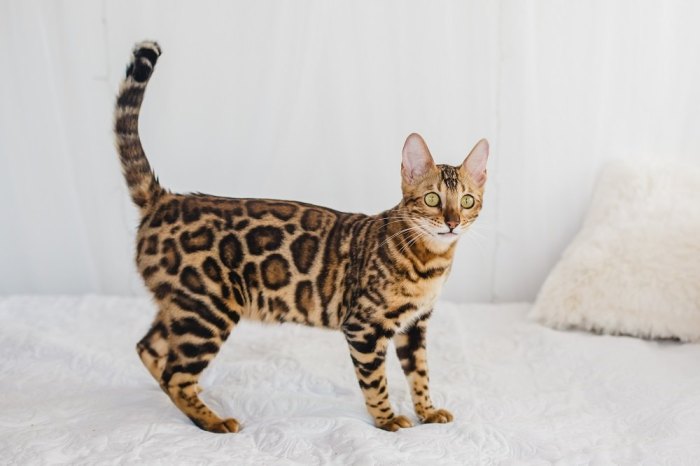
Source: cats.com
Selecting a reputable breeder is paramount to ensuring you acquire a healthy and well-socialized kitten. Look for breeders who prioritize health testing, provide a clean and stimulating environment for their cats, and are knowledgeable about the breed.When evaluating a kitten or adult cat, observe their overall health and behavior. Look for clear eyes, a clean coat, and a playful, confident demeanor.Adopting a spotted brown tabby from a shelter or rescue organization is a rewarding option.
Many shelters have cats of all ages and personalities waiting for loving homes.Here’s a checklist of questions to ask a breeder before purchasing a kitten:
- What health testing do you perform on your breeding cats?
- Can I see the kitten’s parents?
- What is the kitten’s vaccination and deworming history?
- What is your policy on returns or guarantees?
- Can you provide references from previous buyers?
- What is your socialization process for the kittens?
Illustrative Descriptions
A spotted brown tabby kitten, no older than eight weeks, playfully batted at a feather toy, its tiny paws extending with surprising agility. Its eyes, a vibrant gold, followed the feather’s every movement, and a soft chirp escaped its mouth with each pounce. The spots on its short, velvety fur seemed to shimmer in the light, a miniature version of a wild cat’s camouflage.A mature spotted brown tabby cat basked in a patch of sunlight, its fur radiating warmth.
The texture of its coat was plush and dense, with subtle variations in brown shades creating a mesmerizing pattern. The sunlight highlighted the edges of the spots, making them appear to glow against the darker background.A spotted brown tabby cat interacted with a gentle giant of a dog, a Labrador Retriever. The cat’s body language was relaxed and curious, its tail held high in a friendly greeting.
The dog responded with a wagging tail and a playful bow, demonstrating a harmonious relationship.In a dimly lit room, a spotted brown tabby cat seemed to come alive. The spots on its coat appeared to glow faintly, creating an ethereal effect. The contrast between the dark background and the lighter spots accentuated the cat’s unique markings, transforming it into a captivating silhouette.
Common Misconceptions
The term “spotted tabby” can be confusing because “tabby” refers to a pattern (stripes, swirls, spots) rather than a breed. A spotted tabby simply means a cat with a spotted pattern that also exhibits tabby characteristics.A leopard cat is a distinct wild species,Prionailurus bengalensis*, while a spotted tabby cat is a domesticated feline with a similar coat pattern. The key difference is domestication – leopard cats are wild animals, while spotted tabby cats are domesticated companions.Not all spotted cats are Bengals.
While Bengals are the most well-known breed with a spotted pattern, other breeds, such as Ocicats and Abyssinians, can also exhibit this trait.
| Misconception | Correct Information |
|---|---|
| “Spotted tabby” is a breed. | “Spotted tabby” describes a pattern, not a breed. |
| Spotted cats are always Bengals. | Several breeds can exhibit the spotted pattern, including Ocicats and Abyssinians. |
| Spotted cats are dangerous. | Spotted tabby cats are domesticated and generally friendly. |
Closing Summary
From their intriguing genetic makeup to their playful antics, the spotted brown tabby truly embodies a unique combination of beauty and personality. We’ve covered a lot of ground, from understanding the nuances of their coat patterns to addressing potential health issues and finding a reputable breeder. Ultimately, providing a loving and enriching environment is the key to unlocking the full potential of these remarkable cats, ensuring they thrive and bring joy to your life for years to come.
So, whether you’re captivated by their wild appearance or charmed by their affectionate nature, the spotted brown tabby is a feline friend worth knowing – and perhaps, welcoming into your home!
Question Bank
Do all spotted brown tabbies have the same personality?
Not at all! While they often share traits like playfulness and intelligence, individual personalities vary greatly depending on genetics, upbringing, and environment. Some are incredibly affectionate, while others are more independent.
What’s the best way to groom a long-haired spotted brown tabby?
Regular brushing (2-3 times a week) is essential to prevent mats and tangles. Use a stainless steel comb and a soft brush, working in the direction of hair growth. Pay special attention to areas behind the ears and under the legs.
Are spotted brown tabbies prone to specific behavioral problems?
Like any cat, they can exhibit behavioral challenges like scratching, spraying, or aggression. These are often rooted in boredom, stress, or underlying medical issues. Providing plenty of enrichment, a consistent routine, and addressing any health concerns can help.
What is the difference between a rosette and a spot?
A spot is a distinct, circular marking. A rosette is a larger, more complex marking that resembles a rose or a bullseye, often with a lighter center. Rosettes are more common in breeds like Bengals.
How can I tell if a breeder is reputable?
A reputable breeder will be knowledgeable about the breed, health test their cats, allow you to visit their facility, and be transparent about the kitten’s history and health. They should also prioritize the well-being of their cats over profit.
Can I adopt a spotted brown tabby from a shelter?
While less common, it’s certainly possible! Shelters and rescue organizations often receive cats of all breeds and mixes. Be prepared to be flexible and open to different ages and personalities.

