What Are the Cats That Look Like Leopards? A Spot-On Guide

There’s something undeniably captivating about big cats – their power, their grace, and especially those mesmerizing spotted patterns. It’s no surprise so many of us find ourselves wondering, “What are the cats that look like leopards?” The quest to find a feline friend with a wild, exotic appearance has led to some truly fascinating breeds, and this article dives deep into the domestic cats that share a striking resemblance to their leopard cousins.
We’ll explore everything from the well-known Bengal to the more obscure Toyger, uncovering the genetics and breeding behind these miniature marvels.
From hybrid origins to intentional breeding programs, the journey to create cats that mimic the look of leopards is a testament to human ingenuity and our enduring fascination with the natural world. We’ll also touch on the ethical considerations surrounding these breeds and offer a glimpse into the differences between a domestic feline and its wild counterpart.
What Are the Cats That Look Like Leopards? Exploring the Wild Look in Domestic Breeds
The allure of big cats – their power, grace, and those mesmerizing spotted patterns – has captivated humans for centuries. There’s something primal and fascinating about a creature that embodies both wildness and beauty. It’s no surprise then that people often search for “cats that look like leopards.” This curiosity stems from a desire to bring a touch of that wild elegance into our homes, or simply to appreciate the remarkable similarities that have been selectively bred into certain domestic cat breeds.
This article will delve into the breeds that most closely resemble leopards, exploring their origins, characteristics, and the genetics behind their striking appearances. We’ll cover Bengals, Ocicats, Savannahs, Egyptian Maus, Toygers, and a few other breeds that occasionally display leopard-like traits, while also touching on the ethical considerations surrounding hybrid breeds.
Bengal Cats: The Most Common Comparison
The Bengal cat is arguably the breed most frequently associated with leopards. Their appearance is so striking that it’s often the first thing people think of when searching for a cat with a wild look. The story of the Bengal begins in the 1960s when Jean Mill, a breeder, crossed an Asian Leopard Cat (ALC) – a small, wild cat native to Asia – with domestic cats.
The goal wasn’t initially to create a pet, but rather to introduce desirable traits from the ALC, like disease resistance, into the domestic cat gene pool. However, the resulting offspring were so visually appealing that a breeding program focused on developing the Bengal as a domestic pet was established.Bengal coats are characterized by their distinctive spotted, marbled, or rosette patterns.
The “spotted” pattern is the most leopard-like, featuring randomly distributed spots across the body. “Marbled” Bengals have a swirling, flowing pattern reminiscent of marble, while “rosetted” Bengals have spots that are larger and more circular, resembling the rosettes found on leopards. The colors vary widely, including brown, snow (seal lynx point, seal mink, seal sepia), silver, and charcoal. The intensity of the markings, known as “glitter,” can also vary significantly, with some Bengals exhibiting a shimmering effect in their fur.
Some Bengals possess a very intense leopard-like appearance, while others have more subtle markings.
| Characteristic | Bengal Cat | Leopard |
|---|---|---|
| Size | 14-18 inches (body length), 8-15 lbs | 3.3-4.9 ft (body length), 82-200 lbs |
| Weight | 8-15 lbs | 82-200 lbs |
| Lifespan | 12-16 years | 10-12 years (in the wild), up to 20 years (in captivity) |
| Temperament | Active, playful, intelligent, often vocal | Solitary, territorial, powerful predator |
I once heard a story about a Bengal named “Shadow” who was so convincingly leopard-like that neighbors initially mistook him for an escaped exotic animal. His owner had to constantly reassure them that he was, in fact, a beloved house cat!
Ocicat: The Domestic “Mini-Leopard”
The Ocicat is a fascinating breed intentionally bred to resemble a wild cat, specifically a leopard or ocelot. Unlike the Bengal, the Ocicat has no wild cat ancestry in its direct lineage. The breed was created in the 1960s by crossing Abyssinian, Siamese, and American Shorthair cats. The breeder, Virginia Daly, aimed to create a cat with the appearance of a wild cat but with the temperament of a domestic pet.
She even considered renaming the breed “Ocil,” but ultimately chose “Ocicat” to emphasize its resemblance to an ocelot.Ocicats are known for their distinctive spotted patterns and a range of color variations. The most common colors are “occar” (brown spotted), chocolate, cinnamon, and blue. Their spots are typically bold and well-defined, and they often have a “ticked” appearance, meaning that each hair has bands of different colors, creating a shimmering effect.
While they share the spotted pattern with leopards, the Ocicat’s build is noticeably different. They are more muscular and compact than a leopard, with a more rounded head and shorter legs.
“The Ocicat truly embodies the spirit of the wild in a domestic package. Their confident demeanor and striking spotted coat always draw attention, and people are often surprised to learn they aren’t a hybrid.” – Sarah Miller, Ocicat Breeder.
Savannah Cats: The Exotic Hybrid
Savannah cats are a hybrid breed resulting from a cross between a Serval – a medium-sized African wild cat – and a domestic cat. The first known Savannah was born in 1986, and the breed has gained popularity for its unique appearance and energetic personality. The generation of a Savannah cat is denoted by an “F” number (e.g., F1, F2, F3), indicating how many generations removed it is from its Serval ancestor.
F1 Savannahs, being the closest to the Serval, typically exhibit the most pronounced Serval characteristics, including a taller, leaner build and larger ears. Subsequent generations (F2, F3, etc.) become progressively more domestic-like in appearance.The range of Savannah cat appearances is quite diverse, depending on the generation and the domestic cat breeds used in the breeding program. Early generations (F1-F3) often have a striking resemblance to Servals, with long legs, large ears, and a spotted coat.
Later generations (F4 and beyond) tend to be smaller and more closely resemble domestic cats, although they still retain some of their wild cat features.Due to their Serval ancestry, Savannah cat ownership is subject to legal considerations and restrictions in many regions. Some areas prohibit ownership altogether, while others require permits or specific enclosures. It’s crucial to research local laws before acquiring a Savannah cat.Here’s a list of common Savannah cat colors and patterns:
- Brown Spotted (Traditional): The most common and recognizable pattern.
- Silver Spotted: A beautiful variation with silver-toned spots.
- Black Spotted: Less common, but striking.
- Smoke Spotted: A unique pattern with a smoky appearance.
- Blaze Savannah: Characterized by a white “blaze” marking on the face.
Egyptian Mau: Ancient Elegance with Spots
The Egyptian Mau is a naturally spotted breed with a rich history dating back to ancient Egypt. Depictions of cats resembling the Mau can be found in ancient Egyptian art, suggesting that the breed has existed for thousands of years. The breed nearly went extinct during the 19th century but was revived by Russian princess Natalie Troubetzkoy in the 1950s.The Mau’s most distinctive feature is its naturally occurring spotted coat.
The spots are small, round, and evenly distributed across the body. They also possess unique “mascara” markings around their eyes, giving them an expressive and alert appearance. The colors typically seen in Egyptian Maus are silver, bronze, and smoke. Their body type is athletic and muscular, with a distinctive “shelf” back. While not as overtly leopard-like as Bengals or Savannahs, their spotted coat and agile movements evoke a sense of wildness.The Egyptian Mau is known for its intelligence, loyalty, and playful nature.
They are often described as being very attached to their families and can be quite vocal.
Toyger: Bred to Resemble a Miniature Tiger (and Leopard)
The Toyger is a relatively new breed intentionally bred to resemble a miniature tiger. However, the breeding program has also resulted in cats with striking leopard-like markings. The Toyger breeding program began in the 1980s with Judy Sugden, who aimed to create a domestic cat with the appearance of a tiger, but in a manageable size. While the primary focus is on tiger-like stripes, some Toygers exhibit spotting, adding to their wild appearance.Toygers display a combination of striped and spotted patterns.
The desired pattern is a series of bold, dark stripes that resemble those of a tiger, but with the potential for spots to appear within the stripes. Breeders also strive for a “glitter” effect in the coat, where the fur has a shimmering quality. The breeding program has faced challenges in achieving the desired markings consistently, but significant progress has been made over the years.
| Stage | Description | Approximate Year |
|---|---|---|
| Initial Concept | Judy Sugden begins breeding program to create a miniature tiger. | 1980s |
| Early Generations | Focus on developing striped patterns, with some spotting appearing. | 1990s |
| Breed Recognition | The TICA (The International Cat Association) recognizes the Toyger as a championship breed. | 2007 |
| Current Standards | Breeders continue to refine the markings and strive for the desired “glitter” effect. | 2010s – Present |
Other Breends with Leopard-Like Features
While Bengals, Ocicats, Savannahs, Egyptian Maus, and Toygers are the most prominent breeds that resemble leopards, other domestic cat breeds occasionally exhibit leopard-like markings or patterns. These resemblances are often due to spontaneous mutations or the inheritance of specific genes.Here’s a list of less common breeds with potential leopard-like traits:
- Abyssinian: Some Abyssinians display ticked coats with subtle spotting.
- Sokoke: This rare breed from Kenya has a naturally ticked coat with a distinctive pattern that can evoke a leopard-like appearance.
- Bengal Crosses: Cats with mixed ancestry, particularly those with Bengal heritage, may exhibit spotting.
Understanding Leopard Coat Patterns and Genetics
The genetics of spotted patterns in cats are complex and not fully understood. However, it’s generally believed that the Agouti gene plays a crucial role in determining whether a cat will have a spotted or striped pattern. The Agouti gene controls the distribution of pigment within individual hairs. In cats with the Agouti gene “on,” each hair has bands of different colors, resulting in a ticked or spotted appearance.
In cats with the Agouti gene “off,” the hairs are a single color, resulting in a solid or striped pattern.Different types of spots (rosettes, spots, blotches) are likely influenced by other genes that modify the expression of the Agouti gene. Environmental factors, such as temperature and nutrition, can also influence coat development and pattern expression. The interaction of multiple genes creates the variety of patterns seen in both leopards and domestic cats.
Distinguishing Features: Leopard vs. Cat
While some domestic cat breeds can closely resemble leopards, there are key physical and behavioral differences that distinguish them. Leopards are significantly larger and more powerfully built than domestic cats, with longer tails, broader heads, and more robust skeletons. Their hunting styles differ as well; leopards are solitary ambush predators, while domestic cats often engage in playful hunting behaviors. Vocalizations also differ, with leopards producing a variety of roars, growls, and hisses, while domestic cats primarily meow, purr, and hiss.
Finally, leopards inhabit a wide range of habitats across Africa and Asia, while domestic cats are found worldwide in close association with humans.Imagine a side-by-side comparison: A leopard’s skeletal structure is more robust and elongated, particularly in the spine and limbs, allowing for greater flexibility and power. A Bengal cat, while muscular, has a more compact skeletal structure, reflecting its domestic origins and smaller size.
Responsible Breeding and Ethical Considerations
The breeding of hybrid cat breeds, particularly those involving wild cat species, raises ethical considerations. It’s crucial to prioritize the health and well-being of these cats and to ensure that breeders are knowledgeable and responsible. Reputable breeders conduct genetic testing to minimize the risk of inherited health problems and provide proper socialization and care for their kittens.Potential health concerns associated with hybrid breeds include:
- Genetic Disorders: Hybrid cats may be predisposed to certain genetic disorders due to the mixing of different gene pools.
- Behavioral Issues: Some hybrid cats may exhibit unpredictable or challenging behaviors due to their wild ancestry.
- Health Problems from Wild Ancestry: Certain diseases common in wild cats may also affect hybrid breeds.
Closure
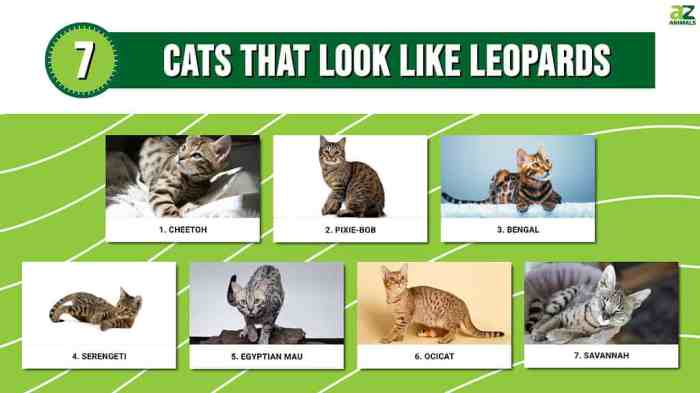
Source: a-z-animals.com
So, whether you’re a seasoned cat lover or simply curious about the world of feline mimicry, we’ve covered a lot of ground. From the popular Bengal to the unique Egyptian Mau and the ambitious Toyger, there’s a surprising variety of domestic cats that can evoke the spirit of a leopard. Understanding the genetics, responsible breeding practices, and key distinctions between these cats and their wild counterparts is crucial for appreciating their beauty and ensuring their well-being.
Ultimately, these “leopard-like” cats offer a captivating blend of domestic charm and wild allure, proving that a little bit of the jungle can thrive within our homes.
Quick FAQs
Do cats that look like leopards require special care?
Many of these breeds, especially hybrids like Savannahs, can have specific dietary and enrichment needs. Research the breed thoroughly and consult with a veterinarian experienced in exotic breeds.
Are Bengal cats truly wild?
While Bengals have Asian Leopard Cat ancestry, they are domesticated cats. However, they retain a high energy level and require plenty of playtime and mental stimulation.
How much do Savannah cats cost?
Savannah cats are among the most expensive domestic cat breeds, with prices ranging from $1,000 to $20,000+ depending on the generation (F1 being the most expensive).
Is it legal to own a Savannah cat where I live?
Savannah cat ownership is restricted in some states and cities. Always check your local laws before acquiring one.
What is the “glitter” effect in Toygers?
The “glitter” effect refers to a shimmering quality in the Toyger’s coat caused by hollow hair shafts, reflecting light and adding to their tiger-like appearance.
What is the lifespan of a Bengal cat?
Bengal cats typically live between 12 and 16 years with proper care and a healthy diet.
Are Egyptian Maus hypoallergenic?
While no cat is truly hypoallergenic, Egyptian Maus produce less of the Fel d 1 protein, which is a common allergen, making them potentially more tolerable for some allergy sufferers.
