White cats have captivated humans for centuries, appearing in myths, legends, and as beloved companions. Their striking appearance, often paired with mesmerizing eye colors, makes them instantly recognizable. But there’s so much more to these beautiful felines than meets the eye! From their fascinating history across cultures to the unique genetic factors that create their pristine coats, let’s dive into the world of white cats and uncover the secrets behind their charm.
This exploration will cover everything from the historical significance of white cats in different societies, like their revered status in Japan and their symbolic roles in ancient Egypt, to the science behind their white fur and the potential health considerations that come with it. We’ll also look at popular breeds known for their white coats, grooming tips to keep them looking their best, and even their appearances in art and folklore.
Origins and History of White Cats
White cats have captivated humans for centuries, appearing in myths, legends, and art across diverse cultures. Their striking appearance and often perceived mystical qualities have made them symbols of both good fortune and ill omen. Understanding their history requires exploring their significance in different societies and the genetic factors that contribute to their unique coat color.The prevalence of white cats throughout history has fluctuated, and perceptions of them have evolved alongside cultural shifts and scientific advancements.
Early beliefs often attributed supernatural powers to these cats, while modern understanding focuses on the genetic mechanisms behind their coloration.
Historical Significance Across Cultures
The historical significance of white cats varies greatly depending on the culture. In Japan, the white cat, particularly theshiro-neko*, is considered a symbol of good luck and prosperity, often depicted in art and folklore. They were believed to ward off evil spirits and bring good fortune to homes. Conversely, in some parts of Europe, white cats were historically associated with witchcraft and bad luck, particularly black and white cats.
In ancient Egypt, cats in general were revered, and while white cats weren’t specifically singled out, their rarity likely contributed to their perceived value. Egyptian art frequently depicts cats, showcasing their importance in religious and domestic life. The reverence for cats in Egypt stemmed from their association with the goddess Bastet, who was often depicted with a cat’s head.
Genetic Mutations Leading to White Coat Color
The white coat color in felines isn’t a pigment itself; rather, it’s theabsence* of pigment. This is due to a complex interplay of genetic mutations. The primary gene responsible is the ‘W’ gene (also known as the Dominant White spotting gene). This gene interferes with the normal distribution of melanin, the pigment responsible for coat color. It essentially prevents pigment from reaching the hair follicles, resulting in a white coat.
Other genes can influence the extent of white spotting, leading to variations from completely white to predominantly white with patches of color.
Timeline of Understanding and Portrayal
* Ancient Egypt (c. 3000 BCE): Cats, including likely some white cats, are revered and depicted in art.
Medieval Europe (c. 12th-17th centuries)
White cats, particularly black and white cats, are often associated with witchcraft and bad luck.
Japan (Edo Period, 1603-1868)
White cats become symbols of good luck and prosperity, frequently appearing in art and folklore.
19th Century
Selective breeding begins to establish white cat breeds like the Turkish Angora.
Early 20th Century
Genetic research begins to unravel the mechanisms behind coat color inheritance, including the ‘W’ gene.
Present
White cats are increasingly recognized for their unique genetic traits and potential health considerations.
Genetics of White Fur and Associated Traits
The genetics behind a white cat’s coat are more intricate than simply “white equals no pigment.” Several genes interact to determine coat color and associated traits, and understanding these interactions is crucial for responsible breeding and owner awareness.
The ‘W’ Gene and its Impact on Pigmentation
The ‘W’ gene is dominant, meaning that a cat only needs one copy of the gene to exhibit a white coat. It overrides other color genes, effectively masking them. The gene doesn’tcreate* white fur; it prevents the expression of other pigment genes. This is why a white cat can still carry genes for other colors – they’re simply not visible.
The ‘W’ gene affects the melanocytes, the cells responsible for producing melanin, preventing them from migrating to the hair follicles.
Connection Between White Coat and Deafness
A significant concern with white cats, particularly those with blue eyes, is deafness. This connection is due to the shared developmental pathway of melanocytes and the inner ear. Melanocytes are needed to develop the inner ear properly. The ‘W’ gene, by affecting melanocyte migration, can also disrupt the development of the inner ear, leading to congenital deafness. The risk of deafness is higher in white cats with blue eyes than in those with gold or green eyes.
Comparing the ‘W’ Gene with Other Coat Color Genes
While the ‘W’ gene masks other color genes, other genes determine the underlying color that
- would* be visible if the ‘W’ gene weren’t present. For example, the Siamese point pattern is controlled by the
- cs* gene, which restricts pigment production to the cooler areas of the body (points). A white cat with the Siamese
- cs* gene would appear white, but if the ‘W’ gene were absent, it would display the Siamese point pattern. The ‘W’ gene essentially acts as a “blanket” over these other color genes.
Visual Representation of Inheritance Patterns
Let’s illustrate the inheritance patterns. We’ll use ‘W’ to represent the dominant white gene and ‘w’ to represent the recessive non-white gene.* Parent 1: Ww (White Carrier)Carries the white gene but isn’t fully white.
-
Parent 2
ww (Non-White)
- Doesn’t carry the white gene.
| | W | w || :—- | :-: | :-: || w | Ww | ww || w | Ww | ww |This Punnett square shows that there’s a 50% chance of offspring being Ww (white carrier) and a 50% chance of offspring being ww (non-white).
If both parents are Ww, the possibilities are: 25% WW (fully white), 50% Ww (white carrier), and 25% ww (non-white).
Different Breeds Commonly Featuring White Coats
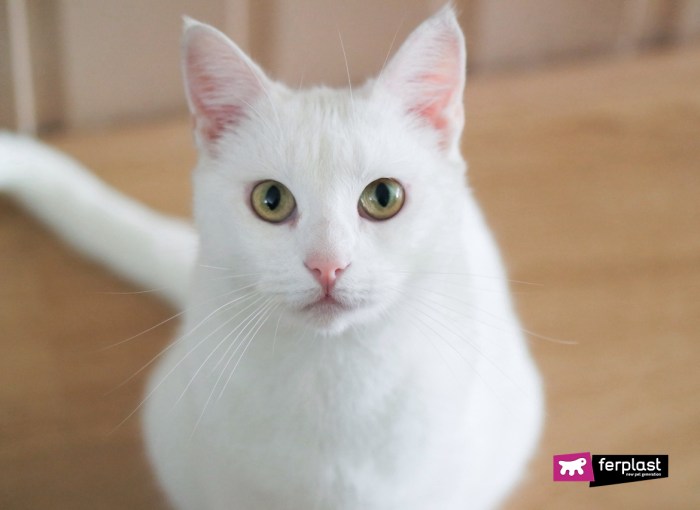
Source: ferplast.com
Several cat breeds are known for their striking white coats, each with unique characteristics and temperaments. While white is a common color within these breeds, variations in coat texture and eye color add to their individual appeal.
Comprehensive List of Breeds
Here’s a list of cat breeds frequently associated with white fur:* Turkish Angora
- Persian
- British Shorthair
- American Shorthair
- Ragdoll
- Maine Coon
- Birman
- Oriental Shorthair
- Exotic Shorthair
Breed Characteristics and Temperament
Each breed exhibits distinct characteristics. Turkish Angoras are known for their silky, flowing coats and playful, energetic personalities. Persians are renowned for their luxurious long fur and gentle, docile nature. British Shorthairs are sturdy, calm, and affectionate. Ragdolls are famous for their docile and floppy nature, often going limp when picked up.
Maine Coons are large, gentle giants with thick, shaggy coats. Birmans are known for their striking blue eyes and affectionate personalities.
Breed Table
| Breed | Origin | Typical Appearance | Temperament ||—|—|—|—|| Turkish Angora | Turkey | Long, silky white coat; often blue or green eyes | Playful, energetic, affectionate || Persian | Iran (formerly Persia) | Long, luxurious white coat; round face | Gentle, docile, affectionate || British Shorthair | Great Britain | Dense, plush white coat; round face | Calm, affectionate, independent || American Shorthair | United States | Short, dense white coat; muscular build | Affectionate, playful, adaptable || Ragdoll | United States | Semi-long, silky white coat; blue eyes | Docile, affectionate, relaxed || Maine Coon | United States | Long, shaggy white coat; large size | Gentle, playful, intelligent || Birman | Burma (Myanmar) | Semi-long, silky white coat; blue eyes | Affectionate, gentle, sociable || Oriental Shorthair | Great Britain | Short, sleek white coat; large ears | Active, intelligent, vocal || Exotic Shorthair | United States | Short, plush white coat; round face | Gentle, affectionate, playful |
White Cat Eye Colors and Their Significance
The eyes of a white cat are often as captivating as their coat. The range of eye colors found in white cats – blue, green, gold, and even odd-eyed combinations – are not random occurrences but are linked to genetics and development.
Range of Eye Colors
White cats can exhibit a variety of eye colors:* Blue: Often associated with deafness.
Green
Less commonly associated with deafness than blue eyes.
Gold/Yellow
Can occur in white cats, though less frequently than blue or green.
Odd-Eyed
One blue eye and one green or gold eye.
Genetic Link Between Eye Color and the ‘W’ Gene
The ‘W’ gene’s impact on melanocyte migration affects not only coat color but also eye pigmentation. Blue eyes develop when melanocytes fail to migrate to the iris, resulting in a lack of pigment. Green and gold eyes indicate that melanocytesdid* reach the iris, albeit in varying amounts. Odd-eyed cats typically have one eye affected by the ‘W’ gene (blue) and one eye that isn’t.
Health Implications of Specific Eye Colors
As mentioned, blue eyes in white cats are strongly linked to deafness. While not all white cats with blue eyes are deaf, the risk is significantly higher. There are no known health implications specifically associated with green or gold eyes in white cats. Regular veterinary checkups are essential for all white cats to monitor their hearing and overall health.
Examples of Famous White Cats
Snowbell, a white Persian cat, gained fame for his role in the filmMeet the Parents*. His striking white fur and blue eyes made him instantly recognizable. Many show cats, particularly in breeds like Persians and Turkish Angoras, are celebrated for their exceptional white coats and captivating eye colors.
Closure
Ultimately, white cats are more than just a visually stunning breed; they’re a testament to the wonders of genetics and the enduring bond between humans and animals. Understanding their history, genetics, and specific care needs allows us to appreciate these unique felines even more and provide them with the happy, healthy lives they deserve. Whether you’re a seasoned cat lover or simply curious about these enchanting creatures, we hope this journey into the world of white cats has been both informative and delightful!
Detailed FAQs
Why are some white cats deaf?
Deafness in white cats is often linked to the ‘W’ gene, which is responsible for the white coat color. This gene can also interfere with the development of inner ear structures. It’s more common in white cats with blue eyes.
What are odd-eyed white cats?
Odd-eyed white cats have two different colored eyes, typically one blue and one green or gold. This is also a result of the ‘W’ gene affecting pigment distribution.
Do white cats need special grooming?
Yes! White fur shows dirt and stains easily, so regular grooming is essential. Gentle brushing with a soft-bristled brush helps prevent matting and keeps their coat looking bright. Specialized shampoos for white cats can also help maintain their color.
Are white cats more prone to sunburn?
Yes, white cats have less melanin, which protects against the sun’s harmful rays. Limiting their exposure to direct sunlight, especially during peak hours, and using cat-safe sunscreen can help prevent sunburn.
What are some common health problems in white cats?
Besides deafness and skin sensitivities, white cats can be prone to certain eye conditions and, in some cases, increased susceptibility to certain cancers. Regular vet checkups are crucial for early detection and preventative care.
What’s the difference between a white cat and a cream cat?
A white cat has a complete lack of pigment, appearing pure white. A cream cat has a diluted color, appearing a pale, creamy shade. The underlying color genetics are different.
Where can I find a white cat to adopt?
Check local animal shelters and rescue organizations. You can also search for breeders specializing in breeds known for white coats, but always prioritize adopting from a shelter if possible.

