Ever noticed your cat’s tail vibrating like a tiny motor? That “cat quivering tail” isn’t just a quirky habit; it’s a complex form of communication. It can signal excitement, anxiety, or even a potential medical issue. Understanding this subtle movement, along with other body language cues, can unlock a deeper understanding of your feline friend’s emotional state and overall well-being.
We’ll dive into the science behind the quiver, explore the various emotions it can represent, and even touch on potential medical causes.
From the intricate muscles that power the movement to the impact of environmental factors, we’ll break down everything you need to know about interpreting your cat’s tail signals. We’ll also look at how tail behavior differs across breeds and how it changes throughout a cat’s life, from playful kittenhood to graceful seniority. Ultimately, learning to read your cat’s tail is like gaining a secret window into their world.
Understanding Your Cat’s Quivering Tail: A Comprehensive Guide
Ever noticed your cat’s tail vibrating like a tiny motor? It’s a fascinating behavior, and while it might seem simple, a quivering tail can actually communicate a surprising range of emotions and even hint at potential health concerns. This guide dives deep into the world of feline tail quivers, exploring the science behind the movement, the emotions it represents, and what to look out for.
Let’s unravel the mystery of the quivering tail and learn how to better understand our feline companions.
Understanding the Physical Action of a Quivering Tail
A quivering tail isn’t just a simple “wiggle.” It’s part of a complex spectrum of tail movements cats use to express themselves. Beyond the quiver, you might observe rapid wags, slow twitches, and subtle vibrations, each carrying a slightly different nuance. Understanding these variations is key to accurate interpretation.
The movement itself is driven by a network of muscles running along the tail. These muscles, primarily the caudal muscles, contract and relax in a coordinated fashion to produce the quiver. The caudal vertebrae, the bones of the tail, provide the structural framework for this movement. The degree of flexibility and muscle mass in a cat’s tail significantly impacts the intensity and speed of the quiver.
Compared to a dog’s tail wag, a cat’s quiver is fundamentally different. Dogs primarily use a broad, sweeping wag to communicate, relying on the entire length of their tail. Cats, however, tend to use a more localized, rapid vibration, often concentrated at the tip. Anatomically, a dog’s tail has a different bone structure and muscle arrangement, allowing for a wider range of motion.
Behaviorally, a dog’s wag is often associated with excitement and friendliness, while a cat’s quiver can signify a more complex mix of emotions.
Imagine a detailed anatomical diagram. The core of the illustration would be the cat’s tail, segmented to show the individual vertebrae. Surrounding the vertebrae, you’d see a layered depiction of the muscles: the caudal muscles (responsible for the main movement), the spinalis muscles (providing stability), and the levator caudae (lifting the tail). Arrows would indicate the direction of muscle contraction and relaxation during a quiver – some muscles shortening to propel the tail tip forward, others lengthening to allow for the return movement.
Color-coding could differentiate between muscles primarily responsible for flexion (bending) and extension (straightening). The diagram would also highlight the nerves that innervate these muscles, demonstrating the neurological control behind the quiver.
Emotional States Associated with a Quivering Tail
A quivering tail isn’t a universal sign of happiness. It can reflect a range of emotions, from intense excitement to deep anxiety. Recognizing the accompanying body language is crucial for accurate interpretation.
Cats might exhibit a quivering tail when experiencing excitement, anxiety, fear, or even anticipation. The intensity of the quiver often correlates with the strength of the emotion. A slight vibration might indicate mild anticipation, while a rapid, intense quiver could signal heightened anxiety or fear.
To accurately assess a cat’s emotional state, consider the entire picture. Ears flattened against the head and dilated pupils often accompany fear or anxiety. A relaxed posture and slow blinking suggest contentment. A puffed-up tail and arched back indicate defensiveness. For example, a cat seeing a favorite toy might quiver its tail while also rubbing against your legs and purring – a clear sign of positive excitement.
Conversely, a cat cornered by a perceived threat might quiver its tail while hissing and displaying flattened ears – a sign of fear and defensiveness.
Distinguishing between a quiver of excitement and one of fear often comes down to the accompanying behaviors. An excited quiver is usually paired with playful behavior, like pouncing or chasing. A fearful quiver is often accompanied by defensive postures, like crouching or hissing. The cat’s overall body language provides vital clues.
Medical Conditions Potentially Linked to Tail Quivering
While most tail quivering is behavioral, it’s important to be aware that certain medical conditions can also cause unusual tail movements. These conditions often involve neurological issues or injuries.
Unusual tail movements, including tremors or involuntary quivering, can be a symptom of neurological problems like feline idiopathic tremors, spinal cord injuries, or even tumors affecting the spinal cord. Injuries to the tail itself, such as fractures or nerve damage, can also trigger abnormal movements.
Symptoms accompanying a medically-induced tail quiver might include weakness in the hind legs, loss of coordination, changes in appetite, and vocalization indicating pain. Differentiating these symptoms from behavioral causes requires careful observation and veterinary examination.
| Potential Medical Cause | Associated Symptoms | Diagnostic Procedures |
|---|---|---|
| Feline Idiopathic Tremors | Involuntary tremors, often affecting the head and limbs, tail quiver | Neurological exam, blood work, MRI |
| Spinal Cord Injury | Weakness or paralysis in hind legs, pain, tail quiver | Neurological exam, X-rays, CT scan |
| Tail Fracture | Pain, swelling, difficulty moving the tail, tail quiver | Physical examination, X-rays |
| Nerve Damage | Loss of sensation, weakness, tail quiver | Neurological exam, nerve conduction studies |
Breed-Specific Tail Quivering Tendencies
While all cats can quiver their tails, certain breeds seem to exhibit this behavior more frequently or with greater intensity. This could be due to a combination of genetic predispositions and breed-specific personality traits.
Genetic factors likely play a role in breed-specific tail movement patterns. Genes influencing muscle development, nerve function, and even temperament could contribute to variations in tail expression. For example, breeds known for their high energy levels might be more prone to exhibiting excited tail quivers.
Siamese cats are often observed to have very expressive tails, frequently twitching and quivering, especially when engaged in playful interactions. Bengals, with their energetic and inquisitive nature, also tend to display more pronounced tail movements. Maine Coons, known for their gentle and affectionate personalities, might exhibit subtle tail quivers as a sign of contentment.
- Siamese: Known for their highly expressive tails, often quivering during play or when seeking attention.
- Bengal: Energetic and inquisitive, Bengals frequently quiver their tails when exploring or anticipating a treat.
- Maine Coon: Gentle giants, Maine Coons might exhibit subtle tail quivers as a sign of contentment or affection.
- Abyssinian: Active and playful, Abyssinians often quiver their tails when engaged in hunting games.
- Oriental Shorthair: Similar to Siamese, Oriental Shorthairs are known for their expressive tails and communicative movements.
Environmental Factors Influencing Tail Quivering
A cat’s environment significantly impacts its behavior, including tail movements. External stimuli, stress, and changes in surroundings can all trigger a tail quiver.
Sounds, smells, and sights can all trigger a cat’s tail to quiver. A sudden loud noise, a new scent, or the appearance of a stranger can all elicit a response. Stress or changes in the environment, such as moving to a new home or introducing a new pet, can also lead to increased tail quivering as a sign of anxiety.
For example, a cat might quiver its tail when hearing the doorbell ring, indicating alertness and anticipation. The vacuum cleaner, with its loud noise and unfamiliar movement, is another common trigger. Creating a calming environment for a cat experiencing anxiety-related tail quivering involves providing safe spaces, minimizing loud noises, and offering familiar scents and objects.
To create a calming environment, ensure your cat has access to quiet, secluded areas where they can retreat when feeling overwhelmed. Use pheromone diffusers (like Feliway) to release calming scents. Maintain a consistent routine and avoid sudden changes in the environment. Provide plenty of enrichment, such as toys and scratching posts, to reduce boredom and stress.
Interpreting Tail Quivering in Different Contexts
Source: catanddoghouse.com
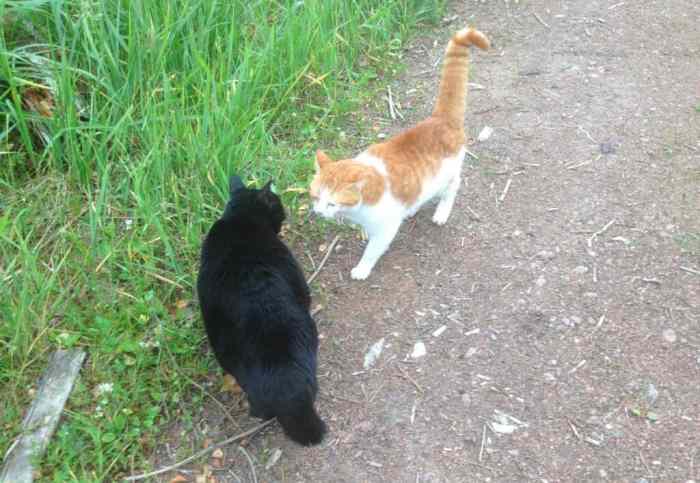
The meaning of a quivering tail isn’t always straightforward. It can change depending on the cat’s age, relationship with its owner, and the overall context of the situation.
Kittens might quiver their tails more frequently as a sign of excitement and playfulness, while adult cats might use it to express a wider range of emotions. Senior cats might exhibit tail tremors due to age-related neurological changes.
A cat’s relationship with its owner or other pets also influences the interpretation of tail signals. A cat comfortable and secure with its owner might quiver its tail as a sign of affection, while a cat wary of strangers might quiver its tail as a sign of anxiety.
Differentiating between a playful quiver and a sign of distress requires careful observation. A playful quiver is usually accompanied by playful behavior, like pouncing or chasing. A sign of distress is often accompanied by defensive postures, like crouching or hissing.
Imagine a flowchart: Start with “Is the cat exhibiting other signs of distress (hissing, flattened ears, dilated pupils)?” If yes, the tail quiver likely indicates fear or anxiety. If no, proceed to “Is the cat engaged in playful behavior (pouncing, chasing)?” If yes, the tail quiver is likely playful excitement. If no, consider the context – is the cat anticipating food, a petting session, or something else?
The answer will help determine the meaning of the quiver.
The Role of the Tail in Cat Communication
The tail serves as a vital visual communication tool for cats, conveying information to other cats and humans. It’s not just about quivering; a variety of tail positions and movements communicate different messages.
Beyond quivering, cats use a range of tail positions and movements to communicate. A high, upright tail signals confidence and friendliness. A tucked tail indicates fear or submission. A swishing tail can signify irritation or focus. A twitching tail often indicates anticipation or excitement.
Cats use their tails to signal dominance, submission, or playfulness. A cat with a puffed-up tail and arched back is signaling dominance and defensiveness. A cat with a tucked tail is signaling submission and fear. A cat with a gently swaying tail is signaling playfulness and invitation.
“The feline tail, a remarkable extension of the spine, has evolved over millennia to serve as a sophisticated communication tool. From subtle twitches to dramatic swishes, the tail allows cats to convey a wealth of information about their emotional state, intentions, and social standing, facilitating complex interactions within their social groups and with humans.”
Distinguishing a Quiver from Other Tail Movements
It’s important to differentiate a quiver from other common cat tail movements, such as swishing, twitching, and puffing, as each carries a distinct meaning.
A quiver is a rapid, localized vibration, often at the tip of the tail. A rapid tail swish is a broader, more sweeping movement, often indicating irritation or focus. A subtle tail twitch is a brief, involuntary movement, often signaling anticipation or excitement. A puffed-up tail indicates fear or defensiveness.
The key difference between a quiver and a rapid tail swish lies in the speed and intensity. A quiver is faster and more localized, while a swish is slower and more encompassing. A subtle tail twitch is less pronounced than a quiver, often barely noticeable. A puffed-up tail is a distinct posture, not a movement.
| Tail Movement | Description | Potential Meaning | Accompanying Behaviors |
|---|---|---|---|
| Quiver | Rapid, localized vibration, often at the tip of the tail | Excitement, anxiety, anticipation | Rubbing against legs, dilated pupils, playful pouncing |
| Swish | Broad, sweeping movement | Irritation, focus, frustration | Ears flattened, hissing, dilated pupils |
| Twitch | Brief, involuntary movement | Anticipation, excitement | Focused gaze, ears forward, slight head tilt |
| Puff | Tail raised and fluffed up | Fear, defensiveness | Arched back, fur standing on end, hissing |
Outcome Summary
So, the next time you see that telltale quiver, remember it’s more than just a wiggle. It’s a message, a subtle clue to your cat’s inner world. By considering the context, accompanying body language, and potential medical factors, you can become a better interpreter of your cat’s needs and emotions. Paying attention to this often-overlooked behavior can strengthen your bond and ensure your feline companion feels understood and cared for.
Keep observing, keep learning, and enjoy the fascinating world of cat communication!
General Inquiries
Why is my cat’s tail twitching slightly when they’re relaxed?
A subtle twitch can be a sign of contentment or simply a residual muscle movement. It’s usually nothing to worry about, especially if your cat is otherwise relaxed and comfortable.
Does a fast, jerky quiver always mean my cat is scared?
Not necessarily! While fear is a common cause, a fast quiver can also indicate intense excitement, like when they’re anticipating a treat or playtime.
Could a sudden change in tail quivering be a sign of illness?
Yes, a significant change in frequency, intensity, or accompanying behaviors warrants a vet visit. It could indicate a neurological issue or other medical problem.
Are there certain cat foods that can affect tail behavior?
While not directly linked to tail quivering, dietary sensitivities or allergies can cause stress and anxiety, which
-could* manifest in altered tail behavior.
How can I tell the difference between a playful quiver and a sign of distress?
Playful quivers are often accompanied by relaxed posture, playful vocalizations, and a generally happy demeanor. Distress quivers are usually paired with flattened ears, dilated pupils, and a tense body.
My cat’s tail puffs up and quivers – what does that mean?
A puffed-up tail combined with a quiver usually indicates fear or defensiveness. Your cat is trying to appear larger and more intimidating.