Ever noticed your cat’s tail twitching, vibrating, or even quivering? It’s a fascinating behavior, and while it might seem random, it’s actually a complex form of communication and a window into your cat’s inner world. From the intricate anatomy of their tails to the neurological processes behind the movement, and the various emotional and physical triggers, let’s dive into the world of cat tail quivering and what it all means.
The tail, far from being just a fluffy appendage, is a sophisticated tool. It’s a direct extension of the spine, packed with vertebrae, muscles, and nerves, allowing for incredible flexibility and control. Understanding this structure is key to understanding why and how cats quiver their tails, and how different breeds might express this behavior differently. We’ll explore everything from the Manx’s lack of a tail to the elegant swish of a Siamese.
The Enigmatic Cat Tail: A Deep Dive into Quivering and Communication
The cat tail. It’s more than just a fluffy appendage; it’s a complex organ, a vital communication tool, and a fascinating subject of study. We’ve all seen it – that rapid, subtle quiver at the tip of a cat’s tail. But what does itmean*? Is it excitement, anxiety, or something else entirely?
This article will explore the anatomy, neurology, behavior, and potential medical implications behind this captivating feline quirk. We’ll unpack the science behind the wiggle, helping you better understand your feline friend.
The Anatomy of a Cat’s Tail
The tail isn’t just an extension of the spine; it’s a sophisticated structure with a specific purpose. Understanding its anatomy is key to understanding its function. The cat’s tail is comprised of vertebrae, muscles, nerves, and skin, all working together to provide balance, agility, and communication.The skeletal structure consists of approximately 18-25 vertebrae, though this number can vary slightly between breeds.
These vertebrae are shorter and more flexible than those in the cat’s spine, allowing for a wide range of motion. Each vertebra is cushioned by intervertebral discs, providing shock absorption and flexibility. Attached to these vertebrae are numerous muscles, arranged in layers. These muscles, controlled by the nervous system, allow the cat to move its tail in various directions – up, down, side to side, and, of course, to quiver.
Nerves originating from the spinal cord run throughout the tail, transmitting sensory information and motor commands. The skin covering the tail is richly supplied with blood vessels and sensory receptors, contributing to the tail’s sensitivity.To visualize this, imagine a detailed cross-section of a cat’s tail. The outermost layer is the skin, covered in fur. Beneath the skin lies a layer of muscle, arranged in concentric rings and longitudinal bundles.
These muscles are connected to the vertebrae via tendons. The vertebrae themselves are visible, each with a distinct disc between them. Within the spinal canal, the spinal cord runs, with nerve roots branching off to innervate the tail muscles and skin. Label key components: vertebrae, intervertebral discs, muscles (longitudinal, circular), spinal cord, nerve roots, skin, fur follicles, blood vessels, sensory receptors.
The diagram should also show a side view illustrating the range of motion possible with the tail’s flexible structure.Tail structure varies across breeds. The Manx, famously, can be born without a tail (or with a severely shortened one), due to a dominant gene mutation. Persians often have long, fluffy tails, while Siamese cats typically have slender, whip-like tails.Here’s a table summarizing these differences:
| Breed | Tail Length | Tail Thickness |
|---|---|---|
| Manx | Absent to Short (1-4 inches) | Thin to Moderate |
| Persian | Long (8-12 inches) | Thick and Plumed |
| Siamese | Medium (6-10 inches) | Slender |
Neurological Basis of Tail Quivering
The quivering action isn’t a random twitch; it’s a carefully orchestrated neurological event. The spinal cord plays a crucial role, acting as a relay station between the brain and the tail muscles. The brainstem, particularly the pons and medulla oblongata, contains centers that control basic motor functions, including tail movements.Specific nerve pathways, primarily involving the ventral spinal cord gray matter, are responsible for the rapid, repetitive contractions that characterize tail quivering.
These pathways involve motor neurons that directly innervate the tail muscles. The precise mechanism isn’t fully understood, but it’s believed to involve a feedback loop where muscle contractions trigger further contractions, creating the quivering effect.Neurotransmitters, chemical messengers that transmit signals between nerve cells, are undoubtedly involved. Likely candidates include acetylcholine, which stimulates muscle contraction, and serotonin, which plays a role in mood and behavior.
Dopamine, associated with reward and motivation, might also be involved, particularly when tail quivering is linked to excitement or hunting behavior.Consider this hypothetical scenario: A cat suffers a spinal cord injury that damages the nerve pathways controlling the tail. As a result, the cat might experience paralysis of the tail, an inability to move it at all. Alternatively, the injury could disrupt the feedback loop responsible for tail quivering, leading to uncontrolled, erratic movements or a complete absence of the quivering response.
Common Causes of Tail Quivering – Emotional States
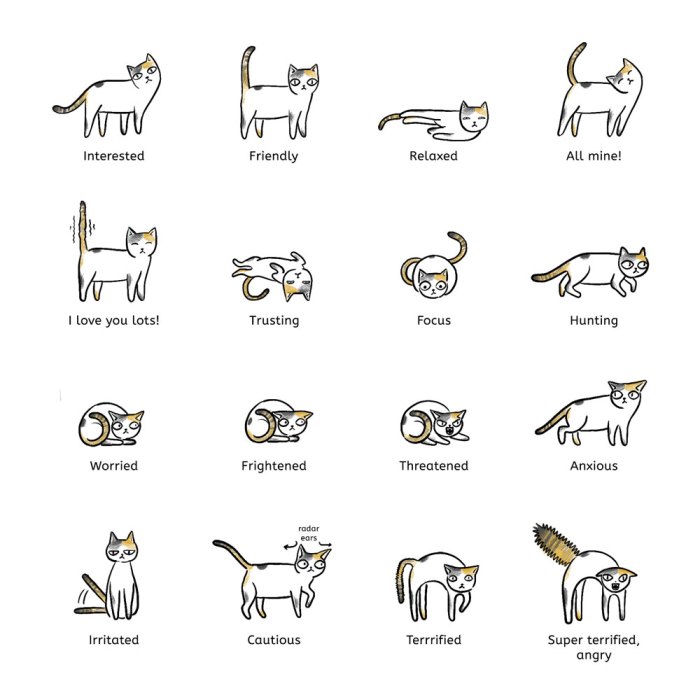
Tail quivering is often a visible manifestation of a cat’s emotional state. It’s a nuanced form of communication, and interpreting it correctly requires considering the context and other body language cues. A wide range of emotions can trigger this behavior, from intense excitement to mild anxiety.Emotions like excitement, anticipation, frustration, and even nervousness can all lead to tail quivering. When a cat is excited, such as when it sees a favorite toy or is about to receive a treat, its heart rate and breathing will increase.
A nervous cat might exhibit dilated pupils and flattened ears alongside the tail quiver. Frustration, often seen when a cat is trying to reach something it can’t, can also manifest as a rapid tail quiver.Accompanying body language cues are crucial for accurate interpretation. An excited cat might have dilated pupils, perked ears, and a playful posture. A nervous cat might crouch low to the ground, tuck its tail, and have flattened ears.
A frustrated cat might vocalize and paw at the object of its frustration.Here’s a table summarizing common emotional triggers:
| Emotion | Tail Quiver Intensity (Low, Medium, High) | Accompanying Body Language | Potential Trigger |
|---|---|---|---|
| Excitement | Medium to High | Dilated pupils, perked ears, playful posture | Seeing a toy, receiving a treat |
| Anxiety | Low to Medium | Flattened ears, crouched posture, dilated pupils | Loud noises, unfamiliar people |
| Frustration | Medium to High | Vocalization, pawing, tense muscles | Inability to reach a desired object |
| Anticipation | Medium | Focused gaze, slightly tense posture | Waiting for food, anticipating playtime |
Common Causes of Tail Quivering – Physical Sensations
While emotions are a primary driver, physical sensations can also trigger tail quivering. Itching, cold, and static electricity are common culprits.A cat’s fur and skin are highly sensitive. Itching, whether due to fleas, allergies, or dry skin, can cause a cat to quiver its tail as it attempts to relieve the discomfort. Cold temperatures can also trigger shivering, which can manifest as tail quivering.
Static electricity, particularly prevalent in dry environments, is a frequent cause.Static electricity builds up as the cat moves, causing a tingling sensation on its fur. This sensation is often accompanied by a crackling sound as the charge dissipates. The cat’s tail, being a long, flexible appendage, is particularly susceptible to static buildup. Imagine the feeling of rubbing a balloon on your hair – that’s similar to what a cat experiences, but on a smaller scale.
The sensation is a prickly, slightly uncomfortable feeling that the cat tries to alleviate by quivering its tail.
Tail Quivering and Hunting Behavior
Source: topcatguide.com
The cat’s tail isn’t just for balance and communication; it’s also intricately linked to its predatory instincts. Tail quivering often occurs when a cat is focused on prey, indicating a heightened state of alertness and anticipation.The connection lies in the cat’s focused attention. When a cat is stalking or preparing to pounce, its entire body is tense and alert. The tail quivering is a manifestation of this heightened state, a subtle sign of the cat’s intense concentration.
It’s a way for the cat to channel its energy and maintain focus.During the stalking phase, the tail might be held low and still, providing stability and minimizing noise. As the cat prepares to pounce, the tail quivering intensifies, becoming more rapid and pronounced. Immediately before the pounce, the tail often freezes, then whips forward with the rest of the body.
“The cat crouched low, muscles coiled like springs. Its eyes were fixed on the unsuspecting mouse, and its tail twitched with barely contained energy. Then, in a blur of motion, it launched itself forward, a silent predator in pursuit of its prey.”
Tail Quivering and Social Interaction
Cats communicate with each other through a complex system of vocalizations, body language, and scent marking. Tail quivering plays a role in this communication, conveying a range of messages depending on the context.Tail quivering can be a form of greeting, a sign of submission, or a display of dominance. A slow, gentle quiver might indicate a friendly greeting. A rapid, agitated quiver can signal anxiety or defensiveness.
A cat that is feeling submissive might quiver its tail while crouching low to the ground.Solitary cats, who have limited social interaction, might exhibit less frequent or less varied tail quivering patterns compared to cats living in multi-cat households. In multi-cat environments, tail quivering becomes a more nuanced form of communication, used to navigate complex social dynamics.Imagine this scenario: A confident cat approaches a more timid cat.
The timid cat, feeling intimidated, begins to quiver its tail slightly while lowering its body. This subtle signal communicates its submission and attempts to diffuse the situation, signaling that it poses no threat.
Medical Conditions Associated with Tail Quivering
While often a normal behavior, unusual or excessive tail quivering can sometimes indicate an underlying medical condition. It’s important to consult a veterinarian if you notice any sudden or significant changes in your cat’s tail behavior.Potential medical conditions include spinal cord abnormalities, nerve damage, skin infections, and arthritis. Spinal cord abnormalities can disrupt the nerve signals controlling the tail, leading to involuntary movements.
Nerve damage, caused by injury or disease, can also affect tail function. Skin infections can cause itching and discomfort, triggering tail quivering. Arthritis in the tail vertebrae can cause pain and stiffness, leading to abnormal movements.Symptoms accompanying tail quivering might include pain, weakness, loss of coordination, and skin lesions. Diagnostic procedures might include a physical examination, neurological assessment, blood tests, and X-rays.Here’s a table summarizing potential conditions:
| Condition | Primary Symptom | Tail Quivering Characteristics |
|---|---|---|
| Spinal Cord Abnormality | Loss of Coordination | Involuntary, erratic movements |
| Nerve Damage | Weakness | Constant, uncontrolled quiver |
| Skin Infection | Itching | Frequent, agitated quiver |
| Arthritis | Pain | Stiff, limited range of motion with quiver |
Breed-Specific Tail Quivering Tendencies
Certain cat breeds might be predisposed to more frequent or intense tail quivering due to genetic factors. While research in this area is limited, anecdotal evidence suggests that some breeds are more expressive with their tails than others.Possible genetic factors could include variations in the density of tail muscles, the sensitivity of nerve receptors, or the regulation of neurotransmitters involved in motor control.
Breeds with long, fluffy tails, like Persians, might exhibit more noticeable quivering due to the increased surface area of the tail.Breeds known for particularly expressive tail movements include Abyssinians, Siamese, and Bengals. These breeds are generally known for their active personalities and communicative nature.Imagine a visual representation comparing tail movement patterns across three breeds: a Persian (slow, deliberate quiver), a Siamese (rapid, whip-like quiver), and a Bengal (dynamic, expressive quiver).
The visualization could be a series of animated GIFs showing each breed’s tail movement in response to a stimulus, highlighting the differences in speed, intensity, and style.
Environmental Factors Influencing Tail Quivering
Environmental factors can significantly impact a cat’s tail behavior. Temperature, humidity, lighting, and stress levels all play a role.Extreme temperatures can trigger shivering, which can manifest as tail quivering. Low humidity can dry out the skin, leading to itching and discomfort. Bright or flickering lights can cause anxiety and stress, potentially leading to increased tail quivering.Stress and anxiety are major contributors to abnormal tail behavior.
Changes in a cat’s routine or surroundings can trigger stress, leading to increased tail quivering.Consider this hypothetical scenario: A new pet, a playful puppy, is introduced into a household with a resident cat. The cat, feeling threatened and anxious by the puppy’s boisterous behavior, might exhibit increased tail quivering, flattened ears, and a defensive posture.
Observing and Interpreting Tail Quivering
Accurately observing and interpreting tail quivering requires careful attention to detail and consideration of the cat’s overall body language. It’s not enough to simply notice the quiver; you need to understand the context and other cues.The cat’s overall body language is paramount. Consider the position of its ears, eyes, and body. Is it relaxed or tense? Is it approaching or retreating?
Is it vocalizing? All of these factors contribute to a complete picture of the cat’s emotional state.Here’s a checklist of questions to ask when trying to determine the cause of tail quivering: What is the cat doing when it starts to quiver? What is happening in the environment? Has there been any recent changes in the cat’s routine or surroundings?
Is the cat exhibiting any other unusual behaviors?Here’s a flowchart illustrating the decision-making process:[Flowchart: Start -> Observe Tail Quivering -> Is the cat showing signs of excitement? (Yes -> Likely excitement; No) -> Is the cat showing signs of anxiety or fear? (Yes -> Likely anxiety/fear; No) -> Is the cat showing signs of physical discomfort (scratching, licking)? (Yes -> Possible physical cause; No) -> Consult a veterinarian if unsure.]
Epilogue
So, the next time you see your cat’s tail quivering, remember it’s more than just a random twitch. It’s a complex signal, potentially reflecting excitement, frustration, physical sensations, or even a deep-seated hunting instinct. By observing your cat’s overall body language and considering the context, you can begin to decipher the message your feline friend is trying to send. Ultimately, understanding cat tail quivering strengthens the bond between you and your furry companion, allowing for a deeper appreciation of their unique communication style.
Common Queries
Why does my cat’s tail quiver when I pet them?
This can be a sign of contentment and relaxation, often accompanied by purring and slow blinking. It’s a way for them to show they’re enjoying the interaction.
Is tail quivering always a sign of excitement?
No, it can also indicate frustration, anxiety, or even discomfort. Pay attention to the rest of their body language to get a better understanding.
Could a medical condition be causing my cat’s tail to quiver excessively?
Yes, certain neurological or spinal issues can cause unusual tail movements. If you notice a sudden or significant change in your cat’s tail behavior, consult a veterinarian.
Why do cats quiver their tails before pouncing?
The quivering is believed to be a way for them to focus their energy and sharpen their senses, preparing for the final strike.
Does static electricity really cause tail quivering?
Yes, especially in dry environments. The friction of fur against fur can build up static charge, causing a tingling sensation that leads to tail quivering.
Are some cat breeds more prone to tail quivering than others?
While all cats can quiver their tails, breeds with particularly expressive tails, like Abyssinians or Bengals, might display it more frequently.