Ever noticed your cat giving you a slow, deliberate wink? It’s a surprisingly common feline behavior, and it’s got many of us wondering – what does it
-really* mean? Beyond the adorable factor, a cat’s wink can be a complex form of communication, rooted in physiology, social dynamics, and even a little bit of evolutionary history. We’re diving deep into the world of feline winking, exploring everything from the science behind it to the cultural significance and how it impacts our bond with these enigmatic creatures.
This isn’t just about a cute quirk; understanding your cat’s winks can offer a fascinating glimpse into their thoughts and feelings. We’ll unpack the different types of winks, the potential medical reasons behind them, and how they fit into the broader context of feline communication. Get ready to become a cat wink expert!
The Enigmatic Wink: Understanding Your Cat’s Subtle Signals
Cats are masters of subtle communication, and a slow blink or a deliberate wink can be surprisingly meaningful. While we often anthropomorphize their behavior, attributing human emotions to their actions, understanding the science and nuances behind a cat’s winking can deepen our appreciation for these fascinating creatures. This article explores the physiological basis of winking, its various meanings, and how it fits into the broader context of feline communication.
The Science of Feline Winking
A cat’s winking action isn’t just a cute quirk; it’s a complex interplay of muscles and membranes. The primary muscle involved is the orbicularis oculi, which encircles the eye and controls its closure. When this muscle contracts, the eyelid draws shut. However, unlike a human wink, which often involves a deliberate, partial closure of one eye, a cat’s blink typically involves both eyes, though the duration and intensity can vary.The differences in winking behavior between breeds can be subtle but potentially related to facial structure and muscle development.
Persian cats, with their flattened faces, might exhibit a slightly different blinking pattern due to the altered positioning of their eyes and surrounding tissues. Siamese cats, known for their expressive faces, might use winking more frequently as part of their overall communication repertoire. However, these are generalizations, and individual variation is significant.A cat’s blink differs significantly from a human wink in both purpose and movement.
A human wink is often a deliberate, social signal – a playful gesture, a secret acknowledgment, or a sign of flirtation. A cat’s blink, while itcan* have social meaning, is also a vital physiological function. It helps to spread tears across the cornea, keeping the eye lubricated and removing debris. The movement is generally smoother and less abrupt than a human wink.The nictitating membrane, or third eyelid, plays a crucial role in feline blinking.
This translucent membrane, located in the inner corner of the eye, sweeps across the eye’s surface during blinking, providing additional lubrication and protection. While humans have vestigial remnants of this membrane, it’s fully functional in cats. The presence and movement of the third eyelid are integral to both regular blinking and winking, contributing to eye health and comfort.
Decoding Cat Communication: What a Wink Might Mean
A cat’s wink isn’t a universal sign of anything specific. Its meaning is heavily reliant on context. It can be a sign of playfulness, affection, dominance, or even a subtle request for attention. Observing the cat’s body language and the surrounding environment is key to accurate interpretation.A slow wink, where the cat closes its eyes slowly and deliberately, is generally considered a sign of trust and relaxation.
It’s often described as a “cat kiss” and is a way of signaling that the cat feels safe and comfortable in your presence. Conversely, a rapid blink can indicate irritation, stress, or even a warning.Cats might wink at humans for various reasons, some intentional and some unintentional. An intentional wink is often a social signal, a way of acknowledging your presence or initiating interaction.
An unintentional wink could be caused by a twitch, an eye irritation, or simply a random muscle spasm. Distinguishing between the two requires careful observation.
| Behavior | Possible Meaning | Contextual Clues |
|---|---|---|
| Slow, deliberate wink | Trust, affection, relaxation | Relaxed posture, purring, slow tail swishing, approaching you gently |
| Rapid, repeated blinking | Irritation, stress, warning | Dilated pupils, flattened ears, tense body posture, hissing |
| Wink followed by head nudge | Affection, desire for attention | Rubbing against you, purring, kneading |
| Wink during play | Playful invitation, acknowledging your movements | Pouncing, batting at toys, playful vocalizations |
Winking in Play and Social Interaction
Winking frequently appears in a cat’s playful repertoire, both with other cats and with humans. During play, a wink can be a way of acknowledging your movements, signaling a playful invitation, or simply adding a touch of humor to the interaction. It’s often accompanied by other playful behaviors like pouncing, batting at toys, and playful vocalizations.Winking plays a role in establishing and maintaining social bonds within a feline group.
A slow wink exchanged between cats can be a sign of mutual trust and acceptance. It’s a way of diffusing tension and signaling that the cat is not a threat.Cats might use winking to signal a desire to play or initiate a friendly interaction. A slow wink, combined with a playful posture, can be a subtle invitation to engage in a game.
It’s a non-threatening way of initiating contact and gauging your response.
- Cat observes human.
- Cat initiates slow wink.
- Human responds with a gentle touch or playful vocalization.
- Cat responds with a head nudge or playful swat.
- Playful interaction ensues.
Medical Considerations: When Winking is a Concern
While winking is often a normal behavior, unusual or excessive winking can be a sign of an underlying medical condition. Eye irritation, corneal ulcers, conjunctivitis, and even neurological problems can all manifest as altered blinking patterns.Signs and symptoms that might indicate a medical problem related to winking include excessive tearing, redness of the eye, squinting, pawing at the eye, and a change in the cat’s overall behavior.
If you notice any of these signs, it’s important to seek veterinary attention promptly.Consult a veterinarian, veterinary ophthalmologist, or a qualified animal healthcare professional if your cat exhibits concerning winking behavior. Early diagnosis and treatment can often prevent serious complications.
| Symptom | Possible Cause |
|---|---|
| Excessive blinking and tearing | Allergies, foreign object in the eye, conjunctivitis |
| Squinting and winking | Corneal ulcer, glaucoma |
| Pawing at the eye and frequent winking | Eye irritation, pain |
| Sudden change in blinking pattern | Neurological problem, facial nerve paralysis |
The Cultural Significance of Cats and Winking
Cats have held a prominent place in human culture for millennia, appearing in art, literature, and folklore across various civilizations. While depictions of cats winking specifically are less common than other feline behaviors, the symbolism associated with cats and their eyes is rich and varied.Ancient Egyptian art frequently portrays cats as revered deities, often with large, expressive eyes. In Japanese folklore, the “maneki-neko” (beckoning cat) is a popular symbol of good luck, often depicted with a raised paw and a knowing gaze.
While not a wink, the expression conveys a sense of intelligence and awareness.The perception of a cat’s wink can vary across different cultural backgrounds. In some cultures, a cat’s gaze is seen as mystical or even supernatural, while in others, it’s simply interpreted as a sign of curiosity or affection.
- Ancient Egypt: Cats were associated with the goddess Bastet, representing protection, fertility, and motherhood. Their eyes were considered windows to the soul.
- Japanese Folklore: Maneki-neko, the beckoning cat, is a symbol of good luck and prosperity.
- Western Culture: Cats are often portrayed as independent, enigmatic creatures, their expressions open to interpretation.
Capturing the Moment: Describing a Cat’s Wink Visually
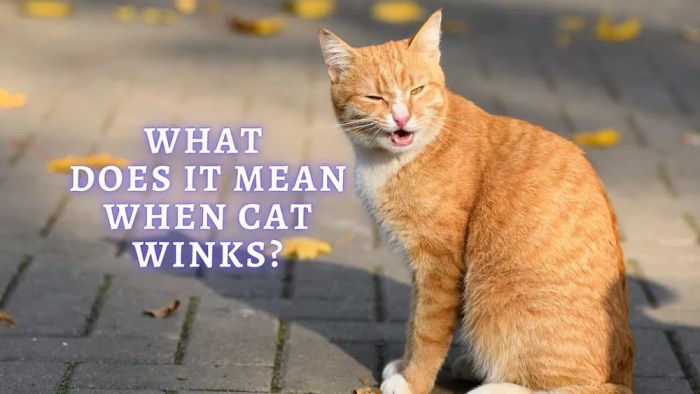
A cat winking is a fleeting moment, a subtle shift in expression that can be difficult to capture in words. The eye itself is the focal point, the eyelid gently descending to meet the lower lid. The orbicularis oculi muscle contracts, creating a slight crease above the eye. The surrounding fur might be slightly flattened or ruffled, adding to the overall expression.To create a visual representation of a cat winking, focus on accuracy and detail.
Pay close attention to the shape of the eye, the curve of the eyelid, and the texture of the fur. Use soft, blended lines to convey the smoothness of the movement.Lighting and shadow play a crucial role in enhancing the expression of a winking cat. Use subtle shading to define the contours of the face and create a sense of depth.
A soft light source can highlight the curve of the eyelid and the glint in the eye, adding to the overall impact of the artwork.
The left eye is gently closed, the eyelid a soft curve against the fur. A faint crease appears above the eye, a subtle indication of the muscle’s work. The right eye remains open, a vibrant emerald green, reflecting the light with a knowing glint.
The fur around the eye is slightly flattened, creating a sense of stillness. The whiskers are relaxed, curving gently outwards. The overall expression is one of quiet contemplation, a moment of connection between cat and observer.
The Psychology of Human Response to a Cat’s Wink
Humans often interpret a cat’s wink as a sign of affection or understanding, attributing human-like emotions to their behavior. This tendency is rooted in anthropomorphism, the projection of human characteristics onto animals. We see a wink and interpret it as a friendly gesture, a sign that the cat likes us.Anthropomorphism influences our perception of feline behavior, particularly winking. We tend to see patterns and meanings in their actions that may not actually be there.
While a cat’s wink can certainly be a sign of affection, it’s important to remember that it can also be caused by a variety of other factors.The neurological processes involved in our emotional response to a cat’s wink are complex and not fully understood. However, it’s likely that mirror neurons, which fire both when we perform an action and when we observe someone else performing that action, play a role.
Seeing a cat wink might trigger a similar neural response as if we were winking ourselves, leading to a feeling of connection and empathy.
“Meow? (Are you looking at me?)
slow wink* (I trust you. You’re okay.) Human
‘Aww, you’re so sweet!’ Cat:head nudge* (Affirmation. Let’s hang out.)”
Winking and Other Feline Facial Expressions
Winking is just one piece of the feline communication puzzle. It’s important to consider a cat’s overall facial expression, including meowing, purring, hissing, and ear position, to accurately interpret their intentions.A cat’s overall facial expression can provide additional context for interpreting a wink. A slow wink combined with a relaxed posture and purring is likely a sign of affection, while a rapid blink combined with flattened ears and hissing is a warning sign.Subtle cues can distinguish a playful wink from a sign of discomfort or aggression.
A playful wink is often accompanied by a relaxed posture, playful vocalizations, and a willingness to engage in interaction. A sign of discomfort or aggression might involve tense muscles, dilated pupils, and a defensive posture.
| Expression | Description | Possible Meaning | Associated Body Language |
|---|---|---|---|
| Slow Wink | Gentle closure of both eyes | Trust, affection, relaxation | Relaxed posture, purring, slow tail swishing |
| Rapid Blink | Quick, repeated blinking | Irritation, stress, warning | Dilated pupils, flattened ears, tense body posture |
| Meowing | Vocalizations of varying pitch and tone | Request for attention, hunger, greeting | Approaching, rubbing against legs, looking at food |
| Purring | Vibrating sound produced by the vocal cords | Contentment, relaxation, sometimes pain | Relaxed posture, closed eyes, kneading |
The Evolution of Feline Communication
Source: thepets.net
The evolution of feline communication is a complex process shaped by genetics, environment, and social interactions. Facial expressions like winking likely evolved to facilitate social interaction and survival.Cats’ ancestors, solitary hunters, gradually developed more complex communication systems as they began to live in closer proximity to each other. Facial expressions, including winking, likely served as a way to signal intentions, diffuse tension, and establish social hierarchies.Genetics and environmental factors play a role in shaping feline communication patterns.
Certain breeds might be predisposed to certain communication styles, while early experiences can also influence how a cat interacts with others.
- Early Felines (Millions of Years Ago): Primarily relied on scent marking and vocalizations for communication.
- Transition to Social Groups (Thousands of Years Ago): Facial expressions, including subtle movements of the eyes and ears, began to evolve as a means of non-verbal communication.
- Domestication (Thousands of Years Ago – Present): Increased interaction with humans led to further refinement of feline communication, with cats adapting their behavior to better interact with their human companions.
Creating a Feline-Friendly Environment that Encourages Positive Interaction
Creating a home environment that promotes positive interactions between cats and humans is essential for fostering a strong bond. This involves providing enrichment, ensuring safety, and understanding feline communication, including winking.Understanding feline communication, including winking, can significantly improve the human-cat bond. By learning to interpret their subtle signals, we can better respond to their needs and create a more harmonious relationship.Respecting a cat’s boundaries and allowing them to initiate interactions is crucial.
Forcing interaction can lead to stress and anxiety. Instead, allow the cat to approach you on their own terms.
- Provide scratching posts and climbing structures.
- Offer a variety of toys to stimulate play.
- Create safe hiding places where the cat can retreat when feeling overwhelmed.
- Observe your cat’s body language and respect their boundaries.
- Learn to interpret their subtle signals, including winking.
Ending Remarks
From the intricate mechanics of the nictitating membrane to the subtle nuances of a playful wink versus a sign of discomfort, we’ve covered a lot of ground. Ultimately, a cat’s wink is a window into their world, a small but significant piece of the puzzle that helps us understand these complex and captivating companions. By paying attention to the context, body language, and overall situation, you can start to decipher the meaning behind those winks and strengthen your connection with your feline friend.
So, next time your cat gives you that knowing look, you’ll be better equipped to interpret it – and maybe even return the gesture (though they might just think you’re a little odd!).
Essential FAQs
Why do cats have a third eyelid (nictitating membrane)?
The nictitating membrane, or third eyelid, helps keep the eye moist and protected from debris. It’s a crucial part of feline eye health and plays a role in both blinking and winking.
Is a rapid blink the same as a wink?
No! A rapid blink is often a sign of stress or anxiety, while a slow wink is usually a sign of relaxation or affection. It’s all about the speed and intention.
Could a cat winking be a sign of a medical problem?
Yes, excessive or unusual winking can indicate eye irritation, corneal ulcers, or other issues. If you notice a change in your cat’s winking behavior, it’s best to consult a vet.
Do different cat breeds wink differently?
While all cats have the ability to wink, some breeds, like Persians with their flatter faces, might exhibit slightly different winking patterns due to anatomical differences.
Why do cats sometimes wink at humans?
It can be a sign of affection, a playful invitation, or simply a way for them to acknowledge your presence. Context is key!
What does it mean when a cat winks and then rubs against me?
This is a strong sign of affection and bonding! They’re marking you with their scent and showing you they feel comfortable and safe around you.