Ever wondered if your cat remembers their littermates, even after years apart? It’s a fascinating question that delves into the complex world of feline social behavior. From scent marking to subtle vocalizations, cats have a surprisingly sophisticated way of communicating and forming bonds. This exploration will unpack the science behind sibling recognition in cats, examining everything from early kittenhood to long-term relationships and the surprising role of genetics.
We’ll journey through how kittens develop these crucial social connections, looking at the vital role scent plays in identification, the nuances of their vocalizations, and even how play contributes to establishing a social hierarchy. Understanding these factors can shed light on why your cat might react a certain way when encountering another feline, especially one from their early days.
Do Cats Recognize Their Siblings? A Deep Dive
The question of whether cats recognize their siblings is surprisingly complex and fascinating. While we often see cats interacting with other felines, the nature of those interactions – especially with those they grew up with – can reveal a lot about their social understanding. This article explores the science and observations behind sibling recognition in cats, covering everything from scent and vocalizations to long-term relationships and the impact of the environment.
We’ll unpack how these furry companions navigate their social world and whether those early bonds truly last a lifetime.The ability to recognize and form bonds with littermates is a crucial aspect of feline social development. It lays the groundwork for how they interact with other cats throughout their lives. Understanding this process can help us better appreciate our own cats and provide them with the best possible environment for social well-being.
Early Development & Sibling Recognition
The first few weeks of a kitten’s life are critical for social development, including the formation of bonds with their littermates. This period, roughly from birth to 8 weeks, is a sensitive time when kittens are highly receptive to forming social attachments. During this time, kittens are heavily reliant on their mother for warmth, food, and security, and these interactions shape their understanding of social cues and relationships.Scent marking plays a vital role in identifying littermates during this critical period.
Kittens begin scent marking very early on, rubbing against each other and their mother to deposit pheromones. These pheromones create a unique “litter scent” that allows kittens to recognize each other. It’s a form of olfactory identification, essentially a scent signature that says, “You belong with me.” Maternal behavior also significantly influences the development of sibling relationships. A mother cat’s grooming, nursing, and play interactions with each kitten contribute to the strengthening of these bonds.
She essentially teaches them how to interact appropriately with others.Here’s a table illustrating scent marking development during kittenhood:
| Age Range | Behavioral Changes | Scent-Related Actions |
|---|---|---|
| 2-4 weeks | Increased mobility, exploration of littermates | Frequent rubbing against littermates and mother, initial scent deposition |
| 4-6 weeks | More active play, beginning to establish hierarchies | More deliberate scent marking, rubbing faces and flanks, urine marking (less common) |
| 6-8 weeks | Independent exploration, weaning | Continued scent marking, establishing individual scent profiles within the litter scent |
Scent as a Primary Identifier
Feline scent communication is far more complex than simply marking territory. It’s a nuanced system used to convey a wide range of information, including identity, emotional state, and reproductive status. Cats possess several scent glands strategically located throughout their bodies. The perianal glands, located around the anus, release a strong scent when a cat feels threatened or is marking territory.
Facial glands, found on the cheeks and chin, are used for familiar scent marking, allowing cats to recognize each other and create a sense of belonging. Paw pads also contain scent glands, leaving a trail of scent as they walk.Cats readily differentiate between familiar and unfamiliar individuals using scent. When encountering a new cat, they will often approach cautiously, sniffing extensively to gather information.
They compare the scent of the unfamiliar cat to their mental “scent library” of familiar individuals, including siblings, other household cats, and even cats they’ve encountered previously.Here’s a flowchart illustrating the process a cat uses to identify another cat through scent:[Imagine a flowchart here. It would start with “Cat encounters another cat.” Then branches to “Sniffs extensively (facial, paw, flank).” Next, “Compares scent to memory bank.” Then branches to “Familiar scent?
Yes -> Relaxed posture, friendly approach. No -> Cautious approach, potential aggression.”]
Vocalizations & Communication
Kittens use a variety of unique vocalizations to communicate with their siblings, particularly during the early stages of development. These vocalizations are often high-pitched and plaintive, used to solicit attention from their mother and siblings. As they mature, these vocalizations change, becoming more varied and nuanced. While they may not retain
exactly* the same sibling-specific calls, subtle differences in tone and frequency can still indicate a special bond.
The vocalizations used with siblings differ from those used with other cats. With siblings, there’s often a greater degree of comfort and familiarity, leading to softer, more relaxed vocalizations. Interactions with unfamiliar cats are more likely to involve hissing, growling, or other defensive sounds.Here’s a categorized list of kitten vocalizations by function:
- Play: Chirps, trills, playful meows
- Comfort: Soft purrs, gentle meows
- Demand: Loud meows, insistent cries
- Distress: High-pitched wails, cries of separation
- Greeting: Short, friendly meows
Play Behavior & Social Interaction
Play is a crucial aspect of feline social development, especially among siblings. Common play behaviors include chasing, pouncing, wrestling, and mock biting. These interactions aren’t just for fun; they contribute significantly to establishing and maintaining social hierarchies within the litter. Kittens learn to negotiate boundaries, assert dominance, and yield to others through play.Play styles often differ when interacting with siblings versus non-siblings.
With siblings, play tends to be more relaxed and forgiving, with a greater tolerance for roughhousing. Interactions with non-siblings can be more cautious and less intense, as cats assess each other’s intentions and boundaries.
| Play Behavior | Sibling Interaction | Non-Sibling Interaction | Potential Meaning |
|---|---|---|---|
| Chasing | Energetic, playful, often with role reversals | More cautious, assessing the other cat’s reaction | Establishing dominance, practicing hunting skills |
| Wrestling | Roughhousing, playful biting, mutual submission | Less intense, more cautious, avoiding injury | Testing boundaries, establishing hierarchy |
| Pouncing | Surprise attacks, playful ambushes | More controlled, less aggressive | Practicing hunting skills, asserting dominance |
Physical Characteristics & Recognition
While cats primarily rely on scent and vocalizations for recognition, theycan* also recognize siblings based on physical appearance, although this is less reliable. Their color perception is limited compared to humans; they see primarily blues and yellows. However, they can still distinguish between subtle differences in coat patterns, markings, and body size.[Imagine a scenario here: “A cat, now an adult, is reunited with a sibling after several years apart.
Initially, the cat approaches cautiously, sniffing extensively. As it recognizes the familiar scent, it also notices the distinctive white patch on the other cat’s ear – a feature it remembers from kittenhood. This combination of scent and visual cues confirms the sibling relationship.”]
Long-Term Sibling Relationships
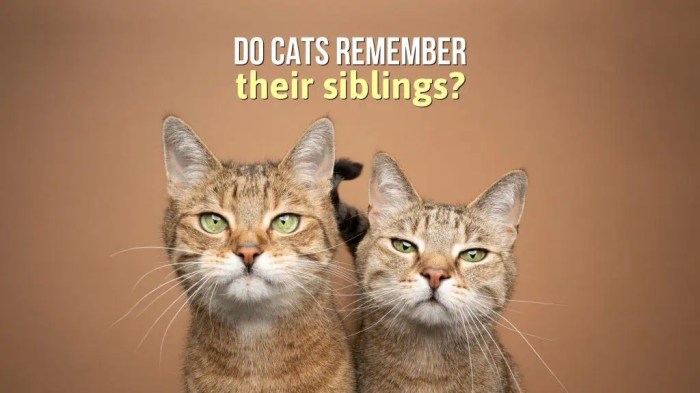
Source: betterwithcats.net
As cats mature and live separate lives, sibling relationships evolve. While the intensity of daily interaction may decrease, the underlying bond often remains. Cats can retain recognition of their siblings even after long periods of separation, sometimes exhibiting excitement or a sense of familiarity upon reunion. Re-establishing bonds upon reunion can be a heartwarming experience, often involving mutual grooming and relaxed postures.[Imagine a timeline here: “Kittenhood (0-8 weeks): Intense bonding through scent and play.
Adolescence (6-18 months): Establishing independence, potential for minor conflicts. Adulthood (18+ months): Reduced interaction, but retained recognition and potential for positive reunions.”]
Environmental Factors & Influence
The environment significantly impacts sibling interactions. A stable, predictable home environment with ample resources promotes positive relationships. Conversely, a stressful environment with limited resources can lead to competition and conflict. Introducing new cats into the environment can disrupt existing sibling bonds, requiring careful management and gradual introductions.
| Environmental Factor | Impact on Sibling Relationship | Potential Solutions |
|---|---|---|
| Limited Resources (food, water, litter boxes) | Increased competition, potential for aggression | Provide multiple feeding stations, water bowls, and litter boxes |
| Stressful Environment (loud noises, frequent visitors) | Increased anxiety, potential for conflict | Create safe spaces, provide enrichment, minimize stressors |
| Introduction of New Cat | Disruption of existing hierarchy, potential for conflict | Gradual introduction, supervised interactions, separate resources |
Individual Cat Personalities
Individual cat personalities profoundly influence sibling dynamics. Dominant personalities may assert themselves more frequently, while submissive personalities may defer to others. Different personality types can affect recognition and interaction, with some cats being more affectionate and playful than others.Here’s a list of personality traits commonly observed in cats and how they might influence sibling relationships:
- Confident: May take the lead in play and social interactions.
- Shy: May be more reserved and less likely to initiate interactions.
- Playful: Will actively engage in play with siblings.
- Independent: May prefer solitary activities and less interaction.
- Affectionate: Will seek out physical contact and grooming with siblings.
Genetic Factors & Predisposition
Genetics likely play a role in the likelihood of cats recognizing their siblings. Shared genes can influence social behavior and bonding, potentially predisposing some cats to form stronger attachments with their littermates. Research exploring the genetic basis of feline social relationships is still in its early stages, but it suggests that certain genes may influence social behavior.[Imagine a diagram here: “A simplified diagram showing genes influencing social behavior.
One gene might be labeled ‘Social Bonding,’ with variations leading to stronger or weaker bonds. Another gene might be labeled ‘Aggression,’ with variations influencing the likelihood of conflict.”]
Behavioral Indicators of Recognition
Observable behaviors suggest a cat recognizes its sibling. These include mutual grooming, sharing resources (food, water, resting spots), and relaxed postures during interactions. Differentiating between friendly and aggressive behaviors is crucial. Friendly interactions involve gentle touching, purring, and slow blinking, while aggressive behaviors include hissing, growling, and swatting. Subtle cues like a relaxed posture or slow blinking indicate recognition and comfort.Here’s a checklist of behavioral indicators to help identify whether cats recognize their siblings:
- Mutual grooming
- Sharing food or water
- Relaxed posture during interaction
- Slow blinking
- Playful interactions
- Absence of hissing or growling
Last Point
Ultimately, the evidence suggests that cats
-do* recognize their siblings, though the strength of that recognition can vary greatly depending on individual personalities, environmental factors, and the length of separation. While visual cues play a minor role, scent remains the primary identifier, and early experiences shape lasting bonds. Whether it’s a joyful reunion or a cautious sniff, the echoes of kittenhood often linger in the feline world, reminding us of the enduring power of family – even for our independent feline friends.
So, next time you see your cat interacting with another feline, consider the possibility that they might be reconnecting with a piece of their past, a sibling from a time of playful wrestling and shared warmth.
Commonly Asked Questions
How early do kittens start recognizing their siblings?
Kittenhood, particularly the first few weeks, is a critical period. Social bonds, including sibling recognition, are formed during this time, heavily influenced by maternal behavior and scent marking.
What’s the most important way cats identify each other?
Scent! Cats have a complex scent communication system, using various glands to convey information. It’s far more than just marking territory; it’s a key identifier.
Do cats use different vocalizations with their siblings than with other cats?
Yes, kittens often develop unique vocalizations with their littermates. While these may change as they mature, there’s evidence they retain some sibling-specific calls.
Can cats recognize their siblings after a long separation?
It’s possible! While the strength of the bond may diminish, cats can often retain recognition, and reunions can sometimes lead to re-establishing bonds.
How does the environment affect sibling relationships?
The environment plays a big role. Resource availability (food, water, litter boxes) and the introduction of new cats can significantly impact sibling dynamics.
What are some signs that a cat recognizes its sibling?
Look for behaviors like grooming, sharing resources, relaxed posture, slow blinking, and a generally comfortable interaction.
Do genetics influence whether cats recognize their siblings?
There’s growing evidence that genetics
-do* play a role, potentially influencing social behavior and bonding tendencies.

