Ever feel like your cat’s shadow, following you from room to room? It’s a common experience, and it can be both endearing and a little perplexing. Why
-is* my cat obsessed with me? The answer isn’t always simple; it’s a fascinating mix of evolutionary history, learned behaviors, individual personality, and even how your cat perceives the world through their incredible senses.
We’ll dive into all of that, exploring everything from their ancestral roots to the subtle ways you might be unintentionally reinforcing their clinginess.
Understanding your cat’s behavior starts with recognizing that cats weren’t always cuddly companions. Their wild ancestors were solitary hunters, but domestication has dramatically altered their social dynamics. Early experiences, particularly during kittenhood, play a huge role in shaping their ability to form bonds. We’ll look at different attachment styles – secure, anxious, and avoidant – and how they manifest in your cat’s actions.
It’s not just about affection; it can also be about resource dependence, personality quirks, and even underlying medical concerns.
Why Is My Cat Obsessed With Me? Unraveling the Feline-Human Bond
You’ve noticed it. That unwavering gaze, the constant presence, the insistent need to be near. Your cat seems… obsessed with you. It’s endearing, sure, but also a little perplexing. Is it just affection, or is something else going on?
This article dives deep into the reasons behind your cat’s intense focus, exploring everything from evolutionary roots to individual personality quirks, and offering insights into how to understand and respond to your feline friend’s behavior.
Understanding why your cat is so attached to you requires looking at a complex interplay of factors. It’s not simply about love (though that’s likely a part of it!). It’s a blend of instinct, learned behavior, personality, and even sensory perception. Let’s break it down.
The Foundation of Feline Affection – Why Cats Bond
The modern domestic cat’s behavior is a fascinating mix of its solitary ancestral past and its long history of coexisting with humans. Wild cats, like their ancestors, were largely solitary hunters, only coming together to mate. However, over thousands of years of domestication, cats have adapted to living alongside humans, and a surprising number have formed strong bonds. This isn’t a complete abandonment of their independent nature, but rather a modification of it, driven by both evolutionary advantage and learned association.
Early socialization plays a crucial role. Kittens who experience positive interactions with humans during their critical socialization period (roughly 2-7 weeks of age) are more likely to develop into confident, affectionate adults. Exposure to gentle handling, playful interaction, and consistent care during this time lays the groundwork for forming secure attachments. Conversely, kittens who are isolated or experience negative interactions may develop anxious or avoidant attachment styles.
Cats, like humans, exhibit different attachment styles. While research is ongoing, we can observe these patterns in feline behavior:
| Attachment Style | Behavioral Indicators | Potential Causes |
|---|---|---|
| Secure | Comfortable being near you, seeks affection on their terms, explores independently, returns to you for reassurance when needed. | Positive early socialization, consistent care, predictable environment. |
| Anxious | Excessive clinginess, constant meowing, follows you everywhere, displays separation anxiety, may become distressed when you leave. | Inconsistent care, early separation from mother, lack of socialization, perceived threats in the environment. |
| Avoidant | Appears aloof, avoids physical contact, may react negatively to attempts at affection, prefers independence. | Negative early experiences with humans, lack of socialization, may have been punished for seeking attention. |
Resource Dependence & The Human Provider Role
At its core, a cat’s attachment to a human is often rooted in resource dependence. Cats are intelligent creatures who quickly learn to associate humans with essential resources: food, water, shelter, and safety. This isn’t just about being fed; it’s about the predictability and security that comes with knowing a human will consistently provide for their needs.
Operant conditioning, a learning process where behaviors are strengthened or weakened by their consequences, plays a significant role. When a cat exhibits a behavior (e.g., rubbing against your legs) and is rewarded with a positive consequence (e.g., a treat, petting), that behavior is more likely to be repeated. This positive reinforcement strengthens the human-cat bond and encourages attention-seeking behavior.
The more a cat relies on a human for these resources, the more likely they are to seek out their attention. It becomes a learned pattern: attention = potential reward.
Here’s a flowchart illustrating this cycle:
- Cat Exhibits Behavior (e.g., meows, rubs)
- Human Provides Resource (e.g., food, petting)
- Cat Experiences Positive Reinforcement
- Bond Strengthens
- Cat Repeats Behavior (Increased Dependence)
Personality Traits & Individual Cat Quirks
Just like humans, cats have distinct personalities. Some are naturally affectionate and cuddly, while others are more independent and aloof. Understanding your cat’s personality type can provide valuable insights into their behavior.
Common feline personality types include: affectionate, independent, playful, anxious, and cautious. An affectionate cat might be constantly seeking your attention, while an independent cat might only approach you when they feel like it. A playful cat might initiate games and interactions, while an anxious cat might exhibit signs of stress, such as hiding or excessive grooming.
A cat’s individual personality can significantly contribute to an intense focus on a specific human. For example, a cat with an anxious personality might cling to their human for reassurance, while a playful cat might constantly seek out their human for games and interaction. Breed can also play a role, with some breeds (like Ragdolls or Persians) being predisposed to increased affection and clinginess.
- Affectionate: Frequent rubbing, purring, kneading, seeking lap time.
- Independent: Minimal interaction, prefers solitary activities, approaches on their own terms.
- Playful: Initiates games, chases toys, enjoys interactive play with humans.
- Anxious: Hiding, excessive grooming, changes in appetite, clinginess, vocalization.
- Cautious: Hesitant to explore new environments, wary of strangers, slow to warm up to new people.
The Sensory Experience – Why You Specifically?
Cats experience the world through their senses in a way that’s vastly different from humans. Their heightened senses of smell, hearing, and vision contribute to their perception of the world and their preferences for certain individuals.
Pheromones, chemical signals released by cats, play a crucial role in feline bonding. A human’s scent, particularly the scent of their skin and clothing, can be particularly appealing to a cat. Cats have a remarkable ability to distinguish subtle differences in scent, and they may be drawn to a human whose scent they find comforting or familiar.
Cats also associate specific sounds and movements with positive experiences. The sound of your voice, the way you move, or even the feel of your touch can trigger positive associations and reinforce their desire to be near you.
Imagine a cat experiencing the world: The air is thick with a symphony of scents – the faint aroma of the neighbor’s cat, the lingering smell of the freshly cleaned litter box, and, most prominently,
-you*. Your scent is a complex blend of familiar notes – the subtle musk of your skin, the comforting fragrance of your laundry detergent, the faint trace of the food you ate earlier.
As you move, your footsteps create a rhythmic vibration that resonates through the floor, a predictable and reassuring pattern. The gentle rustle of your clothing is a familiar sound, a signal that you are present and attentive. It’s a sensory tapestry woven with comfort, security, and the promise of connection.
Routine & Habit Formation – The Predictability Factor
Cats thrive on routine. They find comfort and security in knowing what to expect. Consistent interactions with a specific human can create a strong habit, reinforcing their desire to be near that person.
A cat might become “obsessed” with a human simply because that human is consistently present and predictable. They learn that you are the source of food, affection, and safety, and they naturally gravitate towards you.
Changes in routine can disrupt a cat’s behavior and lead to increased anxiety or attention-seeking. If you suddenly start working from home, traveling more, or changing your feeding schedule, your cat may become clingier or exhibit other signs of stress.
| Routine Element | Cat’s Response |
|---|---|
| Consistent Feeding Times | Predictable behavior, reduced anxiety. |
| Daily Play Sessions | Increased engagement, reduced boredom. |
| Regular Grooming | Relaxation, bonding. |
| Sudden Change in Schedule | Increased anxiety, attention-seeking, changes in appetite. |
Medical Considerations & Underlying Causes
While affection and learned behavior are often the primary drivers of a cat’s intense focus, it’s important to rule out any underlying medical conditions. Hyperthyroidism, for example, can cause increased appetite, restlessness, and clinginess. Cognitive dysfunction, a form of dementia in older cats, can also lead to anxiety and increased dependence on their human companions.
Anxiety or stress can also manifest as increased attention-seeking behavior. A cat who is feeling anxious may cling to their human for reassurance or exhibit other signs of distress.
It’s crucial to consult with a veterinarian to rule out any medical causes before attributing a cat’s behavior solely to affection. A thorough examination and appropriate diagnostic tests can help identify any underlying health issues that may be contributing to their behavior.
The Human Response & Reinforcing Behavior
Our reactions to a cat’s attention-seeking behavior can inadvertently reinforce it. Petting, talking, or playing with a cat when they demand attention can strengthen their desire to repeat that behavior.
Even negative attention, such as scolding or pushing a cat away, can inadvertently reinforce attention-seeking. The cat still receives a response from you, which can be interpreted as a form of interaction and encouragement.
Consistent boundaries and redirection can help manage excessive attention-seeking. Ignoring unwanted behaviors and redirecting the cat’s attention to a more appropriate activity can gradually reduce their reliance on attention-seeking for interaction.
- Do: Provide regular playtime, offer enrichment activities, establish consistent routines, ignore unwanted behaviors.
- Don’t: Reward attention-seeking with excessive petting or treats, scold or punish the cat, ignore signs of anxiety or distress.
Specific Behaviors & Their Interpretations
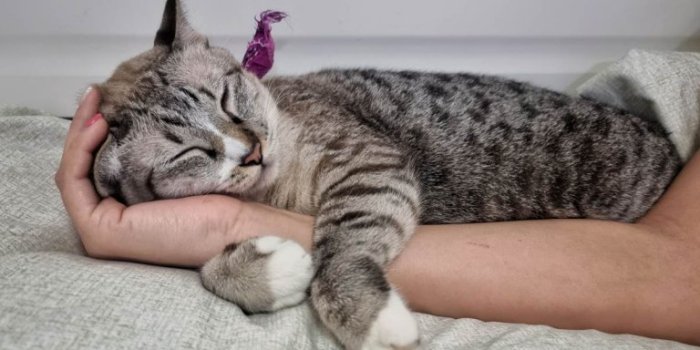
Source: cats.com
Common behaviors associated with a cat’s intense focus on a human include following, rubbing, vocalizing, and kneading. Each behavior can have multiple meanings, ranging from affection to anxiety to resource-seeking.
Following can indicate affection, anxiety, or a desire for food. Rubbing against your legs can be a sign of affection, scent marking, or a request for attention. Vocalizing can be a way of communicating needs, expressing frustration, or simply seeking interaction. Kneading, a behavior learned as kittens while nursing, can be a sign of contentment and relaxation.
The context of the behavior is crucial for understanding its underlying motivation. A cat who follows you around while meowing might be hungry, while a cat who rubs against your legs and purrs might be seeking affection.
Imagine a cat weaving between your legs, purring loudly, and gently kneading your ankles. They then look up at you with wide, expectant eyes, letting out a soft meow. This could be a combination of affection (the purring and kneading), a desire for attention (the meow and eye contact), and perhaps a subtle hint of resource-seeking – they might be hoping for a treat or a head scratch.
The fact that they’re doing this in the kitchen, shortly before their usual feeding time, further suggests that food might be a factor.
Age-Related Changes & Shifting Dynamics
A kitten’s attachment style and behavior evolve as they mature into adult cats. Kittens are often more playful and energetic, while adult cats may become more independent and selective about their interactions.
Senior cats might exhibit increased clinginess due to age-related cognitive decline or anxiety. As their senses decline and their mobility decreases, they may rely more heavily on their human companions for comfort and security.
A cat’s relationship with a human can change over time, influenced by factors such as health, lifestyle, and the cat’s own personality.
- Kittenhood (2-7 weeks): Critical socialization period, forming initial attachments.
- Adolescence (6 months – 2 years): Increased independence, testing boundaries.
- Adulthood (2-7 years): Established routines, stable relationships.
- Senior Years (7+ years): Potential for increased clinginess, cognitive decline, health concerns.
Distinguishing Affection from Anxiety or Need
Differentiating between genuine affection and attention-seeking driven by anxiety or unmet needs is essential for addressing a cat’s behavior effectively. While affection is a positive and rewarding interaction, attention-seeking driven by anxiety or need may indicate an underlying problem that requires intervention.
Signs of anxiety in cats include hiding, excessive grooming, changes in appetite, and aggression. These behaviors can manifest as increased clinginess as the cat seeks reassurance from their human companion.
Addressing underlying anxiety or unmet needs, such as providing a safe and stimulating environment, offering enrichment activities, and ensuring consistent routines, can help reduce attention-seeking behavior.
| Behavior | Possible Interpretation (Affection) | Possible Interpretation (Anxiety/Need) |
|---|---|---|
| Constant Following | Desire for companionship, seeking affection. | Anxiety, fear, separation anxiety. |
| Excessive Vocalization | Greeting, expressing contentment. | Hunger, pain, cognitive dysfunction. |
| Excessive Grooming | Self-soothing, relaxation. | Anxiety, stress, skin irritation. |
Ultimate Conclusion
So, is your cat’s intense focus a sign of pure, unadulterated love, or something else entirely? The truth is, it’s likely a combination of factors. By understanding the evolutionary roots of feline affection, the role of positive reinforcement, and the nuances of your cat’s individual personality, you can better interpret their behavior and build an even stronger, more fulfilling relationship.
Remember, observing changes in behavior is important, and a vet visit can rule out any underlying medical issues. Ultimately, appreciating your cat’s unique quirks and responding thoughtfully to their needs will strengthen your bond and create a happy home for both of you.
Whether it’s a gentle head-butt, a constant purr, or a persistent demand for attention, cherish those moments – they’re a testament to the special connection you share with your feline friend!
Question Bank
Why does my cat follow me everywhere?
It’s often a combination of wanting to be near you for comfort, security, and access to resources like food and attention. It can also be a habit formed through consistent interaction.
Could my cat’s clinginess be a sign of illness?
Yes, increased clinginess can sometimes indicate underlying medical conditions like hyperthyroidism or cognitive dysfunction. It’s always best to consult a vet to rule out any health concerns.
How can I tell if my cat is anxious versus just affectionate?
Look for signs of anxiety like hiding, excessive grooming, changes in appetite, or dilated pupils. Affectionate cats are generally relaxed and playful, while anxious cats may be tense and withdrawn.
Should I reinforce my cat’s attention-seeking behavior?
Be mindful of how you respond. While positive attention like petting is good, avoid rewarding excessive meowing or demanding behavior with treats or playtime every time.
My cat kneads on me constantly – what does that mean?
Kneading is a comforting behavior rooted in kittenhood when they would knead their mother’s belly to stimulate milk flow. It’s often a sign of contentment and relaxation.
Is it normal for older cats to become more clingy?
Yes, senior cats may become more clingy due to age-related cognitive decline, anxiety, or a need for increased comfort and security.
My cat only wants attention when I’m trying to do something else – why?
They’ve likely learned that interrupting you gets them your attention! Consistent boundaries and redirecting their focus can help manage this behavior.

