Ever been captivated by a cat’s unique coat? The swirling patterns of a tortoiseshell or the striking patches of a calico are truly mesmerizing. These aren’t just pretty colors; they’re a fascinating window into the world of feline genetics, revealing a complex interplay of chromosomes and genes. We’re diving deep into the differences and similarities between these two stunning coat patterns, exploring everything from their genetic origins to their cultural significance.
Understanding tortoiseshell and calico cats goes beyond just appreciating their beauty. It touches on the science of X-linked traits, the role of the white spotting gene, and even potential health considerations. We’ll break down the science in a way that’s easy to understand, while also celebrating the unique charm each pattern brings to the feline world.



Tortoiseshell vs. Calico Cats: A Colorful Genetic Tale
The world of cat colors is surprisingly complex, and two patterns – tortoiseshell and calico – often cause confusion. Both are stunning, showcasing a beautiful mix of colors, but they arise from different genetic mechanisms. This article dives deep into the genetics, characteristics, and cultural significance of these captivating felines, helping you understand what makes each pattern unique. We’ll explore everything from the science behind the colors to the breeds that commonly display them, and even touch on some fascinating folklore.Understanding the nuances of tortoiseshell and calico cats requires a bit of genetic detective work.
It’s not just about pretty colors; it’s about how genes interact to create these striking patterns. Let’s unravel the science behind the magic.
Defining Tortoiseshell Cats
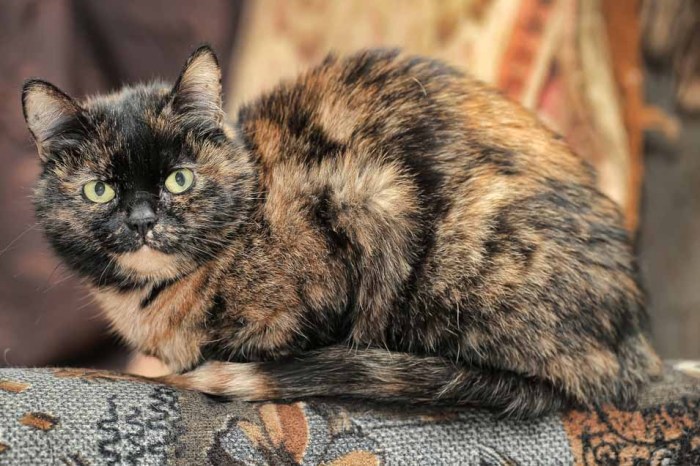
Tortoiseshell cats are a visual delight, known for their patchwork of colors. The name itself, “tortoiseshell,” comes from the resemblance of their coats to the shell of a tortoise. But what creates this unique appearance? It all boils down to genetics, specifically the X chromosome.The genetic basis of the tortoiseshell pattern is fascinating. The gene responsible for orange or black fur color is located on the X chromosome.
Female cats have two X chromosomes (XX), while males have one X and one Y chromosome (XY). During early development, a process called X-inactivation occurs, where one of the X chromosomes in females is randomly deactivated in each cell. This means that some cells will express the orange allele (O) and others will express the black allele (B). The resulting mosaic of cells creates the tortoiseshell pattern.
Males (XY) typically only have one X chromosome, so they usually express either orangeor* black, not both. Rarely, a male can be tortoiseshell due to a chromosomal abnormality (XXY), but this is uncommon and often associated with health issues.The color variations within the tortoiseshell pattern are surprisingly diverse. While the classic combination is orange and black, you can also find variations like cream and chocolate, or even red and blue.
The intensity of the colors can also vary, ranging from deep, rich tones to paler, more muted shades. The distribution of the colors can be patchy, brindled (streaky), or even swirl-like, adding to the uniqueness of each cat.Coat textures also play a role in the overall appearance. Tortoiseshell cats can have short, sleek coats like those of a Siamese, medium-length fur like a British Shorthair, or long, flowing coats like a Persian.
The texture doesn’t directly influence the color pattern but contributes to the cat’s overall aesthetic.Here’s a table summarizing common tortoiseshell color combinations:
| Color Combination | Description | Rarity | Associated Breed (if applicable) |
|---|---|---|---|
| Orange & Black | Classic combination; often vibrant and striking. | Medium | American Shorthair, British Shorthair |
| Cream & Chocolate | Dilute version of orange and black; softer, pastel shades. | Medium | Exotic Shorthair |
| Red & Blue | Rich, deep tones of red and blue-gray. | High | Turkish Angora |
| Apricot & Gray | A softer, more subtle combination. | High | Maine Coon |
Defining Calico Cats
Calico cats are equally captivating, but their genetic makeup differs slightly from that of tortoiseshells. The key difference lies in the presence of the white spotting gene.The genetic requirements for a calico pattern are more complex than those for a tortoiseshell. In addition to the X-linked orange/black gene, calico catsmust* also inherit a gene for white spotting. This gene, located on an autosome (a non-sex chromosome), causes patches of white fur to appear on the cat’s coat.
The combination of the orange/black gene and the white spotting gene results in the characteristic tri-color pattern of calico cats. Like tortoiseshells, calico cats are almost exclusively female (XX).Typical color combinations in calico cats include black, white, and orange; gray, white, and cream; and variations thereof. The distribution of these colors can vary greatly, creating a wide range of unique patterns.A “patched” calico has distinct, well-defined patches of color, while a “van” calico has a predominantly white coat with smaller patches of color.
The term “van” refers to the Dutch Van cat, a breed known for its striking white markings.Here’s a breakdown of the typical percentage ranges of each color in calico cats:
- Black: 10-50%
- White: 20-80%
- Orange: 10-50%
These percentages are approximate and can vary significantly from cat to cat.
Genetics: The Core Difference
While both tortoiseshell and calico cats are visually striking, the underlying genetics are distinct. The core difference lies in the presence of the white spotting gene.The genetic mechanisms behind tortoiseshell and calico coloration differ primarily in the presence of the white spotting gene. Tortoiseshell cats have a mosaic of orange and black (or their dilute versions) due to X-inactivation, while calico cats have a mosaic of orange/black
and* white.
The key gene responsible for orange/black color determination is theOrange* gene (O), located on the X chromosome. This gene controls the production of a pigment called pheomelanin, which results in orange fur. The absence of pheomelanin results in black fur. The gene’s function is to either allow or block the production of this pigment.Almost all tortoiseshell cats are female because the pattern requires the presence of two X chromosomes to express both the orange and black alleles.
Males (XY) typically only express one of these alleles. The chromosomal implications are that the male X chromosome is inactivated, leading to a single color expression, while the female’s two X chromosomes allow for both colors to be expressed in a mosaic pattern.Here’s a flowchart illustrating the genetic pathways:[Flowchart Description: Start with “Female (XX)” branching into “X-inactivation” leading to “Orange Cells” and “Black Cells” resulting in “Tortoiseshell Pattern.” A separate branch from “Female (XX)” leads to “Inheritance of White Spotting Gene” resulting in “Orange, Black, and White Cells” leading to “Calico Pattern.”]
Breed Associations
Certain cat breeds are more commonly associated with tortoiseshell and calico patterns than others. This isn’t because the genes are specific to these breeds, but rather due to genetic predispositions within the breed’s gene pool.Breeds commonly associated with the tortoiseshell pattern include the American Shorthair, British Shorthair, Turkish Angora, and Exotic Shorthair. The Japanese Bobtail is also known to frequently display this pattern.Calico cats are frequently seen in breeds like the Maine Coon, Persian, and Norwegian Forest Cat.
The Japanese Bobtail is also a breed known for its calico variations.Here’s a table illustrating the prevalence of each pattern within specific breeds:
| Breed | Tortoiseshell Prevalence (%) | Calico Prevalence (%) |
|---|---|---|
| British Shorthair | 10-15 | 5-10 |
| Maine Coon | 5-10 | 20-25 |
| Japanese Bobtail | 15-20 | 30-40 |
| Persian | 2-5 | 10-15 |
Color Variations & Shades
The world of tortoiseshell and calico colors extends far beyond the basic orange and black. “Dilute” versions of these patterns add another layer of complexity and beauty.The concept of “dilute” tortoiseshell and calico cats arises from the action of the dilution gene (D). This gene modifies the intensity of the pigments, resulting in paler shades. A dominant D allele produces full color, while a recessive d allele dilutes the color.
Therefore, a dilute tortoiseshell might have cream and blue-gray patches instead of orange and black.Variations in orange shades range from the bright, fiery tones of “ginger” to the softer, more muted hues of “apricot” and “cream.”Black shades also exhibit variations, including the classic “black,” the silvery-gray “blue,” and the rich, dark tones of “chocolate.”Imagine a “chocolate tortoiseshell” cat: its coat would feature patches of deep, rich chocolate brown interspersed with creamy beige or light tan.
The patterns could be swirling or patched, creating a truly luxurious and unique appearance. The eyes would likely be a striking gold or copper, complementing the warm tones of the coat.
Distinguishing Features & Appearance
While both tortoiseshell and calico cats share a common thread of multi-colored coats, there are subtle differences in their typical size, build, and other physical characteristics.Cats exhibiting the tortoiseshell pattern tend to be of average size and build, although this can vary depending on the breed. Calico cats also generally fall within the average size range, but Maine Coon calicos, for example, can be quite large and robust.Common eye colors found in tortoiseshell and calico cats include gold, copper, green, and hazel.
The eye color doesn’t directly correlate with the coat color but adds to the cat’s overall charm.Unique physical characteristics often associated with these patterns include distinctive facial markings, such as a “mask” of darker fur around the eyes and nose. The distribution of colors can vary significantly within each pattern, with some cats having large, distinct patches and others having a more blended, mottled appearance.
Health Considerations (Potential Associations)
While generally healthy, there are potential health links associated with the X-linked genes involved in coat color.The X-linked genes responsible for coat color have been linked to certain health conditions, although the associations are not always definitive. For example, some studies suggest a possible link between the orange gene and a slightly increased risk of mammary tumors in female cats.
However, this is still an area of ongoing research.Responsible breeding practices are crucial to minimize potential health risks. Breeders should prioritize health testing and avoid breeding cats with known genetic predispositions to health problems.
“Current scientific understanding suggests a possible, but not definitive, link between the orange gene and mammary tumors in female cats. Further research is needed to fully understand the nature and extent of this association. Responsible breeding practices, including health testing and careful selection of breeding pairs, are essential for minimizing potential health risks in all cats.”
Cultural Significance & Symbolism
Tortoiseshell and calico cats have held significant cultural and symbolic meaning in various societies throughout history.In Japanese culture, calico cats, particularly those with predominantly white fur and black and orange markings, are considered symbols of good luck and fortune. They are often believed to bring prosperity and happiness to their owners. In some parts of Europe, tortoiseshell cats were once believed to ward off witchcraft.Folklore and superstitions surrounding these coat patterns are diverse.
Some believe that tortoiseshell cats possess healing powers, while others consider them to be messengers from the spirit world.Here’s a table summarizing the cultural symbolism:
| Culture/Society | Associated Symbolism |
|---|---|
| Japan | Good luck, fortune, prosperity |
| Europe (Historically) | Warding off witchcraft |
| United States | Good luck, feminine energy |
Visual Descriptions: Detailed Imagery (No Links)
Let’s paint a picture of these beautiful cats with words.A “classic” tortoiseshell cat might have a coat of swirling, intermingled patches of deep orange and glossy black. The colors blend seamlessly, creating a mesmerizing pattern that seems to shift and change with the light. The fur is dense and plush, with a slight sheen. The cat’s eyes are a striking gold, contrasting beautifully with the dark and warm tones of its coat.A “patched” calico cat presents a more defined appearance.
Large, distinct patches of black, white, and orange are clearly visible, creating a bold and striking pattern. The white patches are often concentrated on the face, chest, and paws, while the black and orange patches are distributed more randomly across the body.A dilute calico cat showcases a softer, more pastel palette. Instead of black and orange, the coat features patches of gray, cream, and white.
The colors are muted and gentle, creating a delicate and ethereal appearance. The overall effect is calming and serene.The key difference between a tortoiseshell and a calico lies in the presence of white. A tortoiseshell cat has only patches of orange and black (or their dilute versions), while a calico cat has a combination of orange, black,
and* white patches.
Terminology & Related Terms
Understanding the terminology surrounding cat coat colors can be confusing. Let’s clarify some common terms.The term “torbie” is often used to describe a tortoiseshell cat with tabby markings. This means that the orange and black patches themselves have subtle tabby stripes or swirls.”Masked” calico refers to a calico cat with a distinct mask of color around the face, typically a darker shade like black or gray.A “tabby tortoiseshell” is a tortoiseshell cat that exhibits tabby markings within its orange and black patches.
This is essentially a combination of the tortoiseshell and tabby patterns.Here’s a glossary of key terms:
- Tortoiseshell: A coat pattern with patches of orange and black (or their dilute versions).
- Calico: A coat pattern with patches of orange, black, and white.
- Dilute: A coat pattern where the colors are paler due to the dilution gene.
- Torbie: A tortoiseshell cat with tabby markings.
- Masked Calico: A calico cat with a distinct mask of color around the face.
- Tabby Tortoiseshell: A tortoiseshell cat with tabby markings within its patches.
Wrap-Up
Source: petfriendlyhouse.com
From the intricate genetic dance that creates their unique markings to the folklore surrounding them, tortoiseshell and calico cats hold a special place in our hearts and cultures. While both patterns are visually striking, their genetic underpinnings and prevalence within different breeds highlight the incredible diversity within the cat world. Hopefully, this exploration has deepened your appreciation for these beautiful felines and the science that makes them so special.
So, next time you encounter a tortoiseshell or calico cat, take a moment to marvel at the genetic masterpiece before you – a testament to the wonders of nature and the enduring allure of our feline companions.
Key Questions Answered
Why are almost all tortoiseshell cats female?
Tortoiseshell coloration is linked to the X chromosome. Females have two X chromosomes (XX), allowing for the expression of both orange and black genes. Males have one X and one Y chromosome (XY), so they typically only express one of these colors. Rare male tortoiseshells occur due to a chromosomal abnormality.
What’s the difference between a “patched” and a “van” calico?
A “patched” calico has distinct, well-defined patches of color (black, white, and orange). A “van” calico has a more blended appearance, with the colors merging together, often resembling a “vanilla” pattern – hence the name.
What does “dilute” tortoiseshell or calico mean?
The “dilute” gene affects the intensity of the colors. Dilute tortoiseshells have softer shades like cream and blue (gray) instead of orange and black. Dilute calicos have pastel versions of black, white, and orange.
What is a “torbie” cat?
“Torbie” is a portmanteau of “tortoiseshell” and “tabby.” It describes a cat with a tortoiseshell pattern
-and* tabby markings (stripes, swirls, or spots). It’s essentially a tortoiseshell cat with tabby genetics showing through.
What is a “masked” calico?
A masked calico has a distinct “mask” of color (usually black or gray) around the face and sometimes extending down the back. The rest of the body displays the typical calico pattern of white, orange, and another color.
Are there any health concerns specifically linked to tortoiseshell or calico cats?
While not directly caused by the coat color itself, the X-linked genes involved in coat color have been associated with a slightly increased risk of certain conditions, such as hyperthyroidism and kidney disease. Responsible breeding practices are crucial to minimize these potential risks.